This isn’t about a new feature or a polished release. It’s about what happens when ambition outruns execution, particularly when the stakes involve fundamental memory safety. For the real people — the developers, the users, the maintainers — this news means Bun’s core is less stable than advertised, and a significant amount of work remains before it can be considered truly trustworthy.
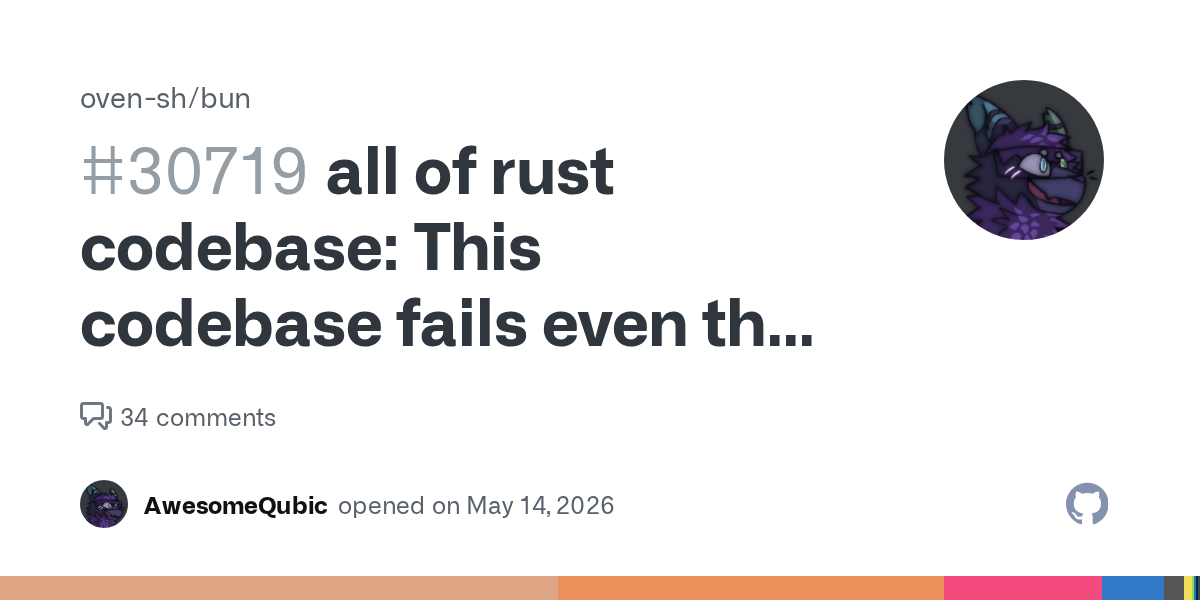
Bun’s move to Rust was pitched as the ultimate upgrade, a promise of blazing speed and ironclad memory safety. The narrative was clear: ditch the slow, the error-prone, and embrace the future. But here we are, staring down the barrel of a Miri failure that screams ‘dangling reference’ and ‘Undefined Behavior’ right in the heart of supposedly safe Rust code.
Bun’s Rust rewrite: code
fn main() {
let test = Box::new(*b"Hello World");
let init = PathString::init(&*test);
drop(test);
println!("{:?}", init.slice());
}
shows a critical misstep. The error message itself is stark: error: Undefined Behavior: constructing invalid value of type &[u8]: encountered a dangling reference (0x20933[noalloc] has no provenance). This isn’t a subtle bug. This is a fundamental violation of Rust’s safety guarantees, exposed by Miri, Rust’s own built-in tool for detecting Undefined Behavior.
The Architecture of Error
The issue, as the traceback indicates, lies within PathString::slice and its reliance on core::slice::from_raw_parts. The core problem: a Box is dropped before the raw pointer derived from it is used to construct a slice. In safe Rust, this is a hard no. You can’t create a slice pointing to memory that’s no longer valid.
This isn’t just a typo. It points to a deeper architectural misunderstanding or, perhaps more charitably, a rushed implementation. The team behind Bun appears to have treated Rust’s safety primitives, particularly around lifetimes and memory management, with a level of casualness that simply won’t fly if you’re aiming for the kind of reliability Rust promises.
Please consider not vibe coding rust as AIs are not good at writing Rust and also hire a real rust dev
This sentiment, though blunt, echoes a growing concern in the community. Rust’s power comes from its stringent safety guarantees, enforced by the compiler and tools like Miri. Circumventing or misunderstanding these guarantees, even accidentally, erodes that trust. It’s like building a fortress with meticulously designed walls, only to leave the main gate wide open.
Why Does This Matter for Developers?
For developers eagerly adopting Bun, this is a yellow flag, perhaps bordering on red. The allure of speed is powerful, but stability and correctness are paramount. When a project touts its rewrite in a memory-safe language like Rust, the expectation is that it will be memory-safe. A failure to pass basic Miri checks indicates that this isn’t just a minor oversight; it suggests that the underlying architecture may not be as sound as initially believed.
This also highlights a critical point: AI-generated code, or code heavily influenced by it, can be a minefield if not rigorously reviewed by human experts. The original comment even hints at this. While AI can assist, it can’t (yet) fully grasp the subtle, complex rules of Rust’s borrow checker and memory management, especially when dealing with unsafe blocks and raw pointers. The temptation to ‘vibe code’—to write code that looks right or feels fast without deep understanding—is amplified when AI tools are involved.
My unique insight here is that this isn’t just a Bun problem; it’s a canary in the coal mine for the broader trend of large-scale rewrites in memory-safe languages, particularly when they are pushed to market aggressively. The pursuit of performance can create blind spots, and the promise of safety can lull teams into a false sense of security. The Miri failure is a stark reminder that while Rust enables safety, it doesn’t guarantee it without careful, expert engineering.
The Path Forward (or Sideways)
What’s next for Bun? They’ve acknowledged the issue, and presumably, a fix is coming. But the damage to immediate trust is done. This isn’t about shaming; it’s about the practical implications for anyone relying on Bun for critical tasks. The rewrite was supposed to be a leap forward, a demonstration of superior engineering. Instead, it’s become a cautionary tale about the complexities of systems programming and the unforgiving nature of memory safety.
This incident underscores the importance of rigorous testing and validation, especially in systems programming. Miri isn’t a ‘nice-to-have’; it’s a fundamental tool for ensuring Rust code behaves as expected, even in complex scenarios. Ignoring its findings, or failing to pass them, is a direct invitation to bugs that can be incredibly difficult to track down and exploit.
This is where the real work lies, not just in fixing the bug, but in understanding why it happened and ensuring that the architectural decisions made during this rewrite are fundamentally sound. The Rust community values correctness above all else. Bun’s success hinges on its ability to prove it can deliver that correctness, not just speed.
This is the challenge for any ambitious project: balancing innovation with the bedrock of stability. Bun’s Rust journey has just hit a major pothole. How they navigate it will define their credibility in the eyes of the developers they aim to serve.
🧬 Related Insights
- Read more: Harper Promises AI Agents in 5 Minutes — But Who’s Getting Rich?
- Read more: Bubble AI Apps: Pretty Prototypes That Crumble Under Crowds
Frequently Asked Questions
What does Miri do? Miri is Rust’s MIR interpreter, used to detect Undefined Behavior in Rust programs, even within supposedly safe code, by simulating execution. It’s a critical tool for ensuring memory safety.
Will this make Bun unstable? It indicates potential instability and memory safety issues that need to be addressed. While a fix is expected, the presence of such bugs in core functionality is a warning sign for reliability.
Is Bun still worth using? For many use cases, Bun’s speed benefits might still outweigh this specific issue, especially if the fixes are implemented quickly and thoroughly. However, for mission-critical applications where absolute stability is paramount, caution is advised until the codebase proves its robustness.