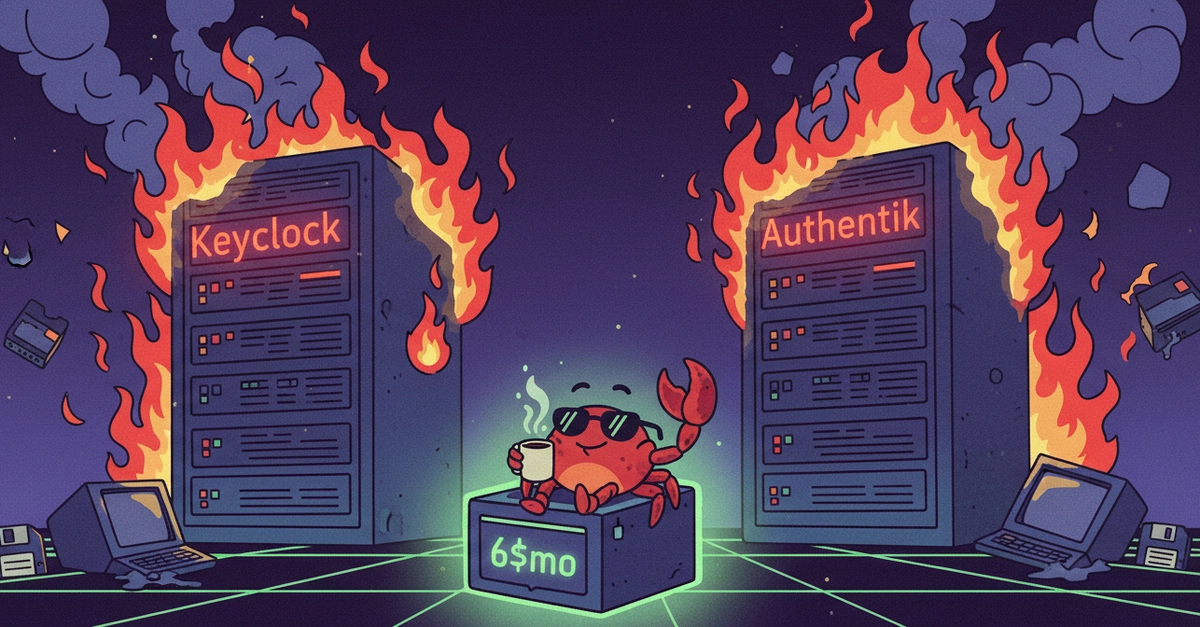
A $6 DigitalOcean droplet hums along, running a full app stack—until the auth server boots up and devours half the RAM.
That’s the moment one developer snapped. After a year wrestling Keycloak across freelance gigs, from enterprise beasts to side hustles, the math stopped adding up. Documentation like a maze for insiders only. SaaS like Auth0? Perpetual fees and third-party trust. So, two weeks ago, OVTL emerged: a Rust-forged OAuth2 + OIDC server idling under 20MB.
Why Does OVTL Crush Traditional Auth Servers on RAM?
Keycloak idles at 512MB. Authentik? Around 735MB split across server and worker, plus Redis baggage. Zitadel trims to 150MB but still demands a beefy host. Java, Python, Go—runtimes with GC overhead you can’t escape, spiking memory, pausing unpredictably.
Rust flips the script. No garbage collector. Binary launches in under a second, stays lean. Picture a sprinter versus a marathon runner lugging extra weight: OVTL fits on the same $6 VPS as your app, no sidecars, no dedicated iron. The creator nailed it: “If your VPS has 1GB of RAM, you’ve already spent most of it before your app starts.”
And here’s the unique insight—echoing the early days of Nginx over Apache. Back then, Apache’s process-per-connection model bloated servers; Nginx’s event-driven async crushed it on low-spec hardware. OVTL does the same for auth: Rust’s zero-cost abstractions make it the Nginx of identity servers, poised to dominate resource-starved indie deployments as edge computing explodes.
What Makes OVTL Secure Enough for Real Users?
Security isn’t bolted on—it’s baked in at compile time. Rust’s ownership model nukes memory bugs before runtime. Zero-knowledge encryption via AES-256-GCM, double-envelope keys: server eyes never touch plaintext creds. The dev rolled a custom crate, hefesto, because off-the-shelf fell short.
Multi-tenancy? PostgreSQL Row Level Security enforces isolation at the DB layer—no app-code leaks. PKCE mandatory on every Authorization Code flow, thwarting interception. MFA, social login, audit logs—all in.
“Zero-knowledge encryption. User data is encrypted at rest with AES-256-GCM using a double-envelope key model — the server never handles plaintext credentials directly.”
None easy choices. But they forge trust.
Can You Run OVTL on Your $6 VPS Today?
Setup’s terminal-native—no browser UI fluff. Fire up ovlt --url http://localhost:3000, and wizards guide tenant creation, users, clients, roles. Core flows work: full OAuth2 + OIDC stack, multi-tenant, encrypted, under 20MB.
It’s alpha. Two weeks young. OIDC compliance tweaks needed, email delivery pending, edges to smooth. Not production-ready—yet. Poke the repo at ovlt.tech if half-baked thrills you.
Compare the field:
| Server | Idle RAM | Language | Extras |
|---|---|---|---|
| Keycloak | ~512MB | Java | None |
| Authentik | ~735MB | Go/Python | Redis |
| Zitadel | ~150MB | Go | DB reqs |
| OVTL | <20MB | Rust | Postgres only |
SaaS? Clerk $25/mo base, Auth0 $23/mo—scaling per seat, creds offloaded.
OVTL bridges the affordability chasm. Self-host everything, predictably.
The Bold Prediction: OVTL Signals Auth’s Rust Era
Rust’s rise in systems code—think Deno, Tokio—hits auth now. GC runtimes served their time, but predictability wins for always-on guards. Expect forks, polishes, maybe Cloudflare Zero Trust integrations. Indies win first; enterprises follow as OVTL matures.
Corporate hype? None here—this is raw builder transparency. No VC gloss, just RAM receipts and code.
The shift feels fundamental: auth as lightweight co-pilot, not RAM elephant. Your app breathes free.
🧬 Related Insights
- Read more: Is Your Laravel CRM a GDPR Ticking Time Bomb?
- Read more: Docker Agent Spits Out News Roundups — Local, Slow, and Stubbornly Useful
Frequently Asked Questions
What is OVTL and how much RAM does it use? OVTL is a Rust-based OAuth2 + OIDC auth server using under 20MB RAM, with zero-knowledge encryption and multi-tenancy via Postgres RLS.
Is OVTL ready for production use? No, it’s alpha software after two weeks of development—core features work, but OIDC compliance and email need work.
How does OVTL compare to Keycloak or Auth0? Far leaner on RAM than Keycloak (512MB), self-hosted unlike Auth0 (from $23/mo), with built-in security like mandatory PKCE.