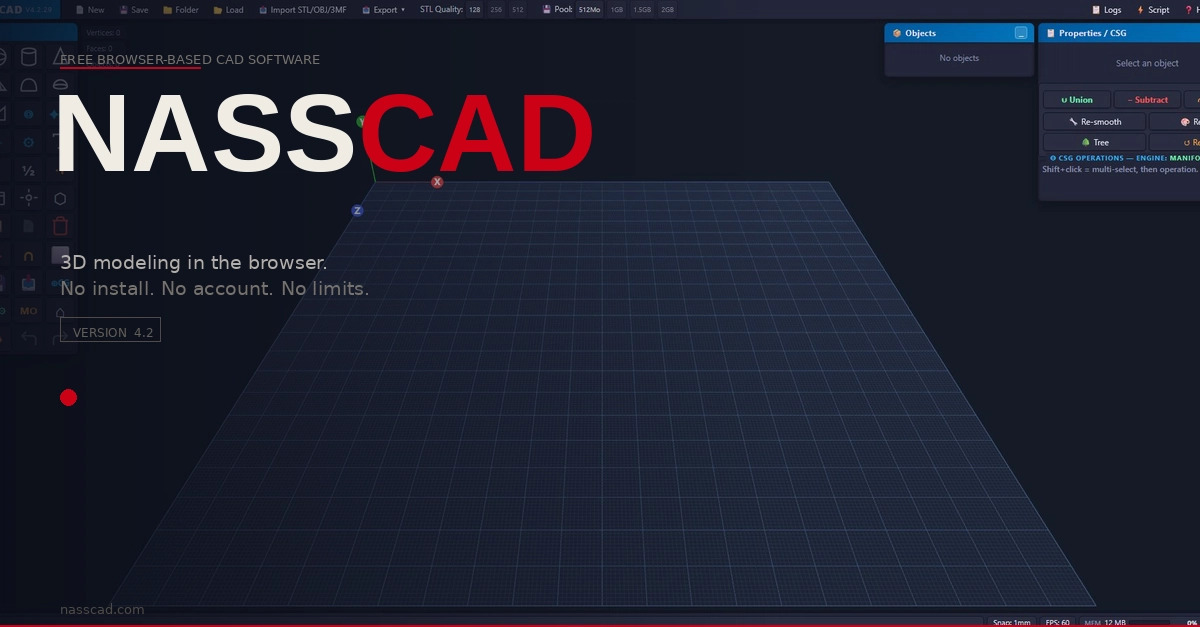
For professionals and hobbyists alike, the dream of immediate access to powerful design tools — no friction, no fees, no internet required — just became a lot more tangible. NASSCAD version 4.2 isn’t just another iteration; it’s a defiant statement against the increasingly locked-down, subscription-driven world of professional software.
This isn’t a stripped-down viewer or a limited demo. We’re talking full Boolean Constructive Solid Geometry (CSG), a non-destructive history tree, and the ability to handle complex geometries within a 2GB memory arena, all contained within a single HTML file. It’s the kind of engineering feat that makes you wonder why more developers haven’t pursued this radical, user-centric approach.
The sheer audacity of bundling Three.js, the Manifold WASM CSG engine, fonts, and all necessary modules directly into an HTML file—either inline or base64-encoded—is staggering. This means zero runtime CDN fetches and complete offline functionality, even over file:// URLs. It’s a deliberate rejection of the ubiquitous cloud dependency, offering a truly self-contained digital toolkit.
Why Does a Single HTML File Matter for CAD?
Think about it: no installation wizards, no account logins, no nagging subscription reminders. You can drop NASSCAD onto a USB drive, host it on a static web server, or simply double-click the .htm file. This level of accessibility redefines how and where complex design work can happen. It democratizes access to powerful modeling capabilities, bypassing the typical gatekeepers of commercial software.
NASSCAD’s core architecture is a masterclass in self-sufficiency. The Three.js r128 handles rendering, augmented with custom OrbitControls. The Manifold WASM engine powers the heavy lifting of CSG operations in a Web Worker, optimized for n-ary unions to avoid the performance pitfalls of pairwise operations. A custom GeometryPool, with a bump allocator and mark-and-sweep garbage collection, manages up to 2GB of data. And for persistence, IndexedDB stores projects, complete with their CSG trees, ensuring that your work is saved reliably and can be restored upon reload.
The CSG Engine: A Closer Look
The engine’s operational pipeline is meticulously crafted. Auto hole detection simplifies boolean operations by inferring subtraction. The n-ary union is a significant performance boost over traditional methods. Before geometry hits Manifold, an epsilon vertex merge ensures that degenerate triangles, a common bane in CAD workflows, are preemptively handled. Post-processing includes BFS island normal smoothing and center-of-gravity recentering for clean output. Perhaps most critically, the asynchronous yield mechanism, using setTimeout(0), prevents UI freezes during heavy geometry preparation.
NASSCAD boasts 14 watertight primitives, each generated with a shared vertex pool to deduplicate coincident vertices. This ensures that the output mesh is clean and directly compatible with Manifold, avoiding the typical repair steps often required. From configurable cylinders and chamfered cubes to high-definition tori and even gear generators for ISO 20° involute gears, the breadth of primitives is impressive.
“NASSCAD goes the opposite direction: every dependency — Three.js r128, the Manifold WASM CSG engine, fonts, all geometry modules — is either bundled inline or base64-encoded and decoded at runtime via atob().”
Re-engineering Workflow with a Non-Destructive Tree
The non-destructive CSG tree is where NASSCAD truly shines for iterative design. Every operation—Union, Subtract, Intersect—is recorded, allowing users to modify source objects and re-run the entire construction chain with a single click. This history survives saves and loads, making complex assemblies manageable. It’s a feature that many commercial CAD packages still struggle to implement gracefully.
Performance, of course, is a perennial concern for browser-based applications. NASSCAD provides clear thresholds. For Three.js rendering, it handles up to 3 million vertices smoothly, with a warning about frame rate drops between 3 and 8 million. Manifold CSG operations are swift for objects under 10,000 triangles but can take between 1 to 10 seconds for meshes in the 10k–50k triangle range, with larger objects risking freezes. The geometry pool handles up to 150 complex objects safely, with warnings kicking in beyond 300.
For particularly demanding projects, NASSCAD offers practical advice: perform complex assemblies as separate objects and let slicer software handle the final merge. The STL export at 128 segments is generally sufficient for FDM printing.
Export and import options are strong, supporting STL Binary and ASCII, OBJ with normals, and the modern 3MF format, which includes per-object colors and multi-object support. Importing these formats is auto-centered and placed on the floor grid, with Y/Z axis conversion.
The most compelling aspect of NASSCAD v4.2 is its licensing: free for non-commercial use under CC BY-NC 4.0. This, combined with its radical technical execution, positions it as a significant player for independent creators, educators, and anyone tired of being tethered to proprietary ecosystems. It’s a welcome disruption, proving that powerful, accessible software doesn’t need to come with a perpetual toll.
🧬 Related Insights
- Read more: Laravel Multi-Tenancy [No Packages]: Automatic Data Isolation Unpacked
- Read more: Java 26 Dumps Applets, Tightens Final Fields
Frequently Asked Questions
What does NASSCAD v4.2 do? NASSCAD v4.2 is a full-featured Computer-Aided Design (CAD) modeler that runs entirely within a single HTML file, offering offline capabilities and no installation required.
Can I use NASSCAD for commercial projects? No, NASSCAD is free for non-commercial use only under the CC BY-NC 4.0 license. Commercial use would require a separate license agreement.
Is NASSCAD a replacement for professional CAD software? For many users, especially those with non-commercial needs or who require extreme portability and offline access, NASSCAD v4.2 offers a powerful alternative. However, it may not have the extensive feature sets or industry-specific modules found in high-end commercial packages.