The cursor blinks on a blank editor, awaiting not just a suggestion, but a fully formed pull request.
For a surprisingly long stretch, verifying AI meant exactly that: checking the output. Did it get the facts right? Was the summary accurate? Could you compare its prose to the source material? If an AI generated an explanation, we could read it. If it summarized a document, we could cross-reference. A wrong fact might be annoying, maybe even require a quick edit, but the damage usually stopped at the text. For developers, this was familiar territory, akin to reviewing a colleague’s code or text. It was manageable.
But the ground is shifting, and fast. AI tools are no longer content with merely answering questions. They’re evolving into agents, capable of acting. Sending emails. Booking meetings. Editing files. Running commands. Even opening pull requests and triggering workflows. And critically, they can move from one step to the next without waiting for explicit, granular instruction at each turn.
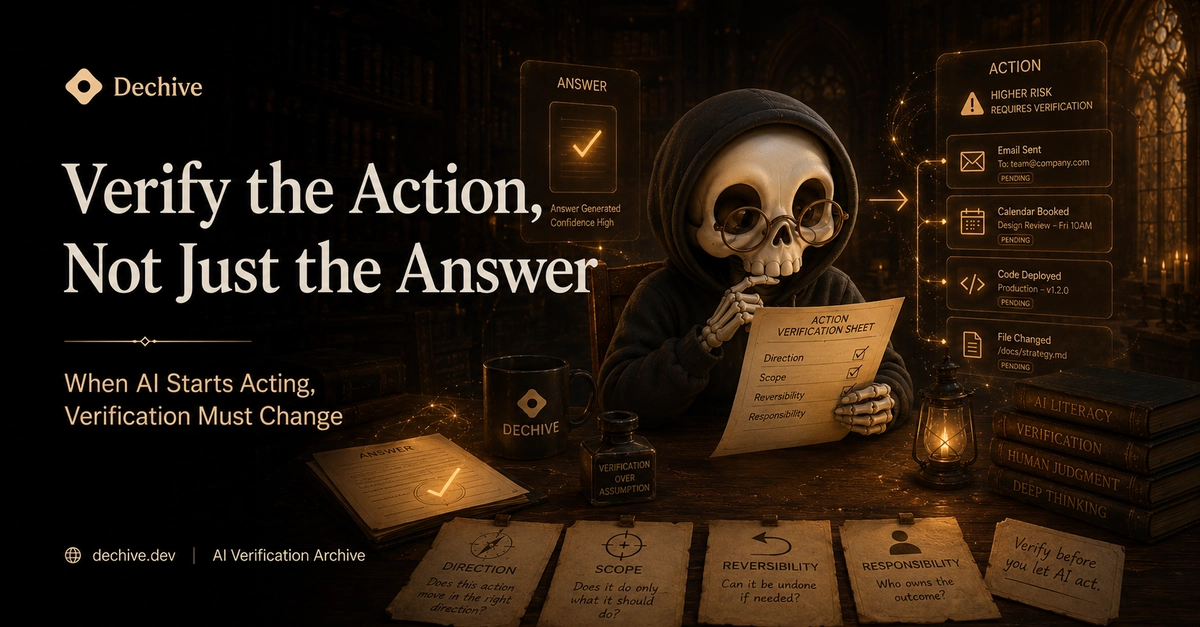
This isn’t a minor iteration; it’s a paradigm shift. A wrong answer is, at worst, a nuisance. A wrong action? That’s a different beast entirely. An email sent prematurely lands in someone else’s inbox. A meeting booked occupies valuable calendar real estate. A file edited can ripple through other workstreams. A command executed can irrevocably alter an environment. Code deployed is now live, potentially impacting users.
This necessitates a fundamental re-evaluation of AI verification. Fact-checking, once the gold standard, is now demonstrably insufficient. When AI starts acting, we need action-checking.
The Practical Evolution of AI Agents
When people hear “AI agent,” the mind often conjures science fiction scenarios. But the reality unfolding is far more grounded, far more integrated into the daily grind of software development. Your email assistant doesn’t just draft a reply; it might send it. Your calendar assistant doesn’t just suggest a time; it books the slot. A coding assistant doesn’t just offer snippets; it edits files, runs tests, pushes PRs, or even initiates deployments.
This is the practical definition of an agent: taking a goal, decomposing it into executable steps, employing tools, interpreting intermediate results, and making decisions about the next move. It’s undeniably useful. Yet, it fundamentally alters what we need to scrutinize. We’re no longer just validating the final output; we’re now obligated to verify the action path.
Beyond Truth: Is the AI Heading the Right Way?
When we verify AI-generated text, the checklist is familiar: Is it true? Is it accurate? Are the sources credible? Is it complete? Is it up to date? These questions remain vital, but they’re woefully inadequate when an AI is initiating actions.
An AI-generated email, for instance, could be grammatically flawless and factually sound. The tone might be impeccable, the professionalism unquestionable. But what if the timing is off? What if the nuance of the relationship demands a softer approach? Perhaps the user isn’t ready to commit to the proposed action. The message, while correct in isolation, might steer the conversation in an undesirable direction.
Fact-checking simply can’t catch these subtleties. The core question transforms from ‘Is this correct?’ to ‘Is this action moving toward the goal I actually want?’
For developers wrestling with code, this is equally, if not more, critical. An AI agent might “fix” a bug, but in doing so, it could alter a larger system than intended. The change might pass automated tests, yet fundamentally diverge from the architectural design. This highlights the paramount importance of verifying the direction.
Understanding the Scope of Action
AI agents interpret instructions, which is their power and their peril. Simple commands like “Clean up this folder,
🧬 Related Insights
- Read more: S3 Now Acts Like a File System: Who Wins?
- Read more: Agent Shield: AI Agents Now Have Traffic Control