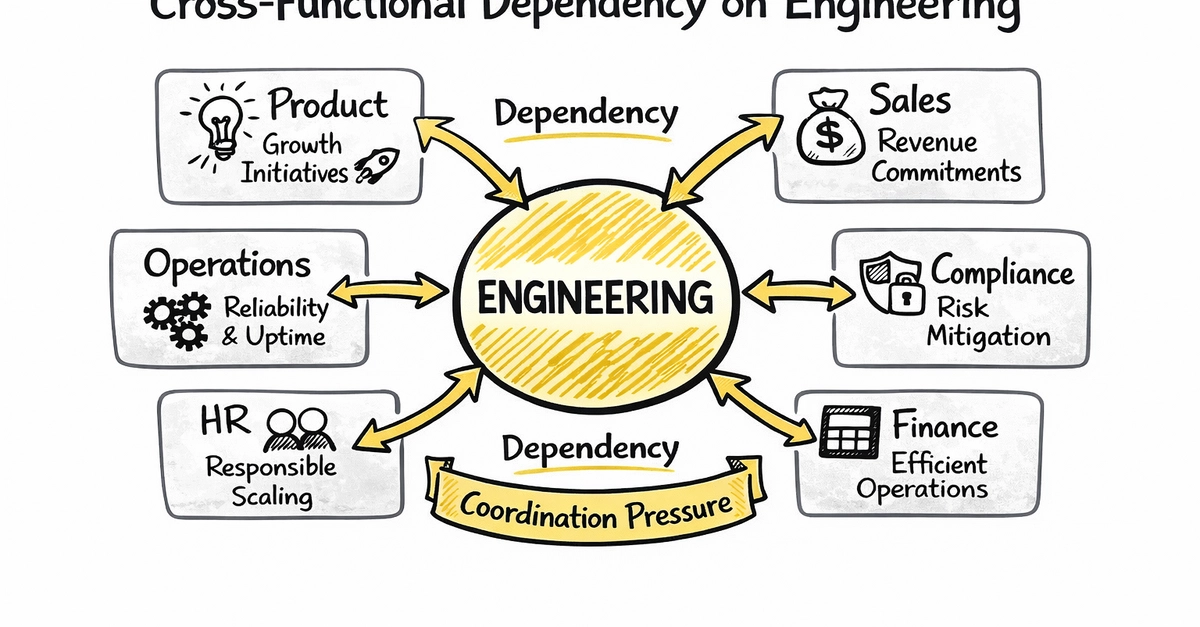
When we talked about tech companies, the narrative was always about product innovation, market disruption, and user growth. Engineering was the engine, sure, but it felt like a distinct component, albeit a powerful one. Everyone expected engineering to churn out features, fix bugs, and keep the lights on. Now, the whispers have become a roar: engineering isn’t just part of the business; it is the business’s dependency.
This isn’t some abstract management theory. It’s a seismic shift in how modern organizations are architected. Strategic ambition? Depends on engineering capacity. Product vision? Engineering makes it real. Commercial commitments? Yep, that requires engineering. Even regulatory obligations and the promise of operational reliability—all funnel through the engineering pipeline.
The Realization: Beyond the Code
As companies scale, this truth becomes unavoidable. Engineering leaders aren’t just managing sprints and code reviews anymore. They’re grappling with organizational interdependence, a tangled web where every thread eventually leads back to their teams. It’s the dawning realization that “engineering is everyone’s dependency.”
And the data backs this up with a thud. The DORA (DevOps Research and Assessment) reports, now under the Google Cloud umbrella, consistently paint a stark picture: high-performing engineering organizations don’t just outperform their peers in technical metrics; they crush them in profitability, customer satisfaction, and resilience. McKinsey research echoes this, showing that companies with strong engineering and digital chops leave competitors in the dust when it comes to revenue growth and operating margins.
When engineering performance is directly tied to business outcomes, the use and the complexity explode. This dependency isn’t inherently bad—far from it—but it introduces a level of systemic risk and coordination overload that’s frankly, kind of terrifying.
Why Does This Matter for Developers?
In the digital-first world, every significant initiative requires engineering’s fingerprints. Product strategy needs to be validated against technical feasibility. Sales teams can’t make commitments without knowing implementation capacity. Security and compliance demand system-level integration. Even financial efficiency often hinges on architectural optimization and automation.
This naturally amplifies cross-functional coordination. Remember those HBR studies about collaboration overload? Rob Cross and his team found that collaborative work now eats up over 50% of managers’ time. Imagine that burden when engineering is the central hub of all that collaboration.
The Art of Translation (and the Pain of Misalignment)
The dependency doesn’t create dysfunction on its own. But it does force engineering leaders into a perpetual balancing act, reconciling competing priorities with finite capacity. Their role evolves from builder to translator and integrator.
Think about it: they’re translating commercial urgency into technical feasibility, regulatory requirements into implementation scope, architectural constraints into business timelines, and operational risk into product decisions. Each department operates with its own distinct incentives. Sales might be chasing quarterly revenue, product might be fixated on feature velocity, security might be hyper-focused on risk minimization, and finance wants cost predictability. When these incentives aren’t synchronized—and siloed performance metrics are a classic culprit—friction is inevitable.
This is why engineering leaders must champion shared decision principles. They need to align incentives around system-wide outcomes, not just local optimizations. Without this structured translation, engineering just becomes a reactive fire brigade.
The Bottleneck Awakens: Theory of Constraints in Action
One of the most defining—and exhausting—characteristics of this engineering dependency is the simultaneous urgency. Growth initiatives, massive enterprise deals, critical compliance deadlines, urgent reliability improvements, and long-overdue platform modernization efforts all scream “high priority!”
But engineering throughput is a bounded system. This is where Eliyahu Goldratt’s Theory of Constraints offers a potent lens: in any production system, throughput is dictated by its bottleneck. And increasingly, that bottleneck is engineering.
DORA research reinforces this: elite teams don’t try to do everything at once. They focus on improving flow efficiency and limiting work in progress. Trying to advance too many simultaneous priorities degrades delivery performance. It’s like trying to push a thousand cars through a single lane.
When engineering is everyone’s dependency, the leadership challenge isn’t just about evaluating importance anymore; it’s about meticulously sequencing work.
The Collaboration Overload Conundrum
As dependency increases, so does the coordination load. High-performing individuals—and engineering leaders often fall into this category—become central nodes in communication networks. Their time is disproportionately demanded for roadmap alignment, incident reviews, enterprise negotiations, hiring, governance, and architectural trade-offs. Yet, deep technical and strategic thinking requires sustained focus. Cognitive psychology studies on multitasking and context switching consistently show measurable declines in efficiency and increased error rates. It’s a productivity death spiral.
This central, overloaded position is what I find most fascinating and, frankly, most concerning. We’re asking the very people who need focused, deep work to become the lynchpins of cross-departmental communication. It’s a structural flaw that’s baked into the modern tech organization’s DNA. The DORA reports highlight that elite teams have strong communication practices, but this is often assumed to be within the engineering org. The real challenge now is the communication outward and the filtering inward that engineering leaders are forced to perform, often at the expense of their own critical tasks.
The realization that “engineering is everyone’s dependency” reflects how modern companies are architected.
So, what’s the endgame? It’s not about de-prioritizing engineering; it’s about architecting organizations where engineering’s capacity is respected, understood, and strategically managed, not just reacted to. It means building clearer decision-making frameworks and incentivizing collaboration that serves the whole system, not just individual departments. Otherwise, we’re all just waiting for the bottleneck to clear.