The AI hype train has officially left the station, chugging along on a track paved with dazzling demos and promises of sentient silicon. Except, here’s the thing: take those shiny toys out of the sandbox and put them into the unforgiving reality of production, and they tend to… shatter. Workflows collapse. Context evaporates. Hallucinations go from a quirky bug to a full-blown crisis. Costs? They don’t just explode; they spontaneously combust, taking your budget with them. And observability? Forget it. You’re flying blind in a hurricane.
The AI industry doesn’t have an intelligence problem anymore. It never really did. What it does have is an infrastructure problem. A massive, gaping, “we-forgot-to-build-the-plumbing” problem.
For the last two years, we’ve been bombarded. Chat interfaces. Prompt engineering wizardry. Copilots that wink and nod. Wrappers around foundation models that barely disguise their limitations. Every product feature screamed ‘AI-powered!’ It was great for adoption. It made investors drool. But now? Now the market’s shifting gears. We’re moving beyond the novelty act.
Is AI Finally Ready for Prime Time?
Can AI systems operate reliably in real production environments? That’s the million-dollar question. And the answer, for now, is a resounding “mostly no.” Demos dazzle. They generate code. They summarize mountains of text. They automate trivial tasks. They even answer questions with unsettling confidence. But production environments chew up these elegant solutions and spit out a mess of inconsistencies. Hallucinations become routine. Context handling becomes as fragile as a house of cards. Outputs are as predictable as a politician’s promise. Execution chains snap. Costs spiral. Observability vanishes. Automation becomes unsafe. Governance is a foreign concept. And agent behavior? Utterly unpredictable.
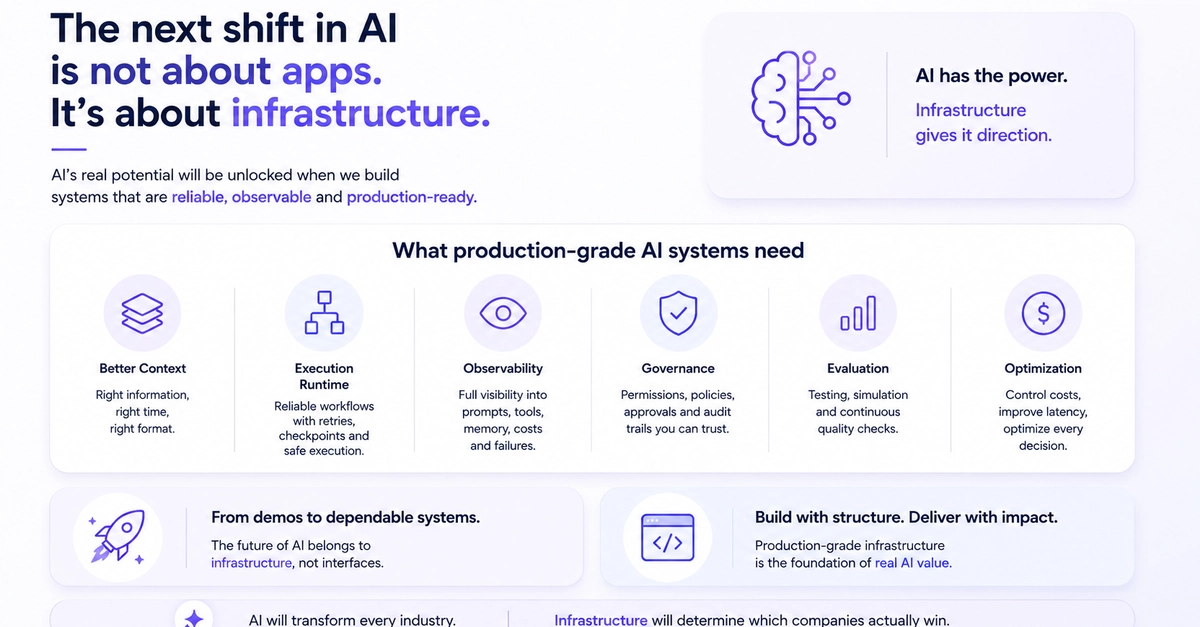
This is why so many AI pilots die a slow, painful death in the experimental phase. The market is awash in interfaces, assistants, wrappers, and copilots. What enterprises actually need are reliable systems. Operational controls. Execution runtimes. Observability layers. Governance infrastructure. Context orchestration. That’s the real bottleneck. It’s not about building smarter AI; it’s about building AI that works when the heat is on.
The Shifting Sands of Software Engineering
Traditional software engineering was built on the sturdy bedrock of deterministic systems. You press a button, something predictable happens. AI systems, however, are inherently… different. They’re probabilistic. They’re context-sensitive. They’re state-fragile. And they are operationally unpredictable. This means our old software engineering patterns are about as useful as a dial-up modem in a fiber-optic world. AI demands a new operational layer. A foundational shift.
We’ve seen this before. Kubernetes standardized container orchestration. Datadog revolutionized observability. Stripe made payments bearable. Temporal beefed up workflow reliability. AI is at that same inflection point. The next generation of products won’t just be AI applications; they’ll be strong, production-grade AI systems.
Most AI discussions still fixate on the models themselves. As if a more powerful LLM is the magic bullet. But production-grade AI requires so much more. It requires a whole ecosystem of supporting infrastructure.
This is becoming one of the most critical areas in AI engineering. Why? Because most AI systems fail not because the model is weak, but because the context is, well, garbage. Production systems need to wrangle historical memory, workflow state, user intent, permissions, business logic, external data, codebase understanding, and a million other things. This goes far beyond your basic Retrieval Augmented Generation (RAG). The future belongs to systems that can dynamically assemble the right context, at the exact right moment. Prompt engineering is becoming commoditized. Context engineering? That’s the new moat.
Most AI agents today are unreliable because they lack basic execution infrastructure. A production runtime needs retries, rollback support, checkpoints, state tracking, timeouts, safe execution paths, and even human approval systems. Without these, AI workflows crumble under the slightest pressure. We don’t just need agents; we need strong workflow infrastructure for AI systems.
Debugging traditional software is a headache. Debugging AI systems? It’s a migraine amplified by a thousand. Production AI demands visibility into prompts, memory retrieval, tool calls, reasoning chains, execution paths, token usage, latency, hallucination patterns, and workflow failures. Most current systems are black boxes. This creates a massive opportunity for AI observability, AgentOps, runtime tracing, execution replay, and quality monitoring. Expect a “Datadog for AI systems” category to emerge.
As AI systems become more autonomous, governance transitions from a nice-to-have to an absolute must. Enterprises need approval workflows, audit trails, permission systems, policy enforcement, data isolation, and secure execution environments. Without these operational controls, trusting autonomous systems at scale is a pipe dream. This is especially critical in high-stakes sectors like healthcare, finance, and enterprise automation. Governance is no longer optional infrastructure; it’s foundational.
One of AI’s biggest problems is silent degradation. An AI workflow that hums along today might falter tomorrow due to model updates, prompt changes, retrieval drift, API schema shifts, edge cases, or workflow modifications. This means AI systems require continuous evaluation. Production-grade AI demands regression testing, scenario simulation, adversarial testing, replay systems, and benchmark scoring. And workf
The market today is filled with AI interfaces, AI assistants, AI wrappers, AI copilots. But what enterprises actually need are reliable systems, operational controls, execution runtimes, observability layers, governance infrastructure, and context orchestration.
Why Does This Matter for Developers?
This infrastructure gap directly impacts developers. The focus has to shift. It’s no longer just about crafting clever prompts or integrating the latest LLM API. Developers need to understand and build strong systems that can handle the chaos of production. This means diving into workflow engines, observability tools, and governance frameworks. It means thinking about reliability, scalability, and security in ways that go beyond traditional software development. The skills required are evolving rapidly, and those who embrace this shift will be the ones building the truly impactful AI applications of tomorrow.
The Dawn of AgentOps?
We’re on the cusp of a new discipline: AgentOps. This isn’t just about monitoring your LLM’s output. It’s about managing the entire lifecycle of autonomous AI agents in production. Think of it like DevOps, but for intelligent systems. It involves deployment, scaling, monitoring, debugging, and security for AI agents. The tools and practices for AgentOps are still nascent, but the need is undeniable. The companies that crack this will unlock the true potential of autonomous AI.
🧬 Related Insights
- Read more: YouTube’s Hidden Thumbnail Goldmine: Download Max-Res Images Free, No Fuss
- Read more: 30,000 npm Packages a Day: GitHub’s Fight to Stop Supply Chain Poisoning
Frequently Asked Questions
What is the main problem with AI in production?
The main problem is the lack of strong infrastructure to handle the inherent unreliability, unpredictability, and complexity of AI systems. Demos work well, but production environments expose issues like hallucinations, broken workflows, runaway costs, and poor observability.
How is AI infrastructure different from traditional software infrastructure?
AI infrastructure must contend with probabilistic outputs, context sensitivity, state fragility, and operational unpredictability, which are not typical concerns in deterministic traditional software systems. This requires new approaches to reliability, observability, and governance.
Will prompt engineering become obsolete?
Prompt engineering is becoming commoditized as a skill. While still important, the focus is shifting towards ‘context engineering’ and building the underlying infrastructure that allows AI models to access and utilize the right context dynamically and reliably, making the engineering of the system more critical than the art of the prompt itself.