AI Remembers. Everything.
This isn’t just a minor tweak; it’s a fundamental platform shift. We’re talking about AI moving beyond the ephemeral, the here-and-now, to become a true institutional historian. For too long, our enterprise AI systems have been like brilliant toddlers – incredibly smart, capable of amazing feats, but utterly forgetful. They’d solve a complex problem, offer a brilliant insight, and then, poof! The moment a new query hit, it was like the slate was wiped clean. This statelessness, while fine for a quick search or a simple chatbot, has been a gaping hole in operational systems where context, history, and learned experience are everything.
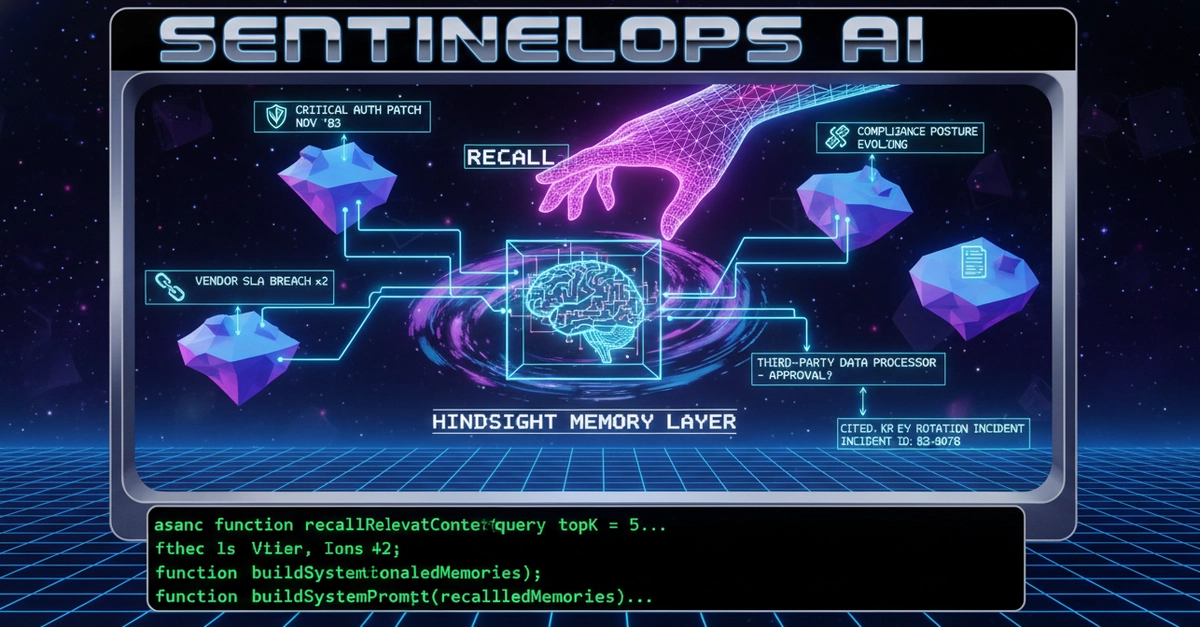
But now, things are changing. The development of a persistent memory layer, as seen with SentinelOps AI’s Hindsight integration, signals a move towards AI that doesn’t just process information but learns from it over time. It’s like giving a super-intelligent intern a personal filing cabinet and a set of cross-referencing tools, rather than just handing them a stack of papers for each new task.
Why Statelessness Was a Stuck Point
Think about it: your organization has critical incidents, recurring vendor issues, evolving compliance postures. A stateless LLM has no clue about any of it. It doesn’t know that your team spent weeks patching a critical auth vulnerability last November, or that a particular vendor has a track record of SLA breaches. It’s a professional amnesiac. For consumer-facing applications, this might be acceptable, but in the enterprise—especially for systems making decisions about third-party data processors or critical security protocols—this amnesia is a critical failure mode. You end up rehashing old debates, missing crucial patterns, and letting institutional knowledge wither in forgotten chat logs.
The old workaround? Stuffing everything into the system prompt. But that’s like trying to fit a library into a matchbox. Context windows have limits, and more importantly, you don’t want everything; you want the relevant pieces. This is a retrieval problem, not a brute-force stuffing problem.
Hindsight: The Filing Cabinet for AI
This is where Hindsight, integrated as SentinelOps AI’s persistence layer, steps in. The architecture is elegantly simple: key decisions, incidents, and governance facts are pulled from AI interactions and then embedded into a vector database. When a new query comes in, it’s not just processed in a vacuum. Instead, a similarity search is performed against this historical store. The most relevant results—think of them as contextual index cards—are then injected into the prompt as background. It’s like a seasoned detective reviewing case files before a new interview.
Here’s a glimpse of the recall function:
import { HindsightClient } from '@vectorize-io/hindsight-client';

const hindsight = new HindsightClient({

url: process.env.HINDSIGHT_URL,

namespace: 'sentinelops-enterprise',

});

async function recallRelevantContext(query, topK = 5) {
  const results = await hindsight.recall({
    query,
    topK,
    filters: { namespace: 'sentinelops-enterprise' },
  });

  return results.map(r => ({
    content: r.content,
    similarity: r.score,
    timestamp: r.metadata.timestamp,
    incident_id: r.metadata.incident_id ?? null,
  }));
}
And how that recalled history gets woven into the AI’s understanding:
function buildSystemPrompt(recalledMemories) {
  const memoryBlock = recalledMemories.length > 0
    ? `## Relevant Organizational History\n${recalledMemories.map(m => `
- [${m.timestamp}] ${m.content} (similarity: ${m.similarity.toFixed(2)})`).join('
')}`
    : '';

  return `You are SentinelOps AI, an enterprise decision intelligence system.

${memoryBlock}

Respond only in the following JSON schema: { summary, risk_level, confidence, recommendation, tradeoffs, governance_flags, citations }`;
}
The AI now sees past events not as external data points, but as integrated parts of its operational knowledge base. It can cite them, reason about them, and build upon them.
What Gets Remembered Matters
Crucially, the system isn’t just a digital hoarder. It’s designed to retain high-signal interactions. Low-risk, flag-free events are intentionally skipped. Why? Because a memory store flooded with trivia will degrade retrieval quality. Imagine asking for advice on a critical security vulnerability and getting back a summary of last week’s coffee orders. The intelligence lies not just in storing data, but in curating what gets stored. Understanding this signal-to-noise ratio is the first, and perhaps most important, architectural decision for any agent memory system.
“The signal-to-noise ratio of your memory store matters. If you retain everything, retrieval quality degrades because every query pulls back a mix of critical incidents and routine lookups. Understanding what agent memory should and shouldn’t store is the first architectural decision you need to make.”
Behavioral Shifts: From Repetition to Recognition
Before this memory layer, SentinelOps AI would answer each query in a bubble. After its integration, the changes are palpable. Firstly, it stopped repeating itself. Queries about a specific vendor’s data residency, which used to get the same basic answer every time, now trigger a response that flags previous assessments and notes the lack of resolution. That’s a richer, more valuable answer because it reflects actual organizational history.
Secondly, it began to synthesize and connect past incidents. This is where AI memory truly shines—identifying subtle, non-obvious patterns that a human might miss in the noise of daily operations. It’s like moving from a librarian who hands you books one by one, to one who can spot thematic links across your entire reading history.
This isn’t just about better recall; it’s about better reasoning. By providing a persistent, searchable context of past organizational events and decisions, systems like SentinelOps AI can move beyond answering questions to actively contributing to institutional learning. It’s a giant leap towards truly intelligent, context-aware operational AI.
Why This Matters for Developers
For developers, this heralds a new era of tool building. We’re not just slapping LLMs onto existing workflows anymore. We’re architecting systems where AI’s memory is a first-class citizen. This means thinking about: the vector database as a core component, embedding strategies that capture nuanced organizational context, and retrieval mechanisms that intelligently surface relevant history. It’s about building AI that doesn’t just respond but remembers and learns, fundamentally changing how we interact with and depend on intelligent systems. The shift from stateless to stateful AI is akin to the shift from simple scripts to dynamic, interactive applications – a foundational change in how software behaves.
🧬 Related Insights
- Read more: JPMC and Barclays’ React Interviews: Race Conditions, AbortControllers, and Other Traps
- Read more: AI Code Works. It’s Not Production-Ready.
Frequently Asked Questions
What does Hindsight actually do for SentinelOps AI? Hindsight acts as a persistence layer, enabling SentinelOps AI to store and retrieve past decisions, incidents, and governance facts, providing contextual memory for improved decision-making.
Will this new memory feature make AI replace my job? While AI with memory can perform more complex tasks and recognize patterns, its primary function is to augment human capabilities, not replace them. It aims to make human operators more efficient and effective by providing crucial historical context.
How is this different from simply using a larger context window? A larger context window only provides more information for a single interaction. A memory layer like Hindsight creates a persistent store of learned information that can be recalled and utilized across multiple, separate interactions, allowing for true long-term learning and pattern recognition.