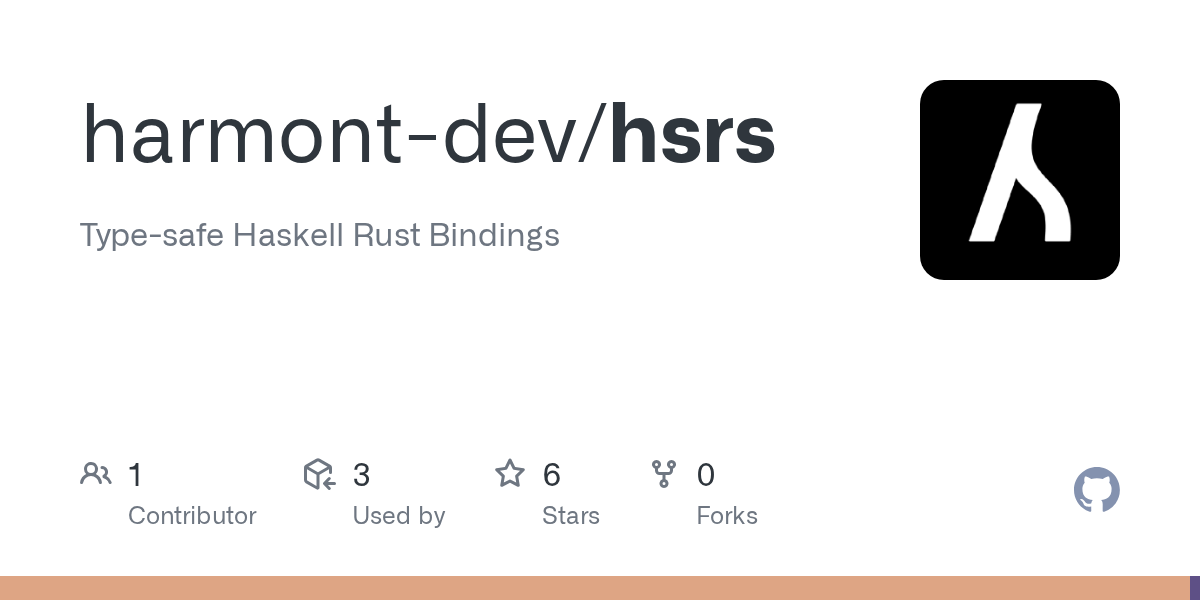
That’s the pitch. Hsrs, a new tool hitting the scene, wants to let you call your shiny, fast Rust code from your elegant, purely functional Haskell world without all the messy boilerplate that usually comes with inter-process communication. For years, bridging these two powerhouses has been a bit of a chore – lots of manual C FFI wrangling, serialization headaches, and the ever-present specter of memory leaks waiting to pounce. Hsrs claims to smooth all that out, using annotations in Rust to generate type-safe Haskell bindings automatically. It handles memory, serialization, and type conversions. Sounds… convenient. Almost suspiciously so.
Look, I’ve been watching the developer tooling space for longer than I care to admit, and whenever something promises to magically solve complex interop problems, my eyebrows go up. The core idea here is to annotate your Rust types and functions, fire up a code generator (hsrs-codegen), and bam – you’ve got idiomatic Haskell that’s supposed to just work. They’re talking about memory management handled by ForeignPtr, which is a standard Haskell way to manage resources from foreign code, and serialization via Borsh, a binary format that’s gained traction. The example they provide is a simple canvas with points, and then a more involved virtual machine with registers and error handling. It’s a good start, showcasing how Result and Option map to Either and Maybe respectively, and how value types get serialized.
Is this the Holy Grail?
Probably not. But it might be a really useful step for certain use cases. The folks behind Hsrs are touting automatic memory management and transparent serialization. That’s the dream, right? No more manual malloc and free across language boundaries, no more wrestling with character encoding on both sides. They’ve put together a table showing how Rust types like String, Vec<T>, Option<T>, and Result<T, E> are expected to transform into their Haskell equivalents (Text, [T], Maybe T, Either E T), all with Borsh doing the heavy lifting behind the scenes. It’s neat. It really is. It simplifies things to a degree that makes you wonder if they’ve actually solved a decades-old problem or just found a particularly clever workaround.
But here’s the real question for any of you who deal with production systems: Who benefits most? It’s clearly developers who have a need for high-performance Rust components but prefer to do their main application logic in Haskell. Think embedded systems, heavy-duty data processing, or anything where Rust’s raw speed is a must-have and Haskell’s expressiveness is preferred for the high-level orchestration. The code generation itself is straightforward: add hsrs to your Rust crate, run the hsrs-codegen command, and you get your Haskell bindings.
Who is actually making money here?
This is the twenty-year veteran question, isn’t it? Right now, it seems like the primary beneficiaries are the developers using Hsrs. They get to save time and reduce potential bugs. The tool itself is open source (MIT or Apache-2.0 license, the usual suspects), meaning there isn’t a direct revenue stream for the tool’s creator based on usage. Unless, of course, this is a stepping stone for a commercial offering down the line – consulting services, enterprise support, or perhaps a hosted solution for managing these bindings. For now, it’s a community play, a gift to the niche but passionate Rust-Haskell interop crowd. The real money will be made by companies that use this to build faster, more reliable products, thereby increasing their own market share. It’s a classic enabling technology scenario.
Why Does This Matter for Developers?
If you’re a Haskell developer who’s ever sighed at the thought of writing FFI code, Hsrs is worth a look. It promises to take away a lot of the pain. The annotations are relatively clean, and the code generation handles the translation. For Rust developers, it means their libraries might become more accessible to a new group of users. It’s about lowering the barrier to entry for cross-language development. The fact that it handles Result and Option smoothly is a big deal – these are fundamental to idiomatic Rust and Haskell respectively, and getting them right across the boundary is often a stumbling block. And for those who love type safety? Well, that’s the core selling point here. This isn’t just about making things work; it’s about making them type-safe, which is the bedrock of reliable software.
This approach reminds me a bit of early attempts at RPC frameworks that aimed for similar levels of abstraction, but the context is different. We’re not talking about network calls across machines necessarily, but within a single process. This tighter coupling, combined with the strong type systems of both Rust and Haskell, gives Hsrs a fighting chance. The risk, as always, is in the details. How well does it scale? What are the performance implications of Borsh serialization for very large data structures? And, most critically, how strong is the generated code when you start pushing edge cases that the original developers might not have anticipated? Those are the questions that separate a cool demo from a production-ready tool.
The Rust code snippet shows how simple it can be to annotate your module, structs, and functions. The #[hsrs::module], #[hsrs::value_type], #[hsrs::data_type], and #[hsrs::function] attributes are the magic sauce. They tell the hsrs-codegen tool what to do. Then, a quick cargo install hsrs-codegen and a run of the command, and you’ve got your Bindings.hs file. The Haskell side looks just as clean, using standard Haskell IO and basic type constructors. It’s designed to feel natural to Haskell programmers.
Hsrs aims to provide type-safe, automatically generated FFI bindings between Rust and Haskell, handling memory management and serialization transparently.
It’s a bold claim. The potential for reducing development time and preventing subtle bugs is significant. However, the maturity of the tool will be the deciding factor. The mapping of Rust’s usize/isize to 64-bit integers is a pragmatic choice for modern platforms, but the note about potential truncation on 32-bit systems is a good reminder that cross-platform compatibility still requires attention. This isn’t a one-click solution for every imaginable scenario, but for the intersection of Rust performance and Haskell elegance, Hsrs might just be the most promising approach we’ve seen in a while.
🧬 Related Insights
- Read more: GitHub Universe 2026: Submit a Talk or Call the Bluff?
- Read more: Monoliths to Microservices: The Real Scaling Playbook
Frequently Asked Questions
What does Hsrs actually do? Hsrs is a code generator that creates type-safe Foreign Function Interface (FFI) bindings between Rust and Haskell. It allows you to call Rust functions from Haskell and vice-versa, handling memory management, serialization, and type conversions automatically.
Will this replace my job? Unlikely. Tools like Hsrs aim to automate tedious tasks and reduce errors, making developers more productive. They don’t typically eliminate the need for developers, but rather change the nature of the work, focusing more on higher-level design and problem-solving.
Is it difficult to set up Hsrs?
According to the provided information, setup involves adding the hsrs dependency to your Rust crate and installing the hsrs-codegen tool. You then annotate your Rust code with specific attributes, and run the generator. The Haskell side requires adding the hsrs runtime package. The examples suggest a relatively straightforward process for basic use cases.