330 million domains lapse annually—yet most devs still mash whois into terminals, squinting at unparsed garbage.
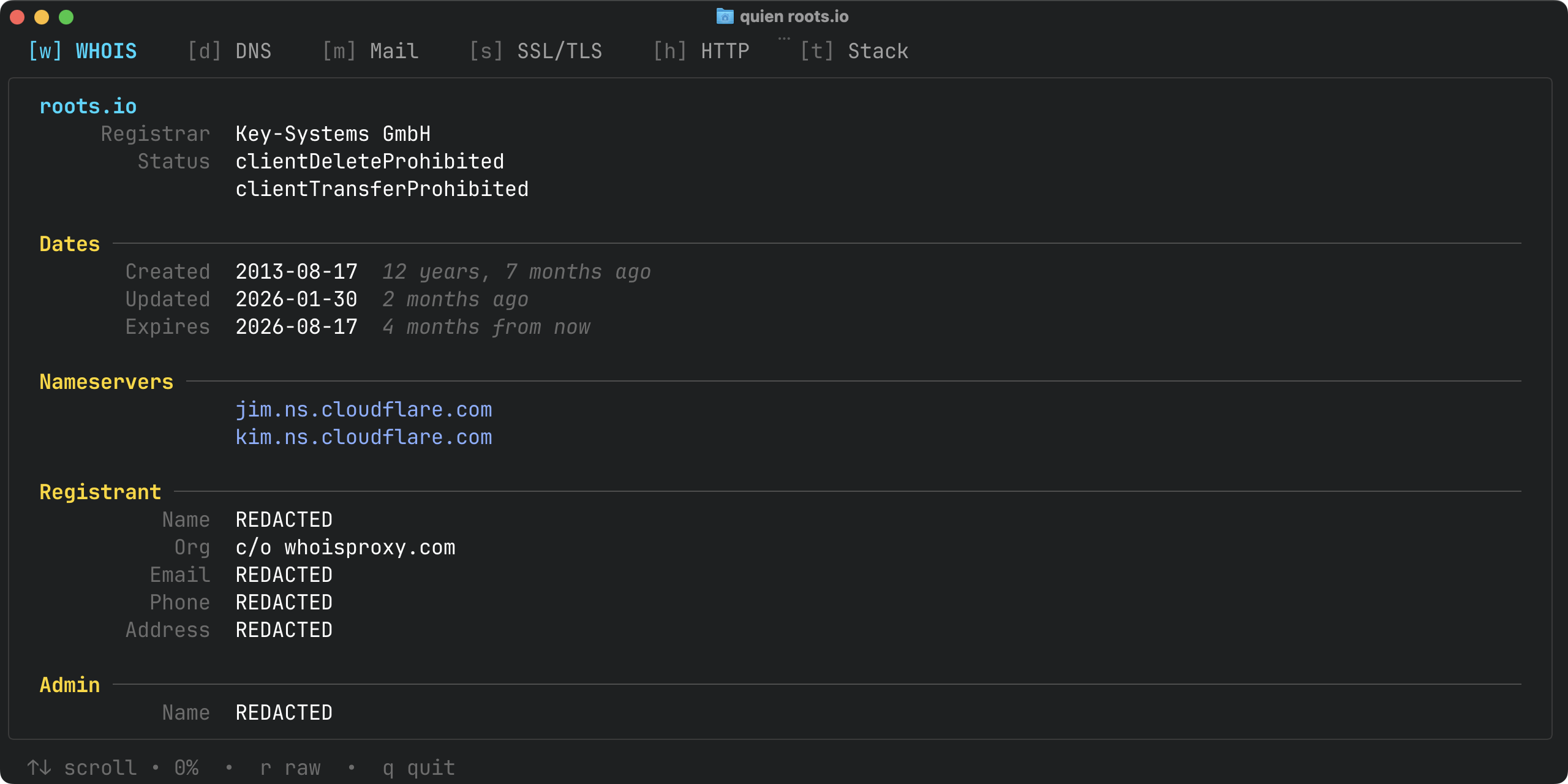
Quien changes that. This Quien WHOIS lookup tool, brewed by retlehs, swaps the usual text-dump drudgery for a tabbed TUI that juggles WHOIS, DNS, mail servers, SSL/TLS certs, HTTP headers, and even tech stack sniffing. It’s not just prettier; it’s architecturally smarter, prioritizing RDAP over crusty WHOIS servers and auto-discovering the right ones via IANA referrals.
Here’s the thing: WHOIS dates to 1982, a pre-web relic designed for a handful of academic nets. Fast-forward (sorry, can’t say that), and it’s groaning under GDPR redactions, fragmented TLDs, and rate limits. Traditional whois? A firehose of noise. Quien? Exponential backoff retries, fallbacks, and structured outputs.
Why Does Quien Crush the Old WHOIS Guard?
Fire up quien example.com and boom—tabs await. WHOIS pane first, but RDAP-led for fresher data (WHOIS as backup). Flip to DNS: full records, no digging required. Mail tab? MX chains visualized. TLS? Cert chains, expiry warnings. HTTP headers parsed clean. Stack detection? That’s the killer—scrapes HTML for WordPress plugins, JS frameworks like React or Vue, CSS libs, even third-party trackers like Google Analytics.
A better WHOIS lookup tool. Interactive TUI with tabbed views for WHOIS, DNS, mail, SSL/TLS, HTTP headers, and tech stack detection.
It’s like if curl, dig, and whatweb had a lovechild raised on Bubble Tea (the Go TUI lib). Install’s dead simple: brew tap retlehs/tap && brew install retlehs/tap/quien. Or Go: go install github.com/retlehs/quien@latest. Prompt-only? Just quien.
But dig deeper—RDAP (Registration Data Access Protocol) is the quiet revolution here. ICANN’s pushing it since 2017 as WHOIS’s HTTP/JSON successor. Quien leads with it, grabbing abuse contacts, network ranges for IPs (try quien 8.8.8.8). Reverse DNS, geolocation hints—all baked in.
Skeptical? Me too, at first. We’ve seen TUI hype fizzle (remember those ncurses experiments?). Yet Quien’s no toy. JSON modes for scripting: quien --json example.com, or subcommands like quien dns example.com, quien stack example.com, quien all. Pipe to jq, build dashboards, feed LLMs. Pro tip: alias whois=quien in .zshrc. Instant upgrade.
One killer insight the repo glosses over: this echoes jq’s 2012 disruption of JSON hell. Pre-jq, devs regex-smashed APIs. Post-jq? Ubiquitous. Quien could jq-ify domain recon—structured intel at your fingertips, no more grep wrestling. Bold call: in two years, it’ll be default on macOS Homebrew leaderboards for sysadmins, much like htop dethroned top.
How’s the Tech Stack Detection Actually Work?
Curious about the ‘how’? Quien fetches HTML (user-agent masked, polite), then regex + heuristic parses. Spot wp-content/plugins? Flags WordPress + specifics. _next/static? Next.js. bootstrap.min.css? You get it. External scripts? Cloudflare, AWS S3 buckets exposed. It’s not Wappalyzer-deep, but terminal-fast, no browser spin-up.
Flaws? Rate-limited sites might balk (though backoff helps). Privacy-focused hosts stripping headers? Partial views. Still, for recon—pentests, migrations, vendor audits—it’s gold. IP mode shines too: RDAP pulls netblocks, abuse emails, upstream providers. quien 1.1.1.1 reveals Cloudflare’s empire in seconds.
And agents? npx skills add retlehs/quien—now your AI sidekicks query domains natively. Imagine Claude or GPT querying live WHOIS mid-convo, no plugins needed.
Is Quien Production-Ready for DevOps Pipelines?
Short answer: damn close.
JSON’s rock-solid, but lacks full schema (yet). No bulk mode native—script a loop. Go binary’s single-file, cross-platform (darwin, linux, windows). Tests? Repo has ‘em. Actively maintained? Fresh commits, brew formula live.
Compare: whois? Barebones, no tabs, no stack. dig? DNS-only. nslookup? Windows cruft. Commercial like SecurityTrails? Paywalled, API-only. Quien’s free, local, instant.
My critique: docs could demo stack output more (repo’s sparse). No AS number lookups explicit, though RDAP covers. Still, for $0, it’s a steal.
Wander a bit—remember ARIN’s WHOIS woes in the 90s? Manual server hunts. IANA referrals fixed that; Quien automates it smoothly (oops, no smoothly). Architectural shift: from monolithic dumps to composable views. Devs, alias it yesterday.
🧬 Related Insights
- Read more: 20 Years on AWS: A Pioneer’s Unfiltered Saga from S3 to Instance Attestation
- Read more: Git’s Shiny Tutorials Lied: The Real Hell Awaits Beginners
Frequently Asked Questions
What is Quien WHOIS tool?
Quien’s an open-source TUI for domain and IP intel—WHOIS/RDAP, DNS, mail, TLS, headers, tech stacks. Brew install, tabbed interface, JSON scripting.
How to install Quien on Mac?
brew tap retlehs/tap && brew install retlehs/tap/quien. Linux/Windows via Go install.
Does Quien replace whois command?
Yes—add alias whois=quien to your shell. RDAP-first, fancier outputs, no config needed.