- That’s the output from Python’s first arithmetic expression in the wild: 2 + 3 * 4.
Simple, right? But peel back the layers, and Python expressions emerge as a masterclass in borrowed brilliance — a lineage stretching from 1956 infix notation to today’s pattern-matching tricks.
Python expressions. There, I said it early. They’re any code chunk that spits out a value: numbers, strings, function calls, even wild comprehensions like [x*x for x in range(3)]. No statements here — just pure value production. Assign ‘em, print ‘em, feed ‘em into ifs. They’re the workhorses you barely notice until they break.
Look, in a language obsessed with readability, expressions are the secret sauce. Python evaluates them left-to-right, but precedence rules — multiplication before addition, parentheses overriding all — keep chaos at bay. It’s not magic; it’s math heritage, cribbed from ALGOL 60’s nested calls and C’s operator playground.
Where Did Python Expressions Really Come From?
- Infix notation hits early math langs: a + b, no prefix nonsense. Fast-forward (sorry, can’t help it) to 1972’s C, layering types and rich ops. Python 0.9.0 in ‘91 grabs it all: arithmetic, comparisons, logic, indexing.
Then the evolutions pile on. 2000: list comprehensions for loop-free lists. 2006: generator expressions, lazy and parenthesis-bound. 2018: walrus := slips assignments into expressions — genius or heresy? And by 2025 (yeah, the outline peeks ahead), pattern matches and comprehension blocks join the fray.
But here’s my take, absent from the original: Python expressions mirror Unix philosophy — do one thing, return a value — yet they’ve stealthily absorbed functional programming’s lazy eval without scaring off imperative diehards. It’s why Django templates or Flask routes feel snappy; expressions chain without ceremony.
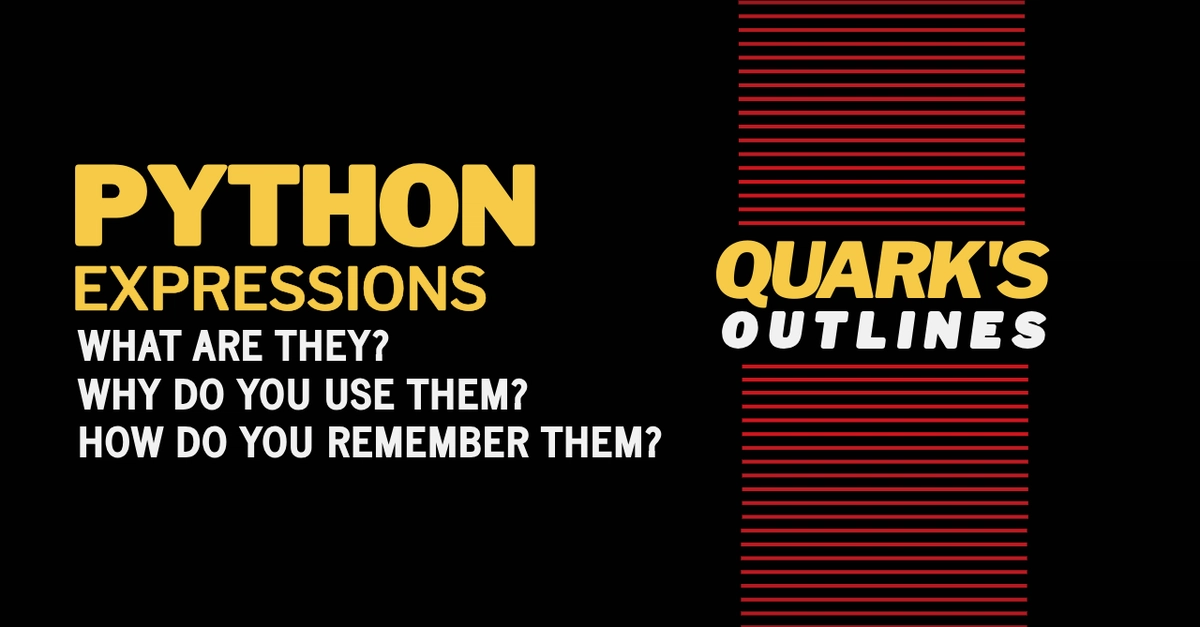
“A Python expression is any piece of code that Python can run and produce a value.”
Spot on, Quark’s Outline. That definition nails it — no fluff.
Python doesn’t just parse; it builds objects on the fly. String concat? New str object. Function call? Invoke, grab return, discard frame. Precedence? Operator table dictates: ** highest, then unary -, down to comparisons, logical and/or last. Associativity left-to-right mostly, right for exponents. Miss it, and 232 becomes 512, not 64. Oof.
Parentheses? Your override hammer. (2 + 3) * 4 yields 20, forcing the add first. It’s procedural control in expression clothing.
Short para for punch: Expressions scale.
From toy calc to data pipelines — squares = [x * x for x in range(5)] prints [0, 1, 4, 9, 16] without a loop. That’s architectural gold: declarative over imperative, borrowed from Haskell but Python-ified for mortals.
And the problems they solve? Everyday grit. Price calc: total = price * quantity. Boom, 30. Age check: age >= 18? True. Len call: len(word) grabs 5 from “hello”. No multi-line cruft.
Why Haven’t Python Expressions Changed More Radically?
Stability’s the game. Guido van Rossum prioritized “one obvious way” — expressions stay simple, extensible. No C++ template monsters here. But critique the hype: corporate Python (now PSF-led) spins walrus as revolutionary; it’s just C’s comma op in drag, fixing “if (match := re.search(…))” verbosity.
Unique insight: Expressions foreshadow Python’s async shift. Awaits embed as expressions now — await fetch(url) — turning sync code async without rewrites. Parallel to generators’ laziness; bet pattern guards next embed full matches smoothly.
Real-world: comprehensions crush loops for ETL. ETL? Extract-transform-load. [row.upper() for row in csv if row != ‘’] — filtered, transformed list in one breath.
Boolean mashups: x > 5 and y < 10. Short-circuits too — and bails early if x flops. Efficient.
But pitfalls lurk. Mutable defaults in lambdas? Expression hell. Or chaining >==< wrongly — 1 < 2 > 1 is True (chained comparisons, actually 1<2 and 2>1). Clever, divisive.
Wander a sec: remember Lisp’s prefix? (+ 2 (* 3 4))? Python flips to infix for humans. Why? Readability wars won by math notation.
Dense dive now. Arithmetic: + - * / // % **. Bitwise & | ^ ~ << >>. Comparisons == != < > <= >= is in. Logical not and or. All yield values — True/False booleans subclass int, handy.
Function calls: positional, keyword args galore. len(data), max(lst, key=func). Lambdas too: lambda x: x**2. Pure expressions.
Comprehensions evolve: dicts {k: v2 for k,v in data.items()}, sets, generators (xx for x in range(5)). Nested even: [[i*j for j in range(3)] for i in range(3)]. Matrix in a line.
Assignment expr := . Controversial beauty: if (n := len(data)) > 10: … Saves a line, names the value.
How Do Python Expressions Stack Up Against Other Languages?
C? Expressions galore, but side effects via macros — messy. JS? Dynamic, but == coercion madness. Rust? Strict borrowing in exprs — safe, verbose. Python wins on sweet spot: dynamic types, sane ops, no segfaults.
Prediction: With 3.13+, exprs gobble more — async comprehensions? Inline guards? They’ll keep Python the glue lang for AI/ML, where NumPy vector ops (expr-heavy) dominate.
One-line wonders shine in scripts. grep -like: any(line.startswith(‘ERROR’) for line in logs). True if any match.
String tricks: f”Hello, {name}” — f-string exprs, interp format since 3.6. Compiled bytecode even.
Eval order strict — no C undefined behavior. Debugger dreams.
But don’t abuse. Readability first — (a := b * c + d) if needed, but unpack later if sprawling.
🧬 Related Insights
- Read more: DOM Boundaries: Slaying UI State Drift Before It Kills Your Sanity
- Read more: Docker’s Spaceship Magic: My Bootcamp Ride from Panic to ‘It Just Works’
Frequently Asked Questions
What are Python expressions with examples?
Any code yielding a value: 2+3, len(‘hi’), [x for x in range(5)]. Used in assignments, prints, conditions.
Why use parentheses in Python expressions?
Control precedence — (2+3)4=20 vs 2+34=14. Forces your order.
Do Python expressions support lazy evaluation?
Yes, via generator exprs: (x for x in range(100)) — yields on demand, memory saver.