Which commit broke everything?
Every developer drowning in a dumpster fire of a codebase has asked that question. We just never had a decent way to get an answer. Until now, maybe.
Six months ago, stuck debugging a production issue in a codebase older than dirt, I faced this. The bug was ancient. Workarounds had workarounds. But pinning down when it started, or what exact change birthed the chaos? Impossible. git log stared back, a blinking cursor on 2,847 commits spanning three years. Every decision, every blunder, every refactor — all buried under commit messages ranging from the terse "fix critical auth bug" to the utterly useless "stuff".
I didn’t need a search engine. I needed a historian. Enter CodeDNA.
The core problem: When did this codebase’s quality start its nosedive, and what was the trigger? Standard git tools show how much changed. Commit graphs track velocity. git blame points fingers. But they don’t connect a March 2019 API shift to a June 2019 bug cluster. That requires actual reasoning across time. Holding 180 commits in context, tracing causal chains. That’s precisely what Gemma 4’s Thinking Mode is built for.
Let’s be clear: “I used an LLM” isn’t the same as “I used Gemma 4 intentionally.” Thinking Mode is the entire point here.
Standard instruction-tuned models? They spit out summaries. They count keywords. They report patterns. Gemma 4, with Thinking Mode engaged, actually reasons about patterns. It traces why a flurry of fix commits followed a specific API change, not just that they occurred. The live reasoning stream isn’t a gimmick; it’s the process made visible. You paste your git log, watch the right panel stream Gemma’s analysis, and you’re seeing it build that causal chain in real time. It’s not post-hoc storytelling; it’s the analysis itself.
And that 128K context? It’s not optional. 180 commits with file stats churn out about 35,000–40,000 tokens. You need both the March pivot and the June bug storm within the same context window to spot the connection. Chunking, the alternative, destroys the causal chain.
Privacy is structural. Your git history is a goldmine of proprietary module names, security fixes, unreleased features. Enough to reverse-engineer your business logic. CodeDNA runs under your own API key, zero data retention. This isn’t a toggle; it’s the only way a real team would ever touch their private repos with this.
I picked React’s 2018–2019 Hooks transition period for a reason: any React dev can verify the output in two minutes. Verifiability. Other projects failed this test. Financial anomaly detection? Requires a judge with expertise. CVE scanning? Knowledge cutoffs. Food photo analysis? Blurry curry breaks the demo. Git history? The commits are public. Anyone can check.
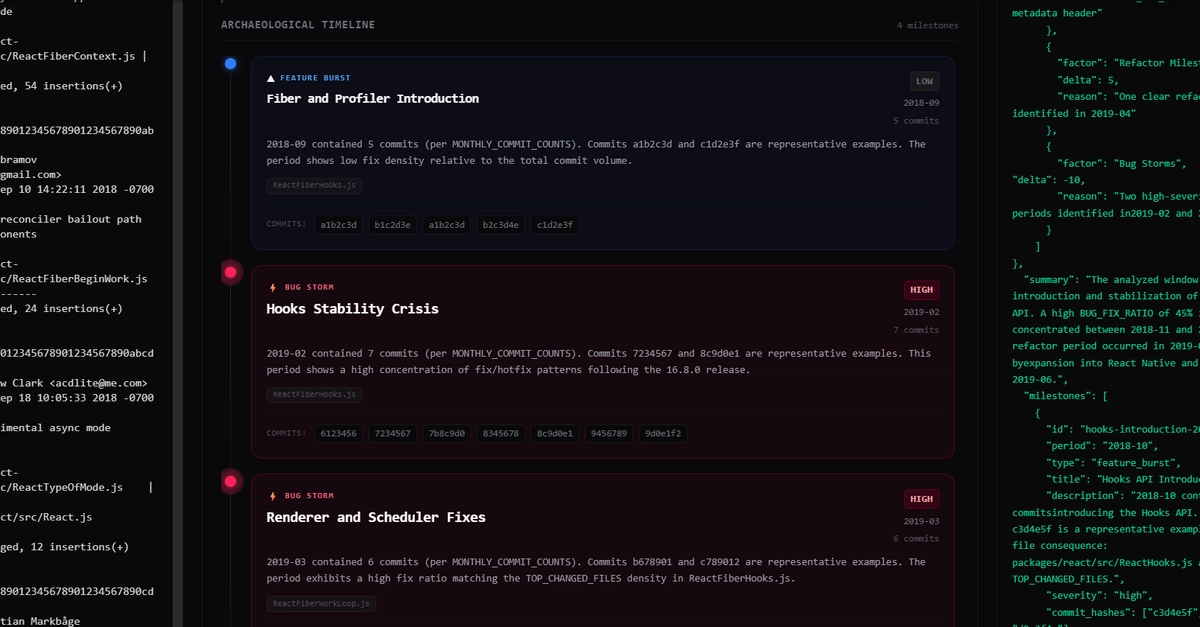
I fed Gemma 4 commits from September 2018 to June 2019. 24 commits in the demo, roughly 180 in a fuller run. The Hooks era – one of the most significant architectural shifts in open-source history.
Here’s what it found:
The milestone Gemma 4 nailed first: A feature burst from July–September 2018. Scheduler time-slicing infrastructure (Scheduler.js, 144 insertions in one commit), then React.lazy, Suspense, and createContext v2 all dropped within six weeks. Factually accurate. Any React dev recognizes this as the foundation laid before Hooks went public.
The milestone that genuinely surprised me: Gemma 4 flagged January–February 2019 as a stability-to-bug-storm transition. It cited ca53456 (fix for useRef) and cb54567 (fix for infinite useEffect loops) appearing days after the 16.8.0 release. Crucially, it noted ReactFiberHooks.js had eight modifications in this period versus two in the stable phase preceding it. I had to look this up. It’s correct. The Hooks release (Feb 6, 2019) was followed by a flurry of hotfixes for edge cases missed pre-release. File-level commit stats reveal this, but only if you’re looking across dozens of commits, not one by one.
The health score: 79/100. Breakdown: +15 for high commit message quality, +10 for a clear refactor era visible in May 2019, -10 for a 21% bug-fix ratio, and a neutral note on concentrated churn in ReactFiberHooks.js. Every factor shown, with evidence. No black-box number.
Getting Gemma 4 to produce specific insights – not corporate-speak summaries – requires a delicate prompt.
Is This a Replacement for git blame?
Not entirely. git blame tells you who touched a line and when. CodeDNA, powered by Gemma 4’s reasoning, tells you why a section of code might be problematic, what architectural shifts preceded it, and if it’s part of a larger pattern of degradation or improvement. It’s a historian, not a witness.
Can This Handle My Monorepo?
The article mentions 180 commits for the React demo. With 128K context, Gemma 4 can process a significant amount of history. For massive monorepos with millions of commits, you’d likely need to chunk the analysis by project or time period. But the quality of reasoning within that context window is the key differentiator. The ability to connect events across that larger chunk is what current tools can’t do.
What if My Commit Messages Are Garbage?
This is where Gemma 4’s power becomes evident. While good commit messages help, the LLM isn’t solely reliant on them. It analyzes file changes, commit frequency, and the relationships between commits to infer context and causal links. It’s designed to find signal in the noise. However, extremely sparse or uninformative commit messages will naturally make the analysis more challenging and potentially less precise. Garbage in, garbage out, to a degree, but it can still surface trends that manual inspection would miss.