So, what does this all mean for the poor sods actually building things on Solana? It means your assumptions about requests, responses, and what constitutes a ‘failed’ operation are utterly trashed. This isn’t your slick, stateless REST API where a hiccup costs nothing but a bit of server CPU. Nope. On Solana, even a broken clock gets paid for ticking. You’re looking at a system where errors aren’t just messages; they’re permanent, immutable records that come with a price tag.
Look, the pitch is always the same: decentralization, speed, low fees. And sure, Solana can be fast. But the devil, as always, is in the details. And the details here involve paying for things that spectacularly blow up. Developers accustomed to the forgiving nature of traditional web services are going to find themselves in a cold sweat realizing that every single broadcasted transaction – successful or otherwise – burns a tiny bit of their users’ (or their own) SOL. It’s a fundamental shift that PR decks conveniently gloss over.
Why Your Failed Solana Transaction Still Costs You
Let’s cut through the blockchain jargon. When you send a transaction on Solana, it’s not just a ping to a server. It’s a proposal for a state change that gets broadcast to a network of validators. Before it even attempts to do what you asked, a bunch of validators have to agree it’s valid, sign off on it, and include it in a block. This entire process – verifying your signature, checking the basic parameters, and attempting to execute the instructions – requires computational effort. And if there’s one thing blockchain networks are designed to monetize, it’s computational effort.
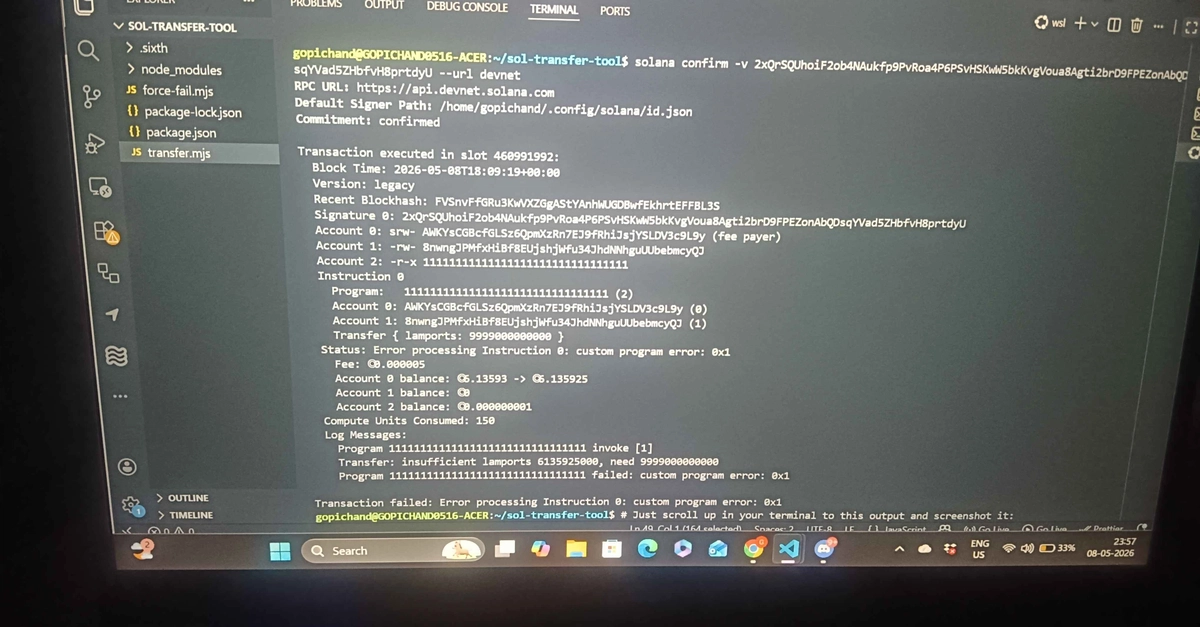
So, when you deliberately try to send 9,999 SOL with only 6.14 SOL in your wallet (and you’ve likely told your client to skip preflight checks for some reason), the network doesn’t just politely say ‘nope.’ It actually tries to make the transfer. It hits the System Program, which, predictably, throws an error. But that error doesn’t mean the work stopped for free. Far from it. The validators did their job, the error is recorded, and yes, a minuscule transaction fee is deducted. You pay for the failed attempt, not just the successful execution. It’s like paying a plumber to show up, look at your leaky faucet, declare it beyond repair, and then hand them their trip charge.
“The network did work (verified signature, attempted execution), so it got paid.”
This is the core difference. In the Web2 world, if a POST request fails because of bad data on the server, you don’t get a bill. The server just returns a 400 or 500 error. On Solana, that error is an on-chain event. It’s a historical fact. And historical facts on a public ledger cost money to create.
Debugging a Messy, Expensive Reality
Forget stack traces in your local development environment. Debugging failed transactions on Solana means staring into the glowing maw of the blockchain explorer. When you see Status: Error processing Instruction 0: custom program error: 0x1, it’s not just a cryptic message. It’s the on-chain equivalent of a database error log, but with the added bonus of knowing it cost someone crypto to generate.
The Log Messages section, as the original text points out, becomes your best friend. Transfer: insufficient lamports 6135925000, need 9999000000000 isn’t just a warning; it’s a forensic report. It tells you exactly what went wrong at the instruction level. This is where developers will spend their time: translating these raw on-chain outputs into actionable fixes. It’s a far cry from the relatively simple debugging loops common in traditional backend development. You’re not just debugging code; you’re debugging a public, immutable ledger of operations.
And the failure modes themselves are varied and costly. A CLI preflight check failing because you don’t have enough funds? No harm, no foul. The transaction never even hits the network. But skip that preflight – perhaps for performance reasons in a high-frequency trading bot (a terrible idea, by the way) – and suddenly you’re on the hook for every single mistake. Every tiny fee, multiplied by millions of transactions, adds up. Who is actually making money here? The validators, of course. They get paid for every block they process, every transaction they validate, regardless of its outcome. It’s a beautiful business model for them, and a potentially brutal one for developers and users if not handled with extreme care.
The Historical Parallel That Should Scare You
This reminds me, in a grim sort of way, of the early days of credit card fraud. Merchants were encouraged to accept cards, but the systems for verifying transactions were nascent. A bad swipe could mean a lost sale and no recourse. Here, it’s not just a lost sale; it’s a direct financial hit for a failed operation. The incentive structure is different. Instead of the network absorbing the cost of a bad transaction, the cost is pushed downstream to the user or the dApp developer. It’s a critical difference that demands strong client-side simulation and meticulous attention to transaction structure. The days of “just send it and see” are over, replaced by a more expensive, more permanent form of digital accounting.
FAQ
What does a Solana transaction consist of? A Solana transaction includes a cryptographic signature from the fee payer, a list of all accounts the transaction will read or write, the specific instructions for operations, and a recent blockhash to prevent replay attacks and ensure freshness.
How long do Solana transactions take to confirm? On devnet, transactions typically go from Processed to Confirmed in about 400ms, and from Confirmed to Finalized in 6-12 seconds. These times can vary in production environments.
Can I retry a failed Solana transaction? No, you cannot simply retry the same signed transaction. Blockhashes expire after approximately 60-90 seconds, meaning you need to reconstruct and re-sign the transaction with a fresh blockhash if the operation needs to be attempted again.