It’s not just about what you did; it’s about structuring it. The ideal for any scientific or development endeavor, really, is a machine-readable flowchart. What you used, precisely how you used it, and what the outcome was. This level of detail is critical for later analysis, for replaying experiments, or even for simply comparing divergent paths. The value proposition is enormous.
But let’s be honest: drafting a formal flowchart for every single iteration is an onerous task. In the heat of discovery, the natural impulse is to jot down a quick sentence. The problem? Pure prose, while fluid for the human mind, resists easy parsing for structured data extraction. The core question then becomes: can we write fluidly and still extract structured provenance? This is the challenge Graphium’s v0.5.0 release tackles head-on.
Consider a simple statement: “Dissolved 5 g NaCl in 80 °C water, obtained a clear solution.” The aspiration is to capture this naturally while retaining the ability to later query: material, conditions, and output.
Earlier iterations of Graphium grappled with this. The “one label per block” approach meant breaking down a single sentence into four distinct fields: Input (NaCl), Parameter (80 °C), Output (clear solution). While the provenance was clean, the user experience felt less like taking notes and more like form-filling. It felt like a compromise.
What’s really at play here is the friction between two seemingly contradictory demands: the need for retrievable, structured data, and the human desire for freeform expression.
One demand is for a machine-readable graph. If your experimental data is searchable, aggregatable, and comparable, then replayability and review become exponentially simpler. From a data science perspective, this is the foundational requirement.
But then there’s the other demand: to capture the moment as it unfolds, without interruption. The traditions of scientific and creative note-taking—lab notebooks, recipe journals, sketchpads—all honor this spontaneous flow of thought and action. They value improvisation.
Graphium’s latest strategy to reconcile these demands hinges on the grammar of the document itself. Writing, as we know it, already possesses inherent grammatical structures: headings, paragraphs, nouns, verbs. The relationship between action and object is embedded within this grammar. By strategically annotating these grammatical elements, writers can continue to compose in natural prose, while simultaneously enabling the generation of a graph structure for the reader, as if by magic. This bridge, built upon linguistic conventions, is the cornerstone of the v0.5.0 redesign.
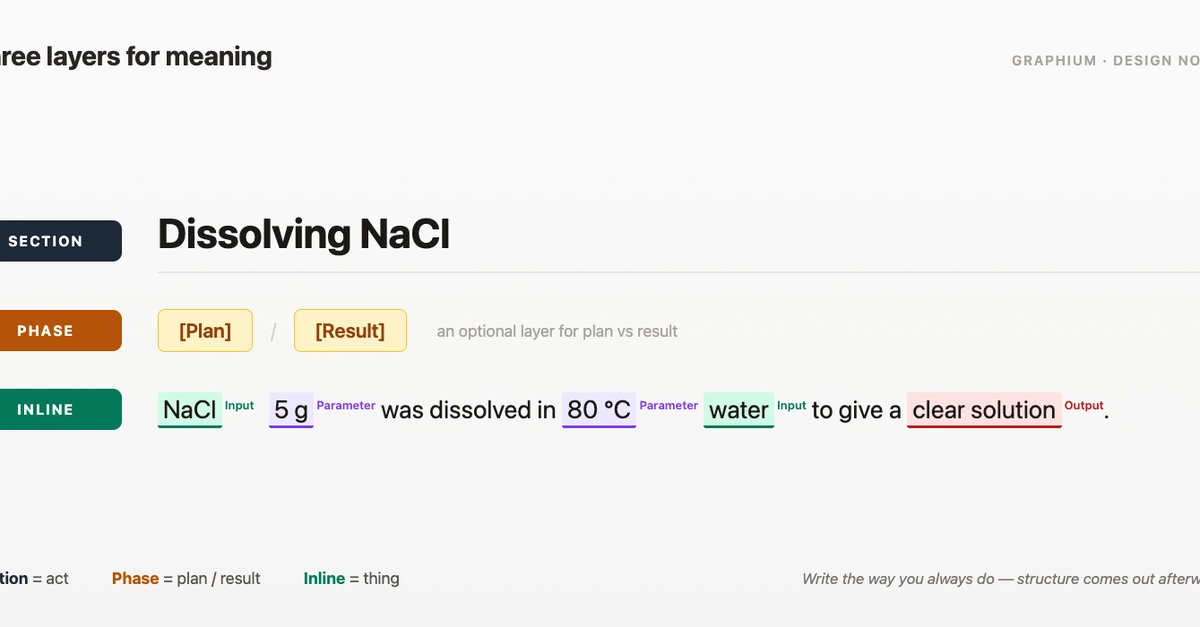
The restructuring introduces three distinct layers: Section (headings), Phase (plan vs. result), and Inline (in-text highlights). The principle is deceptively simple: map the ontology of PROV-DM (Provenance Data Model) onto the existing grammar of written documents.
| PROV-DM | Grammar | Graphium |
|---|---|---|
| Activity (verb / clause) | Heading hierarchy | Section — h1/h2/h3 |
※ PROV-DM extension (graphium:phase) |
Sub-heading | Phase — [Plan] / [Result] |
| Entity / Attribute (noun / phrase) | In-text term | Inline — [Input] / [Tool] / [Parameter] / [Output] |
The middle row, Phase, is the notable outlier. It’s not a native PROV-DM concept; Graphium introduces it as a custom attribute (graphium:phase). Its purpose will become clearer.
Essentially, verbs map to headings, and nouns map to inline highlights. Adhering to this mapping allows for prose to remain prose, with provenance automatically derived.
Let’s revisit that earlier sentence, now under the heading “Dissolving NaCl”:
[Input]NaCl[/] [Parameter]5 g[/] was dissolved in [Parameter]80 °C[/] [Input]water[/] to give a [Output]clear solution[/].
It’s strikingly similar to the original, with only a few color-coded spans added. Behind the scenes, Section constructs an Activity, while Inline creates Entities (NaCl, water, clear solution) and Attributes (5 g, 80 °C). Standard provenance relationships like prov:used and prov:wasGeneratedBy are automatically established.
These inline highlights are versatile, functioning not only within flowing prose but also within bulleted lists. One can rapidly list conditions and then apply highlights, or compose everything as narrative and highlight retrospectively. The three-layer model’s only constraint is respecting the document’s grammar, leaving writing style unhindered.
The Phase layer ([Plan] / [Result]) is arguably less critical in the immediate term. The distinction between planned and executed values can be inferred using Section headings or Inline tags alone. However, its inclusion serves a crucial purpose: enabling process visualization at multiple resolutions. Section headings alone provide a skeletal outline of a procedure. Layering on ‘Plan’ enriches this outline with intended values. Completing it with ‘Result’ transforms the note into a full execution record. The same document can thus be read at three levels: skeleton, skeleton plus plan, and the complete execution. This multi-resolution read is the operating model Graphium is betting on, facilitating straightforward reuse of ‘Step + Plan’ for replication runs or targeted edits to ‘Plan’ for control experiments.
Graphium doesn’t employ PROV-DM’s prov:Plan type directly for this. PROV-DM’s prov:Plan refers to an entire recipe used by an agent. Tagging individual planned values with prov:Plan would be a misapplication. Consequently, Graphium uses Phase as a custom namespace attribute (graphium:phase), and crucially, it splits node identifiers between plan and execution variants.
Why Does This Matter for Developers?
The distinction between writing naturally and capturing structured data has long been a bottleneck in collaborative development, especially in areas like machine learning operations (MLOps), scientific computing, and even complex configuration management. Developers often work with complex parameters, experimental setups, and varied outcomes. The current methods for tracking these—scattered code comments, standalone configuration files, or manual log entries—create significant friction when trying to reproduce results or understand the lineage of a deployed system.
Graphium’s grammatical approach offers a compelling alternative. By embedding provenance directly into the prose of documentation, it aims to make experimental tracking feel less like a burdensome chore and more like a natural extension of the writing process. For teams striving for reproducibility and auditability, this represents a significant potential efficiency gain. The ability to query past experiments not just by keyword but by the precise parameters and outcomes can drastically accelerate debugging and innovation cycles. It’s about making the ephemeral, concrete and searchable.
The Future of Note-Taking in Tech
If Graphium’s ambitious vision for integrating provenance into document grammar proves successful, it could fundamentally alter how technical teams document their work. Imagine code review comments that automatically link to specific experiment runs, or API documentation that clearly delineates planned versus actual behavior. This move toward a more integrated, and intrinsically structured, form of technical writing addresses a core pain point in the industry. The market for tools that genuinely simplify developer workflows and improve data integrity is vast, and Graphium’s approach, while complex in its implementation, is undeniably targeting a significant opportunity.
Graphium v0.5.0 Key Takeaways
- Grammar as the Bridge: Graphium’s core innovation in v0.5.0 is using document grammar (headings, paragraphs, nouns, verbs) to automatically extract structured provenance from prose.
- Three-Layered Approach: The system utilizes Section (headings), Phase (plan/result distinction), and Inline (text highlights) to capture data at different resolutions.
- Bridging Natural Language and Data: It aims to satisfy the dual demands of intuitive, freeform note-taking and the need for machine-readable, searchable experimental data.
- Multi-Resolution Reading: The design allows users to view notes at skeleton, plan, and execution levels, enhancing reusability for replication and control experiments.
🧬 Related Insights
- Read more: HCP Packer’s SBOM Scanning: Vulnerabilities Caught in Seconds
- Read more: AI Codes at Warp Speed—But Reasoning Debt is the Hidden Black Hole
Frequently Asked Questions
What does Graphium actually do?
Graphium is a tool for taking structured notes, particularly for experiments or development processes. Its latest version, v0.5.0, focuses on enabling users to write in natural prose while automatically generating machine-readable provenance data from that text.
Will this replace my lab notebook?
Potentially, yes. Graphium aims to blend the intuitive feel of a traditional lab notebook with the data-extractability of a structured database, offering a way to document experiments more efficiently and effectively for later analysis and replication.
Is it hard to learn?
While the underlying principle is about leveraging existing writing grammar, the system introduces specific inline highlighting syntax and a three-layer structure. Users will need to adapt to this new way of annotating their notes for full provenance extraction, but the goal is to make it feel as natural as possible. The framework for annotating code or configurations is what’s new, not the core act of writing.