Could a swarm of specialized AI agents be the key to unlocking truly scalable code review, ditching the notorious engineering bottleneck and supercharging development velocity? We’re staring at a seismic shift, folks. For ages, code review has been this noble, often agonizing, process. A merge request lands, a developer reluctantly slices into it, leaves a few thoughts on variable names (the bane of many a PR), and the dance continues, often stretching wait times into frustrating hours. It’s a vital check, yes, but a colossal choke point.
This is where Cloudflare’s latest engineering marvel comes in. They’ve moved beyond the off-the-shelf AI code review tools that, while competent, hit a ceiling of customizability for organizations like theirs. Think of trying to fit a skyscraper into a suburban bungalow – it just doesn’t work. Their initial attempts at feeding raw diffs to a single LLM were, as they put it, “noisy.” We’re talking a deluge of vague suggestions, phantom errors, and advice already implemented (hello, “consider adding error handling” on a function that’s drowning in it).
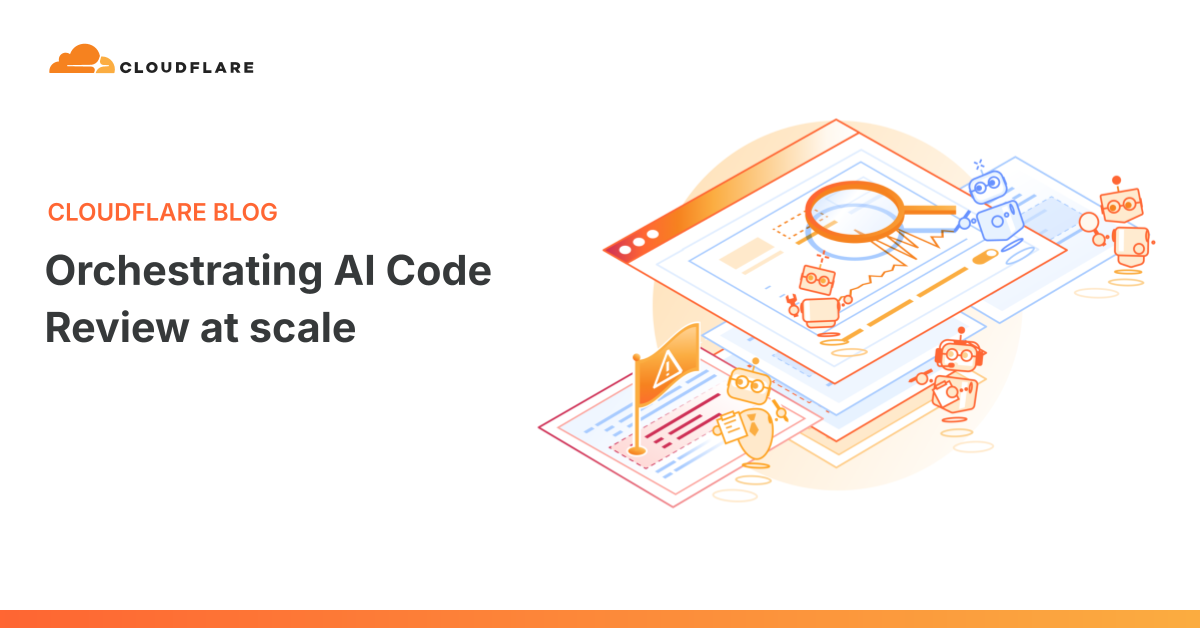
So, they didn’t build another giant, monolithic AI code reviewer. Instead, they’ve orchestrated a symphony. They’ve built a CI-native orchestration system that use OpenCode, an open-source coding agent. Now, when an engineer at Cloudflare opens a merge request, it’s not just one AI looking. It’s a coordinated ensemble of up to seven specialized agents. We’re talking agents dedicated to security, performance, code quality, documentation, release management, and compliance with their internal “Engineering Codex.” These specialists are marshaled by a coordinator agent that’s smart enough to deduplicate findings, assess real severity, and deliver a single, structured review comment. It’s like having a team of highly specialized inspectors, each an expert in their domain, reporting to a smart project manager.
This isn’t theoretical. They’ve run this system across tens of thousands of merge requests internally. It’s approving clean code, flagging genuine bugs with impressive precision, and even actively blocking merges when it spots serious vulnerabilities. This is a core part of their “Code Orange: Fail Small” initiative, pushing for greater engineering resiliency. This is what a platform shift looks like – not just a new tool, but a new way of operating.
The Architecture: Plugins as Building Blocks
Building tooling that scales across thousands of repositories means you absolutely cannot hardcode your version control system or your AI provider. Cloudflare learned this the hard way, realizing that inflexibility means constant rewrites. Their solution? A composable plugin architecture. It’s modular, it’s flexible, and it’s built to adapt. Each component delegates configuration to plugins that then assemble themselves to define how a review actually unfolds.
Here’s the magic in action: A merge request triggers a review. Each plugin implements a ReviewPlugin interface with distinct lifecycle phases. Bootstrap hooks run concurrently and are forgiving – a failed template fetch won’t derail the entire process. Configure hooks, however, run sequentially and are critical; if the version control system can’t connect, the job halts. And postConfigure handles the asynchronous tasks, like fetching remote model overrides, after the initial setup.
The ConfigureContext is the control panel for plugins. They don’t directly mess with the final config; instead, they contribute through this context API, registering agents, adding AI providers, setting variables, injecting prompt sections, and fine-tuning permissions. The core assembler then merges all these contributions into the opencode.json file that OpenCode ingests. This isolation is key – the GitLab plugin doesn’t know about Cloudflare’s AI Gateway, and vice-versa. All version control system-specific coupling is neatly tucked away in a single ci-config.ts file.
“Instead of building a monolithic code review agent from scratch, we decided to build a CI-native orchestration system around OpenCode, an open-source coding agent.”
This plugin roster illustrates the depth of their approach. You’ve got dedicated plugins for GitLab integration, the Cloudflare AI Gateway, and even their internal “Codex” for compliance. It’s a proof to thinking about extensibility from the ground up.
Why This Matters for Developers
This isn’t just an internal Cloudflare play; it’s a blueprint for the future of development workflows. The traditional code review cycle, as we’ve discussed, is a notorious drag. Imagine this AI-orchestrated system as an incredibly intelligent co-pilot for your merge requests. It’s not just finding typos; it’s identifying potential security holes, performance bottlenecks, or documentation gaps before a human reviewer even has to spend cycles on them.
What this means for developers is clearer, faster feedback. Instead of waiting hours for a human to find a simple mistake, you get immediate, actionable insights from specialized AI agents. This frees up human reviewers to focus on the truly complex architectural decisions and knowledge sharing that AI can’t (yet) replicate. It’s about augmenting human capability, not replacing it. It’s about making the entire development process more fluid, more resilient, and frankly, more enjoyable. This shift from a single, slow gatekeeper to a distributed, intelligent advisory board is what I mean by a fundamental platform shift.
The Human Element in AI Code Review
Cloudflare’s approach highlights a crucial point: AI isn’t a magic bullet, but a powerful tool that needs intelligent orchestration. The “coordinator agent” that deduplicates findings and assesses severity is where the human understanding still shines. It’s the difference between a flood of raw suggestions and a curated, prioritized list of actionable items. This blend of specialized AI and centralized intelligence is what makes it work at scale. It’s about building systems that can reason about code contextually, not just syntactically.
What are the challenges of AI-driven code review?
Building and deploying AI code review at scale is, as Cloudflare’s post details, anything but simple. The initial hurdle is the sheer noise generated by naive LLM prompts, leading to hallucinations and irrelevant suggestions. Then comes the integration challenge: making AI agents work harmoniously within existing CI/CD pipelines, managing diverse AI providers, and ensuring compatibility across different version control systems. A significant effort also goes into fine-tuning prompts and agent specializations to ensure accuracy and relevance for specific codebases and organizational standards. Finally, there’s the ongoing task of evaluating and iterating on AI performance, ensuring it provides genuine value without becoming an impediment itself.
Is this better than traditional code review?
For identifying common bugs, style issues, and adherence to predefined standards, AI-driven code review, especially when orchestrated as Cloudflare has done, can be significantly faster and more consistent than traditional human review. It handles repetitive tasks with speed and accuracy. However, AI still struggles with understanding complex architectural nuances, novel design patterns, and the broader business context that experienced human reviewers bring. The ideal scenario, as Cloudflare demonstrates, is a hybrid approach where AI handles the heavy lifting of common checks, freeing up human reviewers to focus on higher-level strategic and design considerations, leading to a more efficient and effective overall process.
Will AI code reviewers replace human developers?
No, AI code reviewers are not poised to replace human developers outright. Their role is fundamentally that of an assistant or a tool to augment developer productivity. They excel at automating repetitive tasks, catching syntax errors, style violations, and common vulnerabilities with speed and scale. However, they lack the critical thinking, creativity, problem-solving skills, and understanding of nuanced business requirements that human developers possess. The future likely involves a symbiotic relationship where AI handles the grunt work of code analysis, allowing human developers to focus on innovation, complex problem-solving, and strategic decision-making.