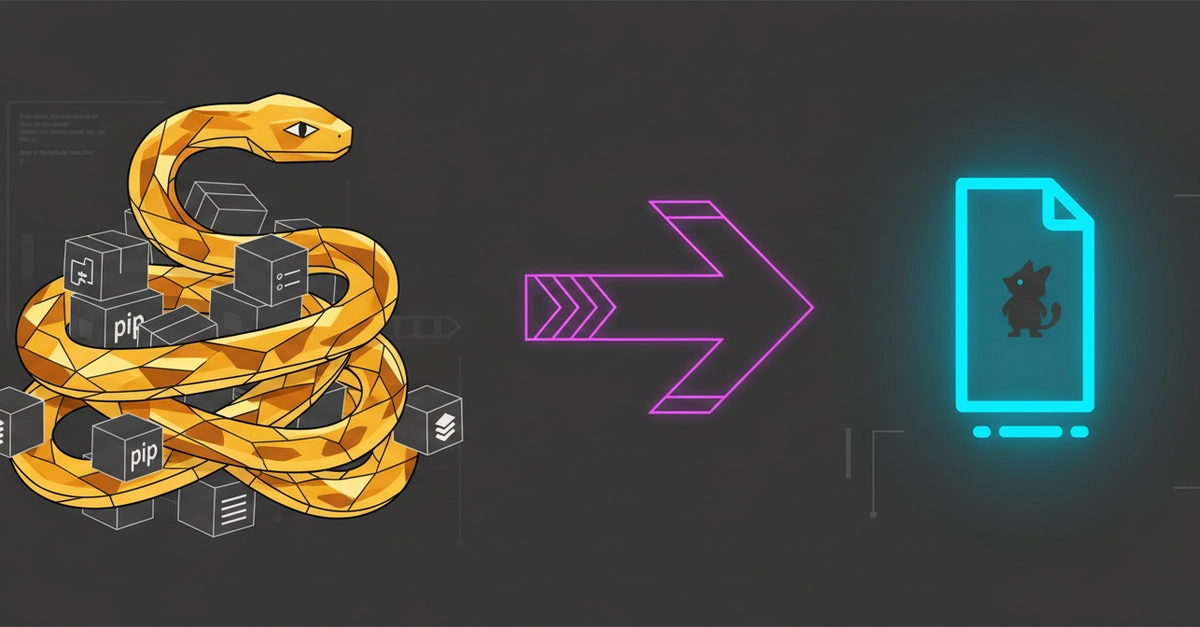
This is about your sanity. Specifically, the sanity of developers trying to integrate a tool into their workflow. You download a thing. It should just work. Not require you to wrestle with Python versions, virtual environments, and a dependency tree that’s probably older than your intern. That’s the real story here. Not a language swap, but a liberation from the tyranny of setup.
TestSmith v1 was a Python CLI. It did its job, allegedly. You pip install testsmith, pointed it at a file, and got a test scaffold. Cute. But integrating this into CI? A nightmare. Every team hit the same wall: Python environments. It wasn’t Python itself that was the villain; it was the sheer, unadulterated pain of distribution. A static analysis tool demanding a specific Python version, a virtual environment, and pinned dependencies is a tough sell for a step that runs on every single commit. They weren’t shipping a tool; they were shipping a setup process.
So, they rewrote TestSmith v2 in Go. The goal? A single, static binary. Drop it anywhere. CI, Docker, a developer’s PATH. It just works. No runtime dependencies. Bliss.
Why Go?
Firstly, the single binary. go build spits out one self-contained executable. No pip. No venv. No requirements.txt. Download, install, done. Simple. It’s like going from a flat-pack furniture nightmare to a pre-assembled sofa.
Then, cross-platform with one build. Remember the v1 CI matrix headaches? Different Python versions across Ubuntu, macOS, Windows, with slightly different quirks on each. Go’s cross-compilation means one build command, and you get executables for linux/amd64, darwin/amd64, darwin/arm64, and windows/amd64. Effortless.
And native concurrency. Test generation is perfect for this. Each file is its own island. Go’s goroutines and channels made the fan-out generation and the debounced file watcher a breeze. No need for clunky async libraries. It’s built-in.
The command surface got a much-needed spa treatment too. v1 was a flag-fest: testsmith <file>, testsmith --all, testsmith --graph. You get the picture. v2 uses proper subcommands: testsmith generate <file>, testsmith generate --all. Cleaner. More intuitive. Cobra’s completion generator handles bash, zsh, fish, and PowerShell for free. Slick.
Before, v1 was a monolithic Python blob. Adding support for a new language meant poking around in multiple core files. It was messy. v2 introduces a LanguageDriver interface. Each language (Go, Python, TypeScript, Java, C#) is its own package implementing that interface. The core engine doesn’t know or care which language it’s dealing with; it just talks through the interface. Adding Ruby or Rust is now just a new package, not a deep dive into legacy code.
type LanguageDriver interface {
    DetectProject(dir string) (*ProjectContext, error)
    AnalyzeFile(path string, ctx *ProjectContext) (*SourceAnalysis, error)
    DeriveTestPath(sourcePath string, ctx *ProjectContext) (string, error)
    GenerateTestFile(analysis *SourceAnalysis, opts GenerateOpts) (*GeneratedFile, error)
    // ... and more
}
And what about the v1 users? They aren’t abandoned. The Python package lives on in archive/v1/ and gets bug fixes during this transition. No forced migration. The v2 binary is a clean slate for new adopters, while v1 remains stable for those already in production. Smart.
Did it solve the CI problem? Unambiguously, yes. The story shifted from “install Python, set up venv, pin deps” to “download one binary.” Windows test matrices went from flaky Python path issues to clean. The plugin architecture means future language support is a cakewalk.
Was it worth it?
The rewrite took longer than a simple feature addition. But distribution friction? That’s a silent project killer. Nobody complains about “annoying setup.” They just quit. This rewrite bought back developer goodwill, which is, frankly, priceless.
Why Does This Matter for Developers?
It matters because developer time is finite and precious. Tools that abstract away complexity are a net positive. When a tool demands you become a sysadmin just to use it, its utility plummets. Go’s strength in creating single binaries directly addresses this. It’s not just about performance; it’s about accessibility. This move by TestSmith is a clear signal: ease of integration is paramount for tool adoption. Forget bells and whistles if the installation process itself is a barrier. We’re seeing a trend towards self-contained, easily deployable developer tools, and this rewrite is a prime example of that philosophy in action.
The Corporate Spin vs. Reality
Did TestSmith just rewrite in Go for speed? Of course not. That’s the PR fluff. The real win? Eliminating the distribution pain. Python’s packaging ecosystem, while powerful, can be a labyrinth for users who just want to get a job done. Go’s simplicity in this regard is its killer feature for tools. This isn’t about Go being ‘better’ than Python; it’s about Go being the right tool for this specific problem of frictionless CLI distribution. It’s a pragmatic, albeit expensive, decision driven by user experience, not abstract language superiority.
TestSmith is an open-source CLI for generating test scaffolds across Go, Python, TypeScript, Java, and C#. The source is at github.com/orieken/testsmith.
🧬 Related Insights
- Read more: Kubernetes Agent Sandbox: Finally, a Home for Rogue AI Agents
- Read more: Vercel’s Claude Plugin [Permanent IDs]
Frequently Asked Questions
What does TestSmith do?
TestSmith is a command-line interface (CLI) tool that automatically generates test scaffolds for your code. It supports multiple programming languages like Go, Python, TypeScript, Java, and C#, helping developers kickstart their testing efforts.
Why did TestSmith switch from Python to Go?
The primary reason for switching from Python to Go was to eliminate dependency hell and simplify distribution. The Python version required complex environment setup (Python versions, virtual environments, pinned dependencies), which was a major hurdle for integration, especially in CI/CD pipelines. Go’s ability to produce single, static binaries without runtime dependencies made the tool much easier to install and use across different systems.
Will I need to migrate my existing TestSmith v1 projects?
No, you won’t be forced to migrate immediately. TestSmith v1, the Python version, continues to be maintained and receive bug fixes during the transition period. The v2 Go binary is a separate, clean break for new users, allowing existing v1 users to continue their workflow without interruption while they gradually adopt the new version if they choose.