For developers building with the latest generative AI, there’s been a quiet, gnawing problem: testing. Every interaction with an LLM API, whether for fine-tuning, integration checks, or even basic sanity tests, chips away at budgets. And when those tests are flaky, failing sporadically in CI pipelines — well, that’s just compounding the agony. It’s a scenario many have faced: a critical test passes one moment, only to inexplicably fail the next, burning precious tokens in the process, all while leaving you scratching your head.
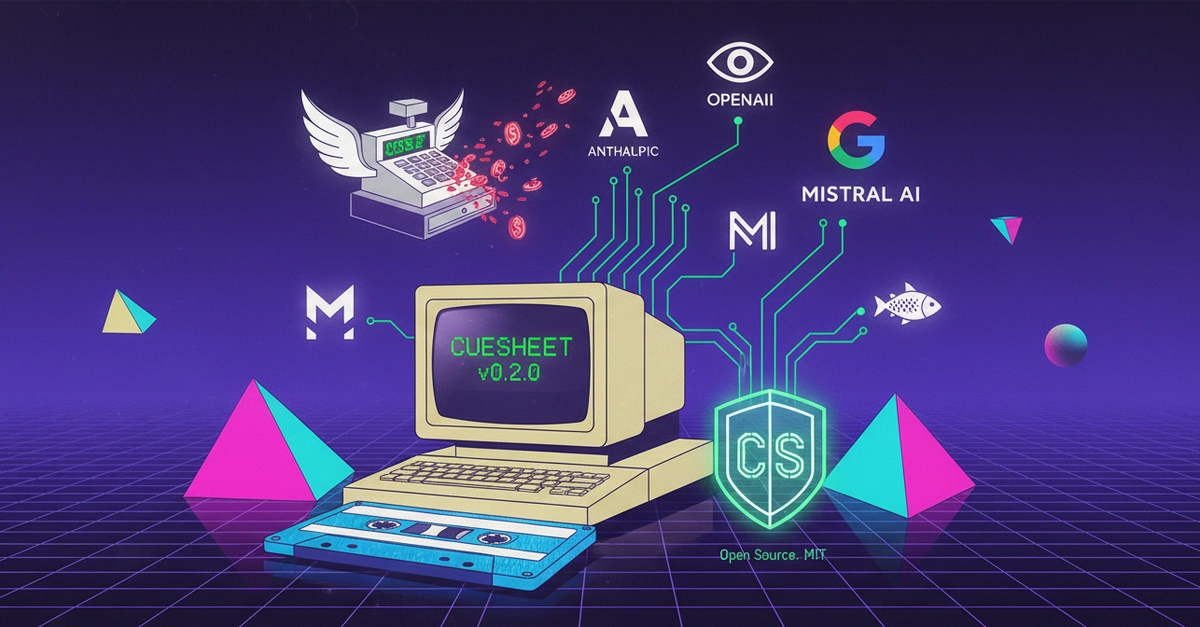
This was the precise frustration driving George Moustakas to build cuesheet. And with the release of v0.2.0 today, what started as a personal project to reclaim hours and budget is now an open-source tool aiming to stabilize LLM development workflows.
The premise is elegantly simple: wrap your LLM API calls in a decorator. The first time the test runs, cuesheet hits the actual API, captures the request and, crucially, the response. This data is then saved into a YAML file – a “cassette” – which you commit directly into your version control system. Subsequent test runs? They bypass the network entirely, replaying the interaction precisely from the saved cassette. Byte-for-byte identical, no network latency, and, most importantly, zero API cost.
This isn’t just a clever trick; it’s an architectural shift in how we can approach LLM testing. Instead of chasing ephemeral network states or praying a token isn’t burned by a phantom request, developers get deterministic, repeatable tests. It’s the kind of stability we’ve come to expect from unit tests for more traditional services, now finally arriving for the often-chaotic world of LLM interactions.
Why Does This Matter for LLM Development?
Think about the typical LLM integration test. You’re not just checking if a function returns a string; you’re evaluating nuanced language, intent, and sometimes even creative output. These aren’t easily asserted with simple equality checks. They demand real model interaction. But doing so repeatedly, especially across multiple developers and CI runners, becomes untenable economically. cuesheet’s approach is a direct salve to this pain point.
Its compatibility is broad, too. The tool works with any Python SDK that utilizes httpx, which covers a significant chunk of the AI ecosystem. This means it’s not just for one vendor; #Anthropic, #OpenAI, #Google Gemini, #Mistral AI, #DeepSeek AI, and others are all implicitly supported. It’s a unifying layer for a fragmented, rapidly evolving landscape.
For the technically inclined, the pytest plugin is a particularly smart implementation. It auto-discovers these cassette files within a tests/cassettes/ directory, keeping tests organized. Even streaming responses, a common pattern for LLMs, are handled gracefully, recorded as raw SSE chunks and replayed in the correct sequence. Security is also addressed: API keys, JWTs, and email addresses are scrubbed before the cassette is written, making them safe to commit to public repositories.
API keys, JWTs, and emails are scrubbed before write so cassettes are safe to commit.
Beyond the CLI and programmatic use, there’s a local web UI. It’s described as “dark + ochre” (a choice that likely sparks its own internal debate among designers), and it watches the filesystem. As tests run and new conversations are recorded, the UI refreshes live. This feature is invaluable not just for code review – allowing stakeholders to see the model’s actual output without running code themselves – but for those critical “what did the model actually say?” moments that can so easily get lost in log files.
The Hidden Costs of LLM Testing
The hype around LLMs often overshadows the practical, day-to-day engineering challenges. The cost of inference is the most obvious, but the cost of validating that inference is equally, if not more, insidious for development teams. Many companies are likely absorbing these costs, or worse, are hesitant to test thoroughly because of the expense. cuesheet’s open-source nature and MIT license suggest a move towards democratizing strong LLM testing.
This release, v0.2.0, signifies a maturation of the project. It’s moving beyond a proof-of-concept to a tool with clear utility and a growing feature set. For developers who have been quietly wrestling with LLM testing costs and flakiness, this offers a tangible solution. It’s about getting precious development hours back and, more importantly, ensuring the AI components of applications are as reliable as the rest of the stack.
Is this the definitive answer to LLM testing? Perhaps not for every edge case or complex simulation. But for the majority of common integration and regression tests, cuesheet presents a compelling, cost-effective, and stability-enhancing approach. It’s a quiet revolution in the backend of AI development.