Are we still pretending that writing a script is the hard part of browser automation?
Look, we all know the drill. Open a page, click a button, snatch some data. Simple enough for a solo mission. Tools like Playwright, Puppeteer, Selenium? They handle the browser dance with aplomb. For one-off tasks, they’re slick. But once you drag this whole operation into a team, suddenly the ability to run a script becomes the least interesting problem.
The real headache? Is this script running under the right account, the right browser profile, the right proxy, the right fingerprint environment, and the right workflow state? That’s the question that sinks many otherwise competent automation efforts.
Forget the tech stack for a second. Think about e-commerce across borders, ad ops managing campaigns, social media teams juggling accounts, or researchers scraping data. These aren’t simple, stateless interactions. They’re tethered to specific user identities, each with its own digital fingerprint and operational needs. A script-only approach treats the browser like a disposable tool—fire it up, do the job, shut it down. But real-world workflows have persistence.
An account needs its own proxy. Another needs its specific cookies, its own local storage, its login state, its browsing history. Retries might need manual oversight. Repeating a workflow across dozens, hundreds, even thousands of accounts without mixing their identities is a nightmare for poorly designed systems.
The harder question becomes: Is this script running under the right account, the right browser profile, the right proxy, the right fingerprint environment, and the right workflow state?
This isn’t a failure of automation code. Your selectors are fine. The page loads. The logic is sound. The browser doesn’t even crash. But the result? Garbage. Because the script, bless its heart, has no clue about the operating environment it’s supposed to inhabit. It’s like sending a perfectly dressed spy into the wrong country wearing the wrong uniform.
The simple automation dependency list looks quaint: script, browser, target page, network access. Cute. Now, try multi-account automation:
account profile
fingerprint configuration
proxy or agent IP
cookies
local storage
browser history
automation endpoint
workflow state
review rule
task log
These aren’t minor implementation details. They’re the bedrock of reliable results. A mismatch in proxy and account means the workflow behaves erratically. Cookies leaking between profiles contaminate your output. Retries under different browser states make results incomparable. And if failure logs aren’t tied to the specific account profile? Good luck debugging anything more complex than a syntax error.
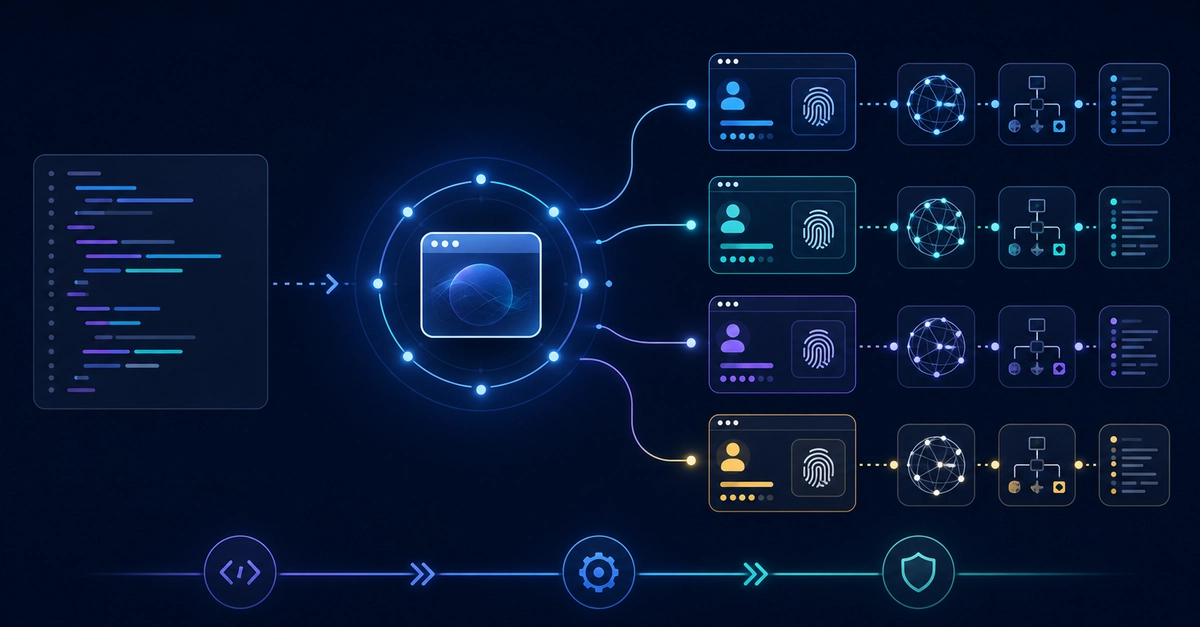
Account context needs to be an execution dependency, not a forgotten line item in a shared spreadsheet or a teammate’s vague recollection. Simple automation is linear: script -> browser -> page -> result. Multi-account? It’s a tangled web: task -> account profile -> proxy -> fingerprint -> browser state -> workflow rule -> result log. Every single one of those layers is a potential point of drift, a place where things can go spectacularly wrong.
Why Account Awareness is the New Automation Necessity
Developers can write pristine Playwright scripts all day long. But the surrounding system has to provide operational clarity. Which profile launches? What proxy does this account use? Is the browser environment clean, reused, cloned, or imported? Headless allowed? Auto-retry or manual review for failures? Where do results land? Who owns this account within the team? Without solid answers, automation crumbles the moment account volume scales. The tools themselves aren’t weak; they just weren’t built for the operational complexity of managing numerous, distinct browser identities. A truly strong setup manages the environment around the script, not just the script itself.
Is Isolation Really That Important?
Yes. Each account needs its own digital island. Separate cookies, local storage, cache, history, fingerprint config, profile data. This isn’t just about preventing awkward login conflicts. It’s about keeping an account’s historical context pristine. Workflows are stateful. If two accounts accidentally share browser data, your automation output becomes suspect, even if the script itself is perfect. It’s about maintaining a consistent operational history for each identity, not just avoiding crossed wires.
And proxies? They shouldn’t be an afterthought, a loose command-line option divorced from the account. They must be intrinsically bound to the account environment. When proxy selection is detached from account identity, mistakes are inevitable. You get the right script, the wrong proxy, the wrong region, and ultimately, the wrong result. This is where cross-border e-commerce, ad checks, social media management, and regional data research become minefields.
The problem is that existing tools, built for individual scripting, fail to manage this crucial context. They offer browser control but lack an execution layer that understands the nuances of persistent, isolated account environments. This deficiency becomes painfully apparent the moment automation scales beyond simple, isolated tasks.
**
🧬 Related Insights
- Read more: Power BI’s Data Ingestion: Fueling AI Dashboards from Chaos
- Read more: BlinkCAD Torches the DWG Viewing Nightmare—No AutoCAD, No Drama
Frequently Asked Questions**
What is account-aware browser execution? Account-aware browser execution means that automation runs not just with a script, but within a specific, isolated environment tailored to a particular user account. This includes its own cookies, local storage, proxy, fingerprint, and browsing history, ensuring operational consistency and preventing data leakage between accounts.
Will this make my existing automation scripts obsolete? Not necessarily. Account-aware execution is an overlay or a framework that enhances existing scripting capabilities. It manages the operational context around your scripts, ensuring they run reliably within the correct account environment, rather than replacing the scripts themselves. It makes your existing scripts more powerful and reliable in team settings.
Can traditional tools like Selenium achieve account awareness? While Selenium can be configured to manage some aspects like cookies and profiles, achieving strong, scalable account awareness is extremely difficult and often requires significant custom engineering. True account-aware execution systems are built specifically to handle the complexities of isolated account environments, including fingerprinting, proxy binding, and workflow state management, which are often bolted on or missing from traditional tools.