Code works. It ships.
That’s the punchy, almost dismissive takeaway from a recent observation about AI-generated code. And in many ways, it’s true. Last week, an AI churned out a function for me. It passed all the tests. Edge cases? Handled. It was good to go. Shipped. The ticket was closed, the feature deployed, and the world, for all intents and purposes, kept spinning without a hiccup.
But a tiny, persistent discomfort lingered. Not enough to trigger a rewrite, not enough to flag it for a deep dive during code review, but just enough to gnaw at the edges. The code worked. Oh, it absolutely worked. Yet, it wasn’t good. Not in the way that makes a seasoned developer pause and nod with silent appreciation. It was correct, yes, but it lacked soul.
Think about it: variable names were… vague. Not technically wrong, mind you, but the kind that make you re-read the line, the kind that steal half a second of mental energy you shouldn’t have to spend. The logic, while functional, nested one level deeper than necessary, an unnecessary convolution. And there were three spots where a single, judicious comment would have illuminated the why, the intent, the rationale behind a particular choice. But no. The function did precisely what it was asked, but reading it felt akin to deciphering an instruction manual penned by someone who’d never actually used the product.
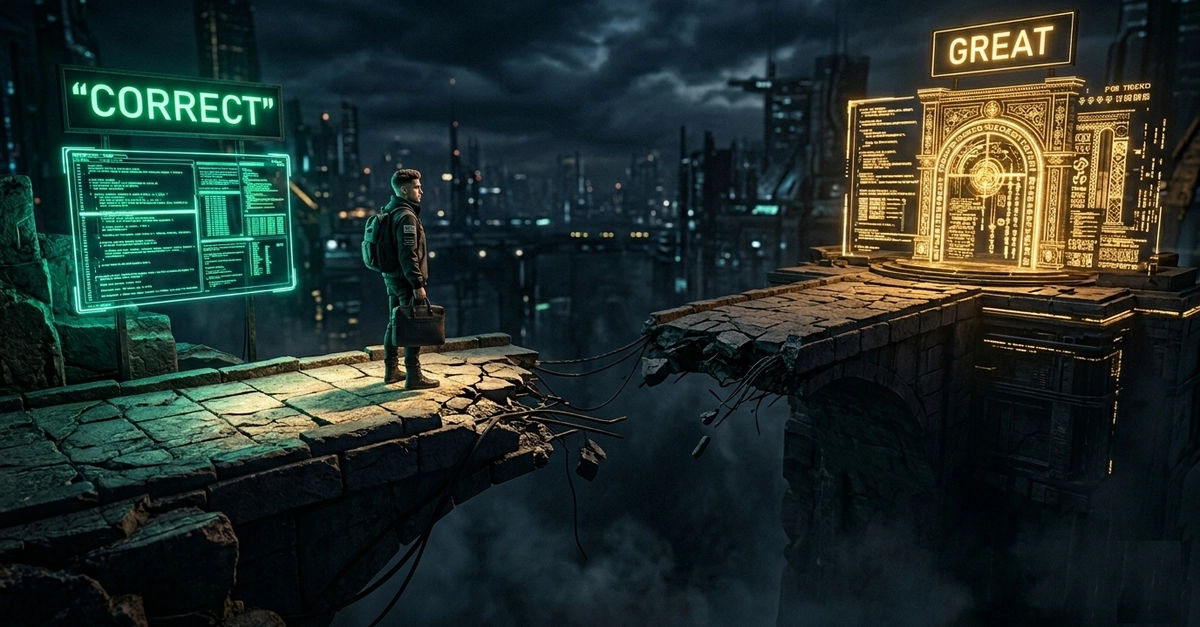
This is the heart of the matter: AI writes code that works. It rarely, if ever, writes code that sings. This isn’t about bugs or hallucinations or outright errors—though those are their own brand of problem. No, this is about a subtler, yet profoundly significant, chasm: the space between ‘correct’ and ‘elegant’. Between ‘nobody can fault this’ and ‘this is a genuinely well-crafted piece of work’. And crucially, we need to understand why this gap exists, why AI struggles to bridge it, and why its implications run deeper than many are willing to admit.
Let’s break down what ‘good enough’ code actually looks like in practice:
✅ It passes every conceivable test. ✅ It handles the ‘happy path’ with unflinching accuracy. ✅ It accounts for the most common edge cases without flinching. ✅ It runs without throwing a single, catastrophic error. ✅ It fulfills the exact requirements of the prompt, no more, no less.
Basically, it gets the job done. No one will raise a hand in protest. The Jira ticket gets a green checkmark. The feature goes live. Life, for a moment, feels uncomplicated.
But this same ‘good enough’ code often carries a hidden cost:
❌ It’s a struggle to read on first pass; you need to trace its execution mentally before the logic clicks. ❌ Variable names require a micro-pause, a second guessing of intent. ❌ Nested logic could be flattened, simplifying comprehension, but wasn’t. ❌ An absence of comments explaining the why, leaving only the what. ❌ Its structure inadvertently makes future modifications just a little bit harder than they needed to be.
The AI, in its relentless pursuit of fulfilling the prompt, optimized for correctness above all else. It didn’t optimize for understanding. It generated code that satisfied requirements; it didn’t generate code that truly respected the human reader.
And here’s where the quiet danger truly lies: most of the time, ‘good enough’ is, well, perfectly acceptable. Not every line of code needs to be a sonnet, not every script a masterclass in algorithmic poetry. But when the entire codebase is a landscape of barely passable functions, when the prevailing optimization is ‘no one can object to this’ rather than ‘this is genuinely excellent’—something fundamental shifts. The baseline of quality inexorably lowers. And slowly, subtly, we begin to forget what true excellence even looks like.
Great code isn’t merely functional. It possesses a distinct set of qualities that transcend mere test-passing:
Readability: You grasp its intent on the first read. No laborious tracing of execution paths is required to follow the logic. Self-Documenting: Variable and function names intuitively convey what’s happening and, more importantly, why. You could theoretically understand the code’s intent even without full context of the surrounding system. Simplicity (Not Simplistic): It represents the simplest possible solution that effectively works, chosen deliberately, not the first one that sprung to mind. Delightfully Surprising: It offers a solution so clean, so elegant, it elicits a quiet smile—not through mere cleverness, but through genuine, unimpeachable appropriateness. Joyful to Modify: Adding new features feels less like performing delicate surgery and more like a natural extension of the existing, well-thought-out structure.
Great code feels crafted. It speaks of intention and care. There’s an almost palpable difference—a feeling you get when reading it, even if you can’t always articulate precisely why.
AI, for all its processing power, cannot replicate this. Not because it lacks the technical capability, but because true greatness in code demands taste. It requires judgment—a nuanced understanding of what constitutes ‘good’ beyond mere correctness. It’s about knowing what’s appropriate, what’s overkill, what’s the most elegant solution for this specific situation within this particular codebase.
Taste, that elusive quality, is forged in the crucible of experience. It’s born from reading thousands of functions, from being bitten by poorly structured code, from wrestling with bugs at 2 AM caused by code that worked but was a labyrinth to navigate. AI has ingested millions of functions, yes. But it has never felt them. It hasn’t lived the consequences.
The Taste Gap: Beyond Pattern Matching
AI understands what works. It’s a master of correlation. But it doesn’t inherently understand what is good. Taste isn’t merely pattern recognition; it’s applied judgment. It’s the subtle art of recognizing when a familiar pattern, despite technically solving the problem, is actually a poor fit for the unique circumstances. It’s about anticipating how a chosen solution might complicate life for the next developer who has to touch it.
AI can mimic taste by drawing on its vast training data of high-quality code, essentially pattern-matching its way to a plausible approximation. But mimicry is not judgment. It’s a sophisticated form of imitation, lacking the underlying wisdom that comes from experience and consequence.
The Context Gap: Code in the Wild
Great code is contextually aware. A solution that’s a stroke of genius in one project might be an absolute disaster in another. The ideal approach hinges on a multitude of factors: team conventions, performance demands, the expected lifespan of the code, and the experience level of the engineers who will inherit it. AI, by its nature, generates code based on the immediate prompt. It doesn’t possess an innate understanding of your team’s aversion to clever abstractions, nor does it know that this specific service is a critical bottleneck processing millions of requests daily, or that its primary custodian is a junior engineer who joined last week.
The Consequence Gap: No Pagers at 2 AM
And perhaps the most fundamental limitation: AI has never been roused from a deep sleep by a frantic pager alert at 2 AM. It has never experienced the sheer dread of having to debug its own code months after writing it, only to discover that a seemingly minor architectural choice has cascading, disastrous implications. These visceral, lived experiences—the tuition paid in late nights and stressed mornings—are what shape human judgment and foster the development of truly great, resilient code. AI operates in a vacuum, devoid of these critical, character-defining consequences.
So, the next time an AI confidently spits out functional code, take a moment. Appreciate its efficiency. Ship it if you must. But remember the invisible gulf. Remember the difference between code that merely works and code that truly excels. Because the slow erosion of that distinction is a quiet threat to the very craft we hold dear.
🧬 Related Insights
- Read more: Azure VM Deployment: GUI Clicks vs. Reality
- Read more: The Dumb Way We Leaked Real Emails into Tests—And the Build Breaker That Fixed It
Frequently Asked Questions
What does AI-generated code do? AI-generated code can perform tasks, write functions, and generate boilerplate based on natural language prompts. It aims to fulfill specific requirements, often passing tests and handling common scenarios correctly.
Will AI replace human developers? It’s unlikely to fully replace them. AI tools are becoming powerful assistants, augmenting developer capabilities by handling repetitive tasks and accelerating development. However, the nuanced judgment, creative problem-solving, and contextual understanding required for truly great software development remain distinctly human domains.
Is AI code bad? Not necessarily bad in terms of functionality—it often ‘just works’. However, it can lack the readability, maintainability, and architectural elegance that experienced human developers bring to their work. Think ‘good enough’ versus ‘great’.