When does a website truly work? Not when it looks pretty, or even when it’s interactive. A site only works when search engines can find it, understand it, and surface it to users. This isn’t some nebulous marketing goal; for many projects, especially those built with modern JavaScript frameworks, it’s a fundamental engineering challenge.
The question isn’t if your Next.js site needs SEO, but how it gets there. And the answer increasingly lies not in third-party plugins or post-launch audits, but in the core architecture of the application itself.
The Invisible App Problem
For years, the single-page application (SPA) model, while offering a fluid user experience, presented a significant hurdle for search engine crawlers. Client-side rendered JavaScript often meant search bots were greeted with a largely empty HTML shell. They couldn’t execute the JavaScript needed to see the actual content, rendering the site effectively invisible for organic search. This is where frameworks like Next.js, particularly with its App Router and Server Components, are fundamentally shifting the paradigm.
It’s not about bolting on SEO; it’s about building for it from the ground up.
When the HTML arrives fully rendered, no JavaScript needed for indexing, you’ve already cleared a massive hurdle. Take a look at how a server-rendered product page in Next.js App Router looks:
// app/products/[slug]/page.tsx
export default async function ProductPage({
  params
}: {
  params: Promise<{ slug: string }>
}) {
  const { slug } = await params;
  const product = await getProduct(slug);
  return (
    <article>
      <h1>{product.name}</h1>
      <p>{product.description}</p>
    </article>
  );
}
This means that by the time the browser even thinks about fetching JavaScript, the search engine’s bot has already seen the page’s core content. This is the engineering perspective: deliver the bits that matter first.
Metadata: More Than Just Tags
Beyond the core content, rich metadata is crucial for how a page is presented and understood. Next.js consolidates this by allowing metadata generation directly within the page component. This isn’t just about title and description tags; it’s about feeding Open Graph data for social previews and Twitter Cards, all from a single, elegant function.
// app/products/[slug]/page.tsx
export async function generateMetadata({
  params,
}: {
  params: Promise<{ slug: string }>;
}): Promise<Metadata> {
  const { slug } = await params;
  const product = await getProduct(slug);
  return {
    title: `${product.name} | Store`,
    description: product.description.slice(0, 160),
    openGraph: {
      title: product.name,
      description: product.description,
      images: [product.image],
    },
  };
}
This consolidation is a significant architectural win. It keeps related concerns co-located, reducing cognitive load and the potential for inconsistencies. It’s a clear signal that the framework’s designers understood that discoverability and shareability are not secondary concerns, but integral to a modern web application’s function.
Structured Data: Speaking Search’s Language
Search engines are becoming increasingly sophisticated, but they still rely on explicit signals to understand the type of content on a page. Schema.org markup, implemented via JSON-LD, provides this crucial context. For e-commerce sites, marking up products with their price, availability, and other details is paramount. For articles, it’s the author and publication date. For FAQs, it’s the questions and answers.
Here’s a look at how product schema can be implemented:
function ProductJsonLd({ product }: { product: Product }) {
  const schema = {
    "@context": "https://schema.org",
    "@type": "Product",
    name: product.name,
    description: product.description,
    image: product.image,
    offers: {
      "@type": "Offer",
      price: product.price,
      priceCurrency: "EUR",
      availability: "https://schema.org/InStock",
    },
  };
  return (
    <script
      type="application/ld+json"
      dangerouslySetInnerHTML={{ __html: JSON.stringify(schema) }}
    />
  );
}
The original author points out the importance of using the appropriate schema for the content – Product, Article, Organization, FAQPage, BreadcrumbList. This isn’t just about adding a tag; it’s about meticulously structuring data so that search engines can use it for rich results, enhancing visibility and click-through rates. It’s a direct translation of your application’s data model into a format that machines can process with confidence.
Sitemaps: The Digital Road Map
Even with great content and structured data, a clear roadmap is essential for search engine crawlers to discover all parts of your site. Next.js streamlines sitemap generation directly within the application.
// app/sitemap.ts
export default async function sitemap(): Promise<MetadataRoute.Sitemap> {
  const products = await getAllProducts();
  return [
    { url: "https://example.com", lastModified: new Date() },
    ...products.map((p) => ({
      url: `https://example.com/products/${p.slug}`,
      lastModified: p.updatedAt,
    })),
  ];
}
This code snippet generates a /sitemap.xml file automatically at build time. No plugins, no external services, just your data feeding into the site structure. This declarative approach means your sitemap is always up-to-date with your application’s content, a direct reflection of the engineering effort put into the site’s data management.
The Architectural Shift: Engineering Over Add-on
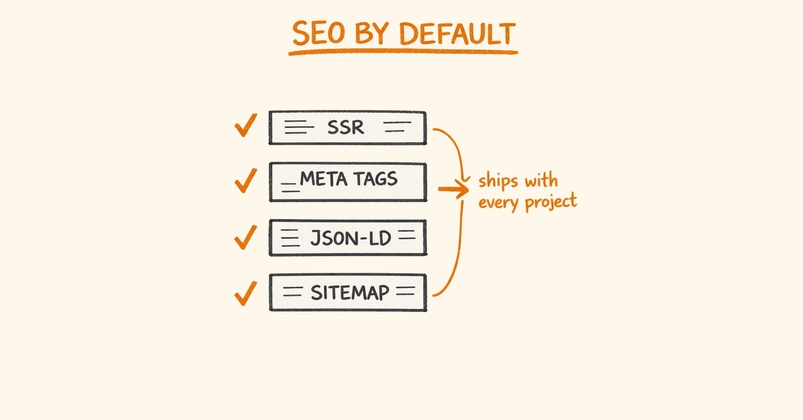
This isn’t about optimization work you hire someone for later. It’s the baseline for a properly built website. When a project ships with these technical SEO foundations already in place, it’s because the development process itself was designed with discoverability in mind.
The underlying architectural shift is clear: Next.js, by embracing server components and a route-based rendering model, is making technical SEO an intrinsic part of development. It’s moving it from the realm of marketing tactics to core engineering principles. A site that search engines can’t crawl or understand is, fundamentally, a broken site. And shipping broken software is never an option.
My own take is that this is a subtle but profound evolution. We’ve moved past the era where SEO was a separate discipline, often at odds with front-end development. Now, with frameworks that inherently support server-side rendering and structured data generation, developers have the tools to build discoverable sites natively. It’s about shipping code that works, not just for users, but for the algorithms that connect users to that code. And that, frankly, is good engineering.
🧬 Related Insights
- Read more: VakyaLang: Sanskrit Syntax Meets Modern Bytecode VM
- Read more: Blank Debian VM to Python CI/CD Pipeline: Zero to Hero in 60 Minutes
Frequently Asked Questions
Will this replace my job as an SEO specialist?
Not entirely, but it will change the nature of your work. Instead of solely focusing on on-page optimization or technical audits, SEO specialists will increasingly need to understand web development principles and collaborate with developers to implement technical SEO from the ground up within frameworks like Next.js.
Is server-side rendering (SSR) the only way to achieve good SEO with Next.js?
While SSR, especially with Server Components, is highly beneficial for SEO in Next.js by delivering fully rendered HTML, other rendering strategies like Static Site Generation (SSG) also offer excellent SEO benefits. The key is ensuring content is accessible to crawlers without heavy client-side JavaScript execution for initial indexing.
What is JSON-LD and why is it important for SEO?
JSON-LD (JavaScript Object Notation for Linked Data) is a lightweight data-interchange format used to provide structured data markup on web pages. For SEO, it’s crucial because it helps search engines understand the context and meaning of your content (e.g., identifying a page as a product, an article, or an event), enabling richer search results and improved visibility.