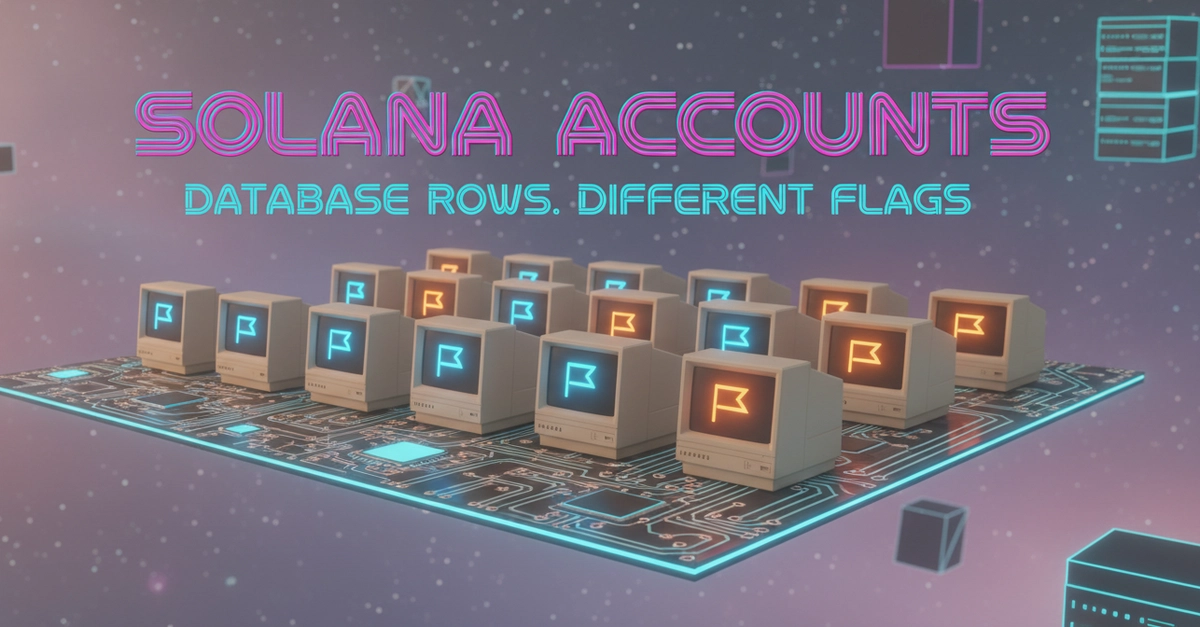
The blockchain industry loves its buzzwords. “Decentralization,” “immutable ledger,” “smart contracts.” But sometimes, the most profound shifts hide behind the most mundane observations. For many dipping their toes into the Solana ecosystem, the realization hits around Day 25 of their learning journey: Solana’s vaunted “accounts” aren’t some mystical blockchain construct. They’re, at their core, database rows. Stripped bare, every account on Solana – your wallet, the very programs that execute transactions, even the network’s clock — fits a single, remarkably simple schema.
It’s a stark departure from the Web2 world, where code and data reside in fundamentally different realms. A user record is a database row, sure. But application logic? That’s compiled code on a server, perhaps managed by Kubernetes. Configuration? Environment variables or a dedicated service. Each has its own storage, its own access patterns, its own conceptual boundaries.
Solana, however, unifies them. The provided schema — a humble CREATE TABLE accounts statement — underscores this: address (primary key), lamports (the SOL balance), owner (which program controls this row), data (an arbitrary payload), and executable (a boolean flag). That’s it. Billions of accounts, all conforming to this single, universal structure.
Here’s the kicker: the difference between a user’s wallet and a critical network program boils down to that executable flag. A wallet is a simple row: executable: false, owned by the System Program. Its value is primarily its lamports field. Think of it as a basic user record in Web2, with no inherent logic attached, entirely managed by an external application server (the System Program).
But flip that flag to true, and that same row transforms. The data field becomes executable bytecode. When you call a program, the Solana runtime doesn’t look for a separate binary on a disk; it looks up that account’s row and executes the data payload. It’s a bit like a stored procedure living within the same database system that holds your data, but far more generalized.
This architectural choice has profound implications for transparency and introspection. Because programs are just accounts, you can inspect them like any other data. A block explorer doesn’t just show your wallet’s balance; it can show a program’s bytecode, its upgrade authority, its entire transaction history. The traditional separation between “application layer” and “data layer” dissolves. It’s all one publicly visible table.
Why Solana’s Unified Account Model Matters
This isn’t just an academic curiosity; it’s the engine driving Solana’s scalability and programmability. By collapsing these distinct concepts into a single primitive, Solana simplifies developer tooling and the runtime itself. The system program, which handles fundamental operations like creating accounts, transferring SOL, and managing rent, isn’t some opaque, privileged entity. It’s just another account, albeit one with executable: true and a specific owner.
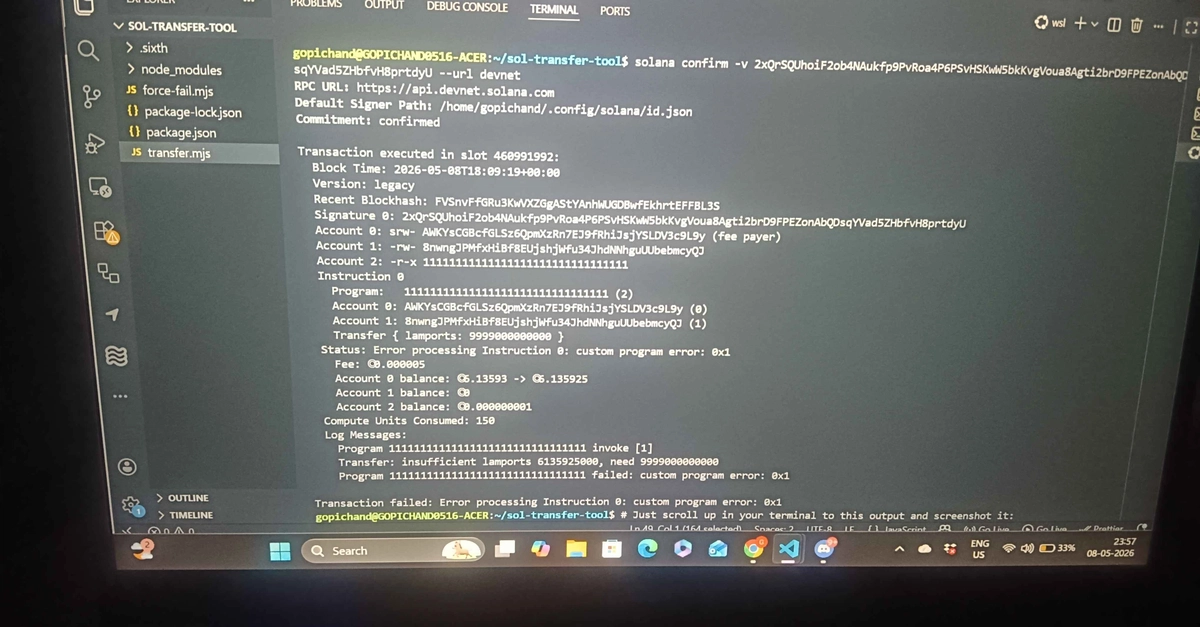
Every interaction, from receiving an airdrop to sending a transaction, becomes an operation on this global table. The System Program acts as the foundational application server, orchestrating these changes by reading from and writing to various rows.
This unified approach also forces a different way of thinking about state. In many Web2 systems, state transitions are managed by distinct processes and APIs. On Solana, state transitions are often direct modifications to an account’s data field or lamports, triggered by the execution of a program—which is itself just another account.
Is This a Database or a Blockchain?
This persistent analogy to databases isn’t accidental. Solana’s design borrows heavily from database principles while layering on the distributed, trustless guarantees of a blockchain. The global state is stored and accessed in a way that feels familiar to anyone who’s queried SQL, yet the consensus mechanism ensures that all participants agree on the validity of those queries and the resulting state changes.
This architectural decision makes Solana’s state machine remarkably simple to reason about, at least at this fundamental level. When you send SOL, you’re not just sending value; you’re instructing the System Program to debit one account row and credit another. When a smart contract executes, its code is retrieved from its account row, and its state modifications are applied to its data field or other associated accounts.
This isn’t to say it’s without its complexities. Managing state, understanding ownership, and interacting with programs still require deep technical knowledge. But the underlying abstraction — that everything is a row in a global table, differentiated by a single boolean flag — provides a surprisingly strong and elegant foundation for a high-performance blockchain.
It’s a powerful reminder that sometimes, the most elegant solutions are the ones that abstract away complexity by unifying disparate concepts under a single, well-defined primitive. Solana’s accounts are that primitive, and understanding them is key to understanding the blockchain itself.
🧬 Related Insights
- Read more: Distributed Locks: The GC Pause That Tripled a Customer’s Bill
- Read more: Deno’s Hidden Open Source Gems [Beyond the Runtime]
Frequently Asked Questions
What does the ‘owner’ field in a Solana account mean?
The ‘owner’ field specifies which program is responsible for managing that account’s data and state. It essentially dictates which program’s logic will be executed when interacting with that account.
Can I see the code of any program on Solana?
Yes. Since programs are also stored as accounts with the executable flag set to true, their bytecode can be inspected using block explorers or developer tools, making them transparent.
How does this ‘account’ model differ from traditional blockchains like Ethereum?
While Ethereum also uses accounts, Solana’s model unifies data and code storage into a single account structure. Ethereum separates externally owned accounts (EOAs) from contract accounts and their associated storage, making Solana’s approach more akin to a global, unified database table.