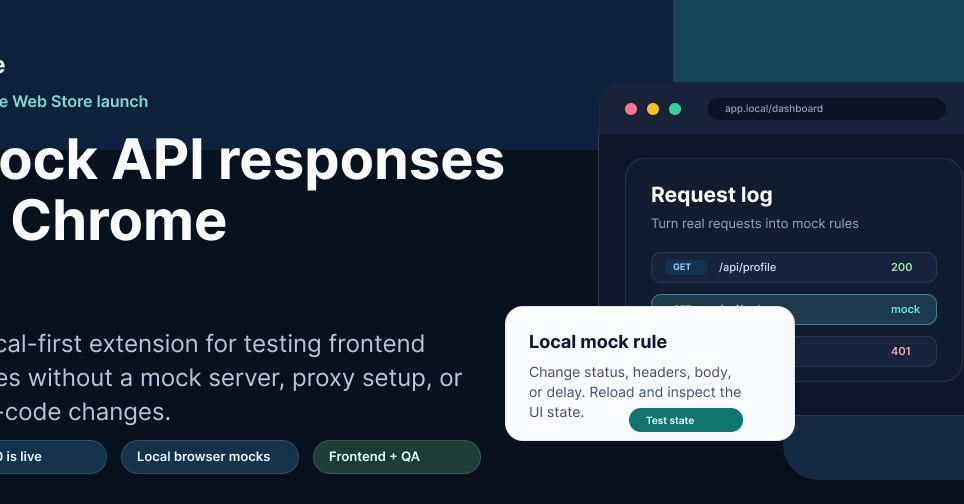
Just yesterday, the digital equivalent of finding a shortcut through a bureaucratic maze landed on the Chrome Web Store: Ruse. It’s a Chrome extension, and its stated mission? To let frontend developers and QA engineers stop wrestling with hard-to-reproduce API states.
Look, we’ve all been there. You need the API to return an empty list for that shiny new “no results” UI. Or perhaps the staging environment is spitting out 400 records when you specifically need to see the graceful handling of a sparse dataset. Maybe QA flagged a permission bug that’s vanished into the ether, and replicating the exact server state feels like a Herculean task. These aren’t fringe cases; they’re the bread and butter of frustrating frontend development cycles. The usual workarounds—spinning up a full mock server, fiddling with backend flags, or, heaven forbid, temporary code hacks—often become more onerous than the problem itself.
And that’s precisely where Ruse plants its flag. It bypasses the need for complex mock server infrastructure or environment configurations. Instead, it operates directly within the browser, leveraging the very requests your application is already making. The workflow is refreshingly straightforward: capture a real request, transform it into a local mock rule, tweak the response (body, status, headers, even delay), hit refresh, and voila—you’re testing the exact UI state you need.
The Over-Engineered Problem
Mock servers, while powerful for team-wide contracts and stable environments, represent overkill when you just need a single, specific response for a fleeting moment. Local fixtures are faster for isolated component testing, but they frequently miss critical nuances of real-world network interactions—authentication handshakes, request timing, retry logic, complex header exchanges, and runtime conditions all play a part. Backend flags or special test data initiatives? They often introduce significant coordination overhead. You’re asking someone else to perform a task, then waiting, hoping the ephemeral state remains intact for your own testing. It’s a fragile dance.
Then there are the temporary code hacks. We’ve all resorted to them: a quick throw statement, hardcoding a response, commenting out a fetch call, or surgically altering data in DevTools. They work, sure, but they’re inherently brittle, easily forgotten, and can introduce subtle bugs of their own.
Ruse’s Minimalist Approach
Ruse, by contrast, offers a pragmatic, browser-level override. Its v0.1.0 is intentionally scoped. It’s not an API client, nor is it a comprehensive mock server replacement or a team collaboration suite. The singular question guiding its development: Can a frontend developer control a real browser request locally, quickly enough to test the UI state they need right now? If that loop—Real Request -> Local Mock -> Controlled UI State—proves valuable, the product has a clear path for growth.
This local-first philosophy is critical for an extension like Ruse. The barrier to entry is low: install the extension, open your app, capture a request, define a rule, and test. Future iterations might incorporate better organization, synchronization, and team functionalities, but the initial value proposition rests on its unadorned simplicity. It aims to earn user trust by being exceptionally easy to use for its core purpose.
The point is not to replace every other API mocking tool. The point is to make one browser-level override fast enough that you actually use it during normal frontend work.
So, who benefits? Primarily, frontend developers building against incomplete APIs, QA engineers tasked with uncovering edge cases, full-stack developers working in parallel, and anyone preparing demos that demand stable, predictable data. It’s especially resonant for those who have uttered the phrase, “I just need this one request to return something different for a few minutes.” My take? This is where the rubber meets the road for many development workflows. The sheer friction of replicating specific API error states or empty data scenarios has long been a drag on productivity. Ruse directly targets this pain point with a tool that’s designed to be used rather than configured at length.
What’s Next for Ruse?
The Ruse team is actively soliciting specific, practical feedback. They’re asking about the request capture process, the clarity of the rule editor, perceived permissions issues, and where mocks unexpectedly failed. This granular input is gold for an early-stage product. For the next release, the focus is on refining permissions, enhancing rule organization, streamlining local workflows, and further optimizing the request-log-to-rule creation flow.
While the product is live, it’s still in a formative stage, meaning user feedback will genuinely shape its trajectory. If you’re in the trenches of frontend development against unstable APIs, giving Ruse a spin and providing that concrete feedback seems like a smart investment of a few minutes.