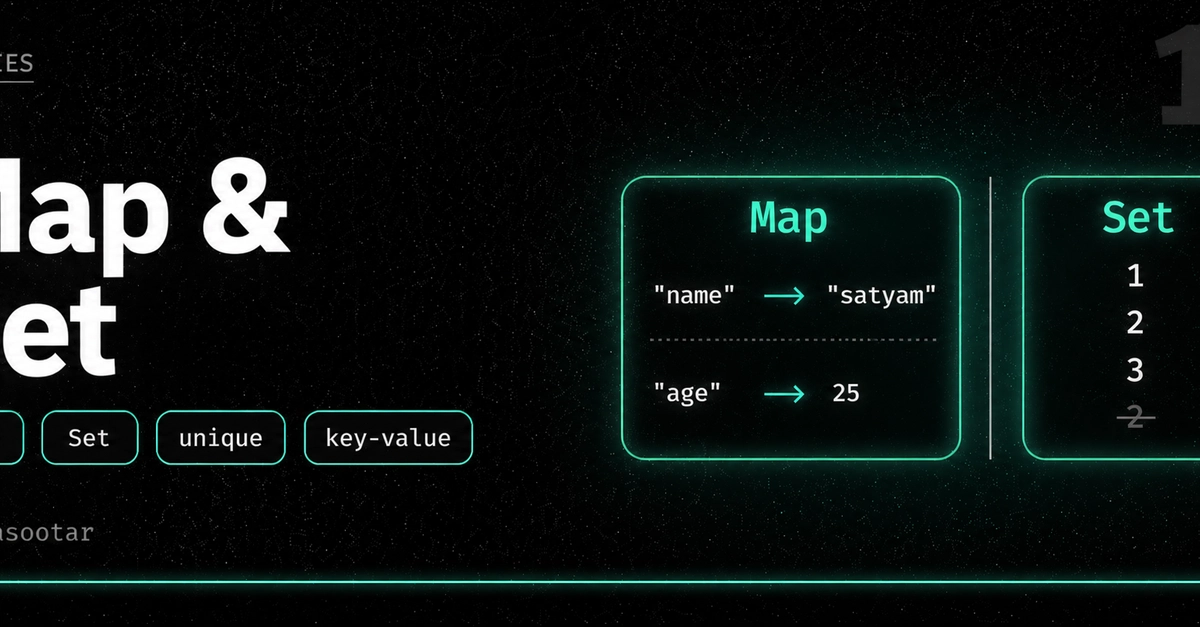
The JavaScript world, circa 2015, was abuzz with the promise of ES6. We anticipated cleaner syntax, arrow functions, and perhaps some syntactic sugar for promises. What we got, beneath the headline features, were two foundational data structures—Map and Set—that promised a more strong, performant, and expressive way to manage data. For years, JavaScript developers have wrestled with the limitations of plain objects and arrays, shoehorning them into roles they were never perfectly designed for. Now, with Map and Set, those compromises are less necessary, and for good reason.
Think about it. For key-value storage, the default has always been the plain old JavaScript object. Need a list of unique items? An array. These tools are ubiquitous, but they come with quirks. Keys in objects are implicitly converted to strings, order isn’t guaranteed (or at least, wasn’t reliably until recently), and managing complex relationships often leads to verbose, error-prone code. Map and Set aim to fix that, offering solutions tailored to specific problems.
Let’s talk about Map first. At its heart, a Map is a collection of key-value pairs, much like an object. But the devil, as always, is in the details. Unlike objects, a Map preserves the original insertion order of its keys. This might sound minor, but for scenarios where iteration order matters—think logging, history, or sequential processing—it’s a revelation. More importantly, Map’s keys aren’t restricted to strings or symbols. They can be any value: an object, a function, a number, even NaN. This opens up possibilities that were previously cumbersome or impossible to achieve with plain objects.
Consider this: you want to associate data with an object instance itself, not just a string representation of that object. With a plain object, you’d be stuck trying to stringify the object and use that as a key, inevitably leading to collisions or loss of information. A Map handles this natively.
const userRoles = new Map();
userRoles.set("satya", "admin");
userRoles.set(42, "meaning of life"); // numbers as keys? Yes!

console.log(userRoles.get("satya")); // "admin"
console.log(userRoles.has(42)); // true
console.log(userRoles.size); // 3

userRoles.delete(42);
console.log(userRoles.size); // 2

for (const [key, value] of userRoles) {
  console.log(`${key}: ${value}`);
}
This example showcases the intuitive methods—set(), get(), has(), delete()—and the direct size property for tracking entries. It’s cleaner, more explicit, and less prone to the kind of gotchas that plague object manipulation.
Why Map Beats Plain Objects for Data Storage
The differences aren’t just cosmetic; they point to fundamental architectural improvements. Plain objects, for instance, have a prototype chain. This means they inherit properties, which can lead to unexpected collisions if you’re not careful—especially when dealing with user-provided data. Prototype pollution, a security concern, is also less of a worry with Maps, which start with a clean slate.
And iteration? Forget trying to iterate directly over a plain object in a predictable way without extra steps. Maps are directly iterable. A simple for...of loop yields [key, value] pairs, making data traversal straightforward and efficient.
Performance is another critical differentiator. For applications that involve frequent additions and deletions of key-value pairs, Maps are optimized. Objects, on the other hand, are not built for that kind of dynamic churn. If your application frequently adds and removes properties, switching to a Map can yield noticeable performance gains.
So, when should you reach for a Map? Anytime you need keys that aren’t strings or symbols, when insertion order matters, when you want to avoid prototype collisions, or when performance for frequent add/delete operations is a concern. It’s a superior tool for many common programming tasks that have long been shoehorned into object usage.
Set: The Unsung Hero of Unique Collections
Now, let’s pivot to Set. If Map is the superior object-like structure, Set is the superior array-like structure when uniqueness is paramount. At its core, a Set is a collection of values where each value can only occur once. Think of it as an array that automatically handles duplicate removal.
const uniqueNumbers = new Set();
uniqueNumbers.add(1);
uniqueNumbers.add(2);
uniqueNumbers.add(2); // Duplicate! Ignored.
uniqueNumbers.add(3);

console.log(uniqueNumbers.size); // 3 (not 4)
console.log(uniqueNumbers.has(2)); // true

// Iterating over a Set
for (const number of uniqueNumbers) {
  console.log(number);
}

// Sets can also be created from existing iterables:
const initialArray = [1, 2, 3, 3, 4, 4, 5];
const mySet = new Set(initialArray);
console.log(mySet.size); // 5
Again, we see intuitive methods like add(), has(), and the size property. The ability to add any type of value, just like with Map, is a significant advantage over arrays, which can sometimes lead to subtle bugs with object references.
Sets are also directly iterable, making it easy to loop through their unique elements. This is particularly useful when you need to process a collection of distinct items without worrying about redundant processing.
When to Use Map vs. Set
The decision between Map and Set often hinges on the intended structure:
- Map: Use when you need to associate values with specific, potentially non-string keys. It’s your go-to for dictionary-like or hash table implementations where keys can be complex.
- Set: Use when you simply need a collection of unique values. It’s perfect for de-duplicating lists, tracking seen items, or managing distinct elements where the order might be secondary to membership.
It’s a simple dichotomy, but one that has saved countless developers from the headaches of manual de-duplication or complex key management.
The Architectural Shift We Might Have Missed
While ES6 brought us let, const, and arrow functions, the introduction of Map and Set represents a quieter, yet arguably more profound, architectural shift. It signaled a move towards providing developers with more specialized, performant tools that align better with common programming patterns. Before Map and Set, developers often had to choose between the flexibility of objects (with their string-key limitation) and the rigidity of arrays (with their potential for duplicates and less direct key access). These new data structures fill those gaps elegantly.
They’re not just conveniences; they’re foundational building blocks that can lead to more readable, maintainable, and performant JavaScript code. If you’ve been defaulting to plain objects for every key-value need or meticulously filtering arrays for uniqueness, it’s time to revisit your toolkit. Map and Set aren’t just ES6 features; they’re essential modern JavaScript.
🧬 Related Insights
- Read more: LAB3’s HashiCorp Workflows Turbocharge Cloud Modernization
- Read more: DIY AI Controller: $15 Bulb Meets MIDI Pad
Frequently Asked Questions
What does Map actually do in JavaScript?
A Map in JavaScript is a collection of key-value pairs where any value (primitive or object) can be used as a key. It preserves insertion order and offers methods for setting, getting, and deleting pairs, along with a size property.
Is Set better than an Array in JavaScript?
Set is better than an Array when you need a collection of unique values and want automatic duplicate prevention. Arrays are more versatile for ordered lists, numerical ranges, or when you need methods like map(), filter(), or reduce() directly on the collection.