Everyone expected the future of AI to be a shiny, cloud-bound monolith. We anticipated needing powerful servers, hefty cloud bills, and a constant, stable internet connection. For a while, that seemed to be the only path. But something extraordinary is happening. The very notion of where an AI model lives and breathes is shifting beneath our feet, fundamentally altering the development landscape. It’s less like a software update and more like the dawn of a new operating system — an AI-native one.
This isn’t just about bigger models or faster chips; it’s about a seismic platform shift. We’re seeing the democratization of powerful AI, not just for consumption, but for integration into the very fabric of our applications. The conversation has moved from ‘Can AI do X?’ to ‘Where should AI do X?’ And that’s where the rubber meets the road, especially for us building developer tools.
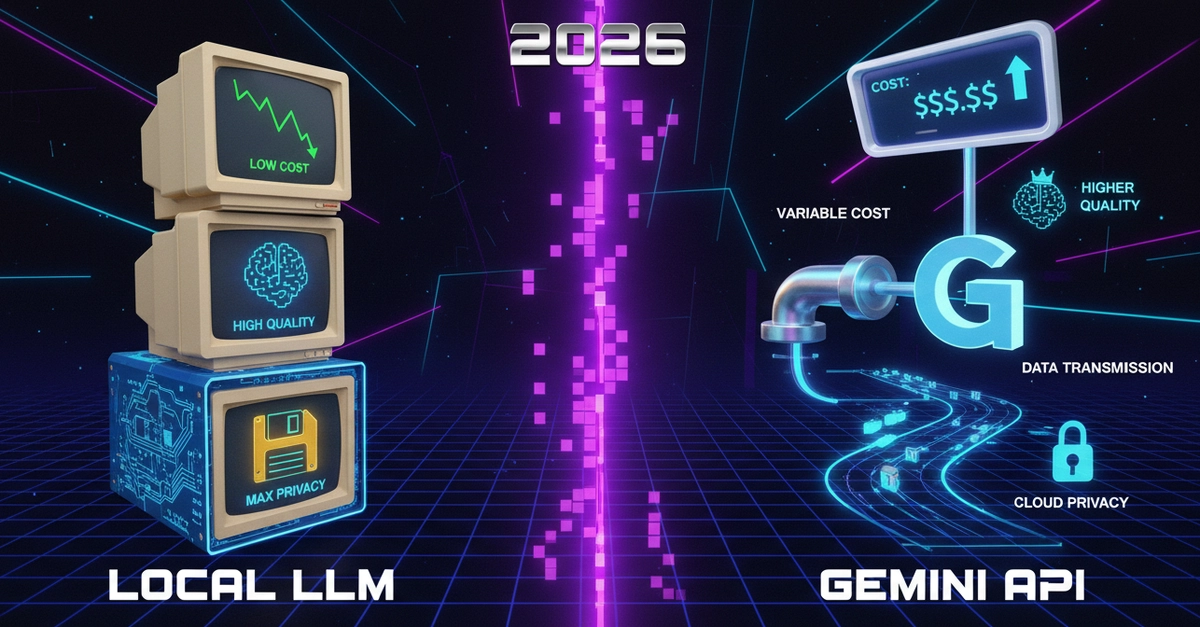
My own journey through this has been a whirlwind. I’m running both local LLMs via Ollama and leveraging the Gemini API in production right now, building tangible developer tools. What I’ve found isn’t just a theoretical comparison; it’s a pragmatic, boots-on-the-ground report from the front lines. The table below isn’t just data; it’s the distillation of countless hours of experimentation and deployment.
| Local LLM (Ollama) | Gemini API (Free) |
|---|---|
| Cost | $0 forever |
| Privacy | 100% local |
| Setup | Install Ollama + pull model |
| Quality | Good (7B), Great (70B) |
| Speed | Fast if model loaded |
| Internet | Not required |
| Rate limits | None |
| Model size | 4–40GB download |
| GPU | Faster with GPU |
Simple tasks, the bread and butter of many AI integrations—think summarization, classification, or basic formatting—often feel indistinguishable. My 7B local model performs on par with Gemini Flash for these jobs. It’s like comparing two incredibly sharp, precise knives for chopping vegetables; both get the job done beautifully.
But when you pivot to complex reasoning—debugging a thorny crash, tracing a convoluted causal chain, or explaining the ‘why’ behind a bizarre behavior—Gemini pulls ahead. A local 7B model, bless its heart, can stumble through multi-step logical leaps. It’s the difference between a well-trained apprentice and a seasoned master craftsman. The apprentice can follow a recipe perfectly, but the master can improvise and solve a unique challenge.
For code completion, though, the landscape shifts dramatically. A tiny local 1.5B model, like the qwen2.5-coder, is not only fast enough but impressively capable. Sending your code snippets to the cloud for autocompletion feels increasingly… quaint. It’s like still using a fax machine when you have instant messaging.
When Does Local AI Truly Shine?
There are scenarios where running LLMs locally isn’t just an option, it’s the only sensible choice. Picture this:
- You’re processing sensitive medical records, confidential legal documents, or proprietary financial data. Privacy isn’t a feature; it’s a mandate. Sending that data off-premise isn’t even on the table. It’s like trying to discuss state secrets in a crowded coffee shop.
- Your users are locked down within corporate networks, subject to stringent egress policies that choke off external API calls. Local means independence.
- You require absolute, zero-latency responses. If the model is already loaded on the user’s machine, there’s no network round-trip delay. The response is instant. This is vital for real-time interactive tools.
- You’re building applications designed for offline use. Think field workers, remote locations, or simply users who value resilience against internet outages.
Why the Cloud Still Commands Respect
Conversely, the Gemini API remains a powerful contender, especially when top-tier performance is paramount and data privacy is less of a concern.
- You absolutely need the pinnacle of reasoning quality available. For tasks demanding nuanced understanding and complex problem-solving, the cloud offers unmatched power.
- Your data isn’t sensitive. If it’s public information or anonymized, sending it to a provider like Google is a non-issue.
- Your users aren’t going to install a 4GB (or larger!) model just to try out your app. The friction of local setup can be a significant barrier for widespread adoption.
- You’re in rapid prototyping mode. Spinning up an API key is far quicker than configuring a local environment, especially for initial experimentation.
The AI Deployment Matrix
It’s not an either/or proposition. The magic lies in choosing the right tool for the right job. My current deployment strategy looks something like this:
- Code autocomplete: Definitely Local. The qwen2.5-coder:1.5b model delivers instant, high-quality suggestions. Why wait?
- Log diagnosis: Leaning towards Gemini API. While local models are improving, Gemini’s superior reasoning is often better for complex debugging and root cause analysis, provided PII is filtered out.
- PDF processing (privacy-sensitive docs): Local is the clear winner here. Keeping sensitive documents entirely on the user’s machine is non-negotiable.
- General chat/conversational interfaces: Gemini API, especially when nuanced understanding and broad knowledge are critical. Quality matters when it’s the primary interaction.
Performance on the Edge (Your Laptop)
Running these models locally is highly dependent on the hardware. On an older 8-year-old MacBook Air with 8GB RAM and an Intel processor, the experience is… varied.
qwen2.5-coder:1.5bis fast and great for autocomplete. It’s a tiny powerhouse.gemma2(9B) is usable but slow, with a noticeable ~8-second initial token generation. It’s like waiting for a dial-up modem.llama3(8B) offers a similar experience to Gemma2. They’re adequate but not zippy.- Anything 70B? Forget it. Not viable with that RAM. It’s like trying to fit a whale into a bathtub.
However, Apple Silicon (M-series chips) completely changes the game. The unified memory architecture provides a massive boost. If you’re on an M1, M2, or M3 Mac, local LLM quality and speed improve substantially. It’s the difference between a sputtering scooter and a sports car.
This is the future unfolding: a decentralized, flexible AI ecosystem where performance, privacy, and cost dictate deployment. It’s exhilarating, and frankly, a bit wild. The era of the monolithic, cloud-only AI is over. We’re building something far more strong, adaptable, and powerful.