Africa’s Messaging Infrastructure
WhatsApp isn’t just a chat app in Nigeria; it’s the backbone of commerce. For businesses there, it’s the primary channel for everything from customer service and order updates to payments and onboarding. Users flock to it faster than email, often even SMS, making it the default for any startup needing reliable user verification or customer interaction.
The Bottleneck: Meta’s API
Here’s the rub: the official WhatsApp Business API, while powerful, presents a significant barrier for many African startups. The hurdles are substantial: weeks of Facebook Business verification, the requirement for a registered company, escalating costs at scale, and a general complexity that overwhelms lean teams. For a solo founder trying to get off the ground, this friction is a deal-breaker, not a stepping stone.
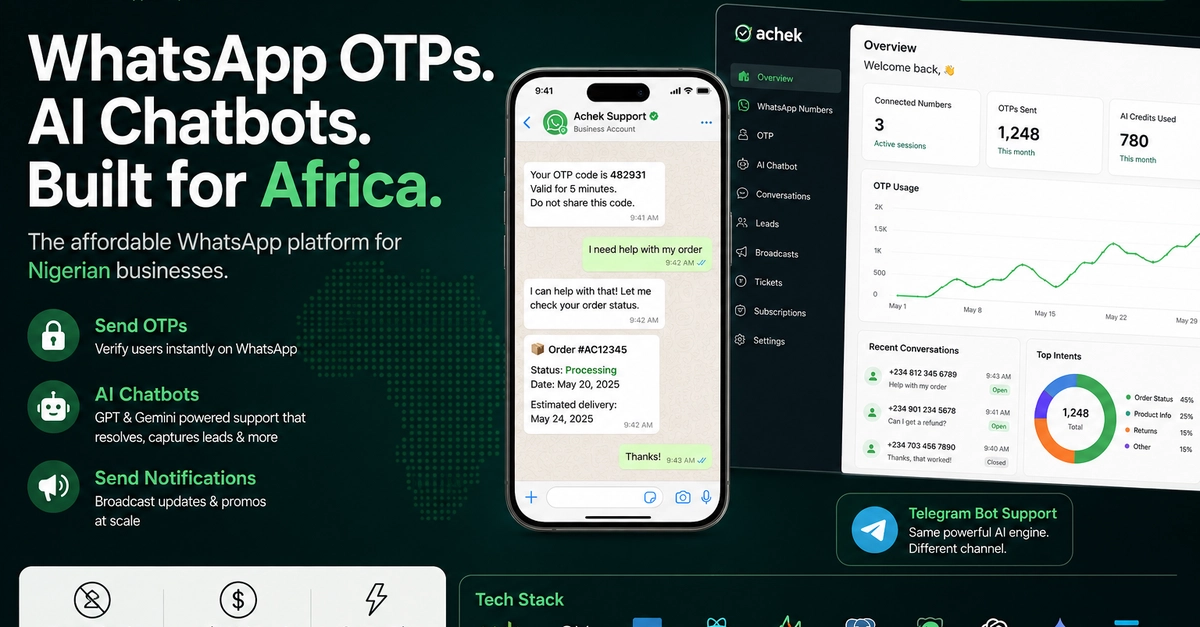
This is precisely the gap Achek, a new platform, aims to fill. It promises a streamlined, affordable route for businesses to send OTPs and deploy AI chatbots directly through WhatsApp and Telegram, bypassing the usual Meta verification gauntlet.
Why Achek Matters
The anecdotal evidence from developers and founders in regions like Nigeria has been consistent and loud: SMS OTPs are unreliable, Twilio has its issues, and the official WhatsApp API is a bureaucratic and financial quagmire. These aren’t minor inconveniences; they’re foundational problems that directly impact user acquisition, retention, and operational efficiency. Achek’s proposition is simple: connect a WhatsApp number in under a minute, send OTPs instantly, integrate AI support without complex infrastructure, and crucially, keep pricing accessible for the African market.
What Achek Actually Does
Achek’s core functionality centers on three key areas, all accessible through familiar messaging platforms:
WhatsApp OTP Verification: Moving beyond SMS, Achek enables businesses to verify users via WhatsApp. This is a significant win in areas where SMS infrastructure can be flaky, promising better delivery rates and a smoother user experience.
AI Customer Support Bots: Leveraging GPT and Gemini, Achek allows businesses to run sophisticated AI chatbots directly on their WhatsApp or Telegram accounts. These aren’t just glorified FAQ bots; they’re designed to handle a range of tasks from answering queries and managing complaints to capturing leads, booking appointments, verifying payments, and even escalating complex issues to human agents.
Notifications & Broadcast Messaging: For mass communication, businesses can push updates, reminders, and announcements to their customer base at scale.
Telegram Bot Support: A particularly interesting expansion is Achek’s ability to run the same AI engine across both WhatsApp and Telegram. This “different transport layer, same backend intelligence” approach is a smart way to maximize the utility of their AI investment and cater to a broader user base.
The Engineering Underpinnings
At its heart, Achek is a modern TypeScript platform, architected with a modular backend, an AI orchestration layer, and multi-channel messaging infrastructure. The system is built to handle the complexities of WhatsApp session management, Telegram bot routing, AI tool-calling workflows, OTP delivery, customer support automation, and subscription billing, all in real-time.
The developer’s intentional design choice to centralize the business logic and AI engine across multiple platforms is a proof to a scalable vision. Expanding from WhatsApp to Telegram, he notes, was significantly easier because the core system didn’t need a rewrite.
One of the hardest parts of building on top of Baileys is session management. WhatsApp Web sessions are tied to the user’s phone. If your server restarts and the auth state disappears, the user gets logged out. That creates a terrible experience.
Session Persistence: A Key Production Hurdle
One of the most significant technical challenges Achek tackled was WhatsApp session persistence. Building on libraries like Baileys, which tie sessions to the user’s phone, means server restarts can lead to users being logged out—a catastrophic user experience. Achek’s solution involves a custom database authentication adapter that stores WhatsApp credentials directly within PostgreSQL. This allows the server to automatically restore all previously connected sessions upon startup, a move that dramatically improves production stability.
Building an Agentic AI Loop: Beyond Basic Bots
Instead of a static, FAQ-driven chatbot, Achek employs an agentic tool-calling system. This allows the AI to access and interact with real business data before generating a response. The AI can dynamically decide which tools to call, enabling it to check account status, verify payment references, look up OTP delivery status, create support tickets, save leads, and schedule follow-ups. This sophisticated architecture moves the bots far beyond simple scripted flows, making them feel genuinely useful and integrated into business operations.
My Take: A Pragmatic Solution for a Real Problem
This isn’t just another AI chatbot startup. Achek directly addresses a palpable pain point for a massive, underserved market. The strategy of sidestepping the cumbersome Meta API for smaller businesses is a shrewd move. It democratizes access to essential communication tools, something that established players often overlook in their pursuit of enterprise clients. The parallel to early mobile app stores is striking: bypassing gatekeepers to unlock latent developer and business potential. The real test will be scaling this operational simplicity without compromising the underlying reliability that is so critical for businesses relying on these channels for their livelihoods.
Is Achek a Game Changer for African Startups?
Potentially, yes. By offering an affordable and accessible alternative to the official WhatsApp Business API, Achek removes a significant barrier to entry. For startups in regions where SMS is unreliable and the cost of official channels is prohibitive, a platform like Achek can be transformative. The ability to deploy AI-powered customer support and automated OTP verification directly on familiar platforms like WhatsApp and Telegram means businesses can operate more efficiently and scale their customer engagement without breaking the bank. It’s a pragmatic approach that could unlock significant growth for countless small and medium-sized enterprises across the continent.
What About Future Development?
The current architecture suggests a strong foundation for expansion. The modular design and the focus on a centralized AI engine open doors to integrating with other messaging platforms or adding more sophisticated AI capabilities. The developer’s mention of custom database adapters and agentic AI loops hints at a commitment to strong engineering and intelligent automation. We can anticipate further refinements in AI tool-calling, potentially expanding the repertoire of available business actions, and continued efforts to simplify the integration and management experience for non-technical users.
🧬 Related Insights
- Read more: No NPM? No Problem: Pure HTML Dashboard Template Exists
- Read more: Gemma 4: Offline AI Fuels Global Dev Access [Analysis]
Frequently Asked Questions
What does Achek do? Achek is a platform that allows businesses to send OTPs and run AI chatbots on WhatsApp and Telegram without needing the official Meta API verification. It focuses on affordability and ease of use for businesses in regions where traditional methods are expensive or unreliable.
Is Achek only for African businesses? While the platform was built with the specific challenges faced by African businesses in mind (like unreliable SMS and the cost of the official WhatsApp API), its capabilities are not strictly limited to Africa. However, its primary value proposition is strongest in markets with similar infrastructure and cost considerations.
How does Achek handle WhatsApp verification? Achek allows businesses to connect their WhatsApp numbers and send OTPs directly, bypassing the lengthy and often costly verification process required by the official WhatsApp Business API. The exact technical method for bypassing Meta’s stringent approval for OTP delivery is a key part of Achek’s value proposition and likely involves leveraging alternative integration methods or specific platform features.