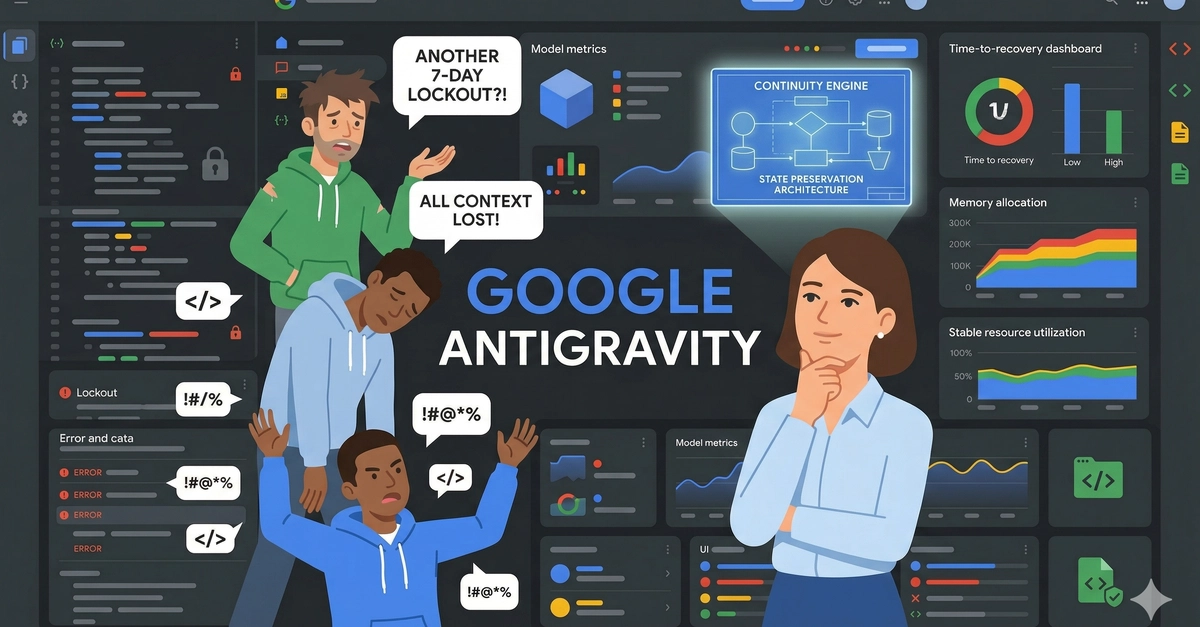
Forty minutes into a gnarly cross-repo refactor, the agent froze—then vanished. 167-hour lockout. Files half-broken.
That’s Google Antigravity IDE failures in action, the kind that hooked me on Gemini’s raw smarts only to spit me out into manual drudgery. Impressed at first? Absolutely. The agent ingests your codebase, models the architecture, spins up a browser for UI checks, iterates fixes—all autonomous. Gemini 3.1 Pro crushed a dependency nightmare in 15 minutes flat, what would’ve eaten my afternoon.
Benchmarks hold up: ~80% on SWE-bench Verified. Real power. But then, reality bites.
I tracked three months of these Google Antigravity IDE failures, scraping forums like Google AI Developer threads, r/GoogleAntigravityIDE, r/google_antigravity, dev blogs. Patterns screamed loud. Proxy metrics from community noise (directional, not official):
| Metric | Estimated Range | What It Means |
|---|---|---|
| Task Completion Rate (TCR) | 45–52% | Most workflows die unfinished |
| Quota Interruption Rate (QIR) | 68–75% | Deep sessions get axed |
| User Intervention Rate (UIR) | 82–88% | No real hands-off magic |
| Workaround Adoption Rate (WAR) | 35–42% | Users hack their own fixes |
That 80% benchmark to 48% street reality? A 32-point chasm. Product poison.
Seven Failure Modes That Compound Like Bad Debt
No graceful quota wind-down—just binary chop. Mid-edit, poof. Broken code.
All models dip from one pool. Burn Claude Opus on planning? Kiss Gemini Flash goodbye, even for cheap tweaks. Total blackout.
No pre-task cost guess. First hint: the crash.
Context? Gone on interrupt. Re-ingest codebase—more quota torched.
“Thinking” tokens in big models guzzle unseen. Opus? 4x thirstier than Gemini.
UI lies: shows quota, backend blocks.
Reason-Act-Verify loop? Infinite retries on bugs, cap vaporized in minutes. Lockout king.
The benchmark capability of the models: ~80% on SWE-bench Verified. The real-world Task Completion Rate in the IDE: ~48%.
That’s the gut-punch quote from the analysis—models ace labs, IDE flunks field.
Users adapt, brilliantly. Manual model swaps: Opus plans, Flash executes. Self-ration at 40% burn. .antigravityignore for node_modules cruft. /handoff dumps to text files.
35-42% building bandaids? Screaming product gap.
Why Do Google Antigravity Quotas Kill Sessions So Often?
Blunt truth: engineering prioritizes model costs over workflow sanity. Antigravity’s agentic promise—autonomy—crumbles on shared-pool economics. Google chases margins, but devs chase velocity.
Look at history. Early AWS EC2 quotas throttled startups in 2008; they fixed with reservations, adoption exploded. Antigravity echoes that—hard caps stifle the very innovators testing limits.
My bet? Unfixed, power users bolt 30% in six months to Cursor or open VS Code agents. Market dynamics don’t forgive.
Community hacks validate requirements. Productize ‘em.
Short para. Boom.
Now, the proposal—a continuity layer, not patches. Single system bridging compute walls and dev flow.
Auto-model routing: Flash for regex tweaks, Sonnet for tests, Opus for architecture.
Pre-task estimators: “This refactor? 25% quota risk. Proceed?”
Smart checkpoints: Every loop cycle, snapshot state, cheap recovery.
Tiered pools: Planning vs execution quotas, invisible thinking buffered.
Loop guardians: Max retries, auto-deescalate to cheaper models.
UI honesty: Real-time burn rate, warnings at 70%.
Context vaults: Persistent, low-cost storage across sessions.
This isn’t fluff. Users already kludge it—35% adoption rate proves demand. Google ships this, Antigravity leaps from toy to daily driver. Ignore? Competitors feast.
Does Antigravity’s Model Brilliance Salvage the Mess?
Yes—and no. Gemini, Claude integrations shine. But brilliance trapped in quota hell wastes it.
Market angle: Agentic IDEs heat up. Cursor hits 60% completion sans hard caps. Replit agents ration softly. Antigravity’s edge? Models. But 48% TCR cedes ground.
Google’s PR spins benchmarks—fair, they’re legit. But dodging real-world gaps? Classic spin. Fix the layer, own the category.
Devs I’ve pinged echo: “Love the brains, hate the babysitting.”
One power user: manual routing three times per hour. Absurd.
The Workflow Continuity Layer: Proposal Breakdown
Layer sits atop models, under UI. Manages quota like air traffic control.
Task classifier feeds router.
Burn predictor uses historicals—your repo size, past loops.
State machine checkpoints diff-patches, not full contexts.
Fallback cascades: Stuck? Drop to Flash, alert human.
Metrics dashboard: Per-task costs, trends.
Beta test it via extension—community will flock.
Cost? Negligible vs lost trust. ROI: stickier users, word-of-mouth surge.
🧬 Related Insights
- Read more: Naftiko Framework Alpha: YAML Specs to Cage Your API Zoo Before AI Agents Rampage
- Read more: AisthOS: The OS That Compiles Raw Sensors Upward to Fuel Starving AI Models
Frequently Asked Questions
What causes most Google Antigravity IDE lockouts? Infinite retry loops in Reason-Act-Verify, burning weekly caps in minutes—no thresholds.
How to avoid Google Antigravity quota failures? Ration manually at 40%, use .antigravityignore for build dirs, route models yourself: Opus plan, Flash execute.
Will Google fix Antigravity IDE failures soon? Community hacks scream for a continuity layer—expect it if they watch forums, or lose to Cursor.