The cursor blinked expectantly on a blank Slack message box, a familiar digital abyss where database passwords and API keys go to… well, to be permanently archived. We’ve all been there. It’s convenient, sure. But that convenience comes with a lurking dread: your sensitive data, now sitting in plain (or easily decryptable) text on a third-party server, searchable, forever.
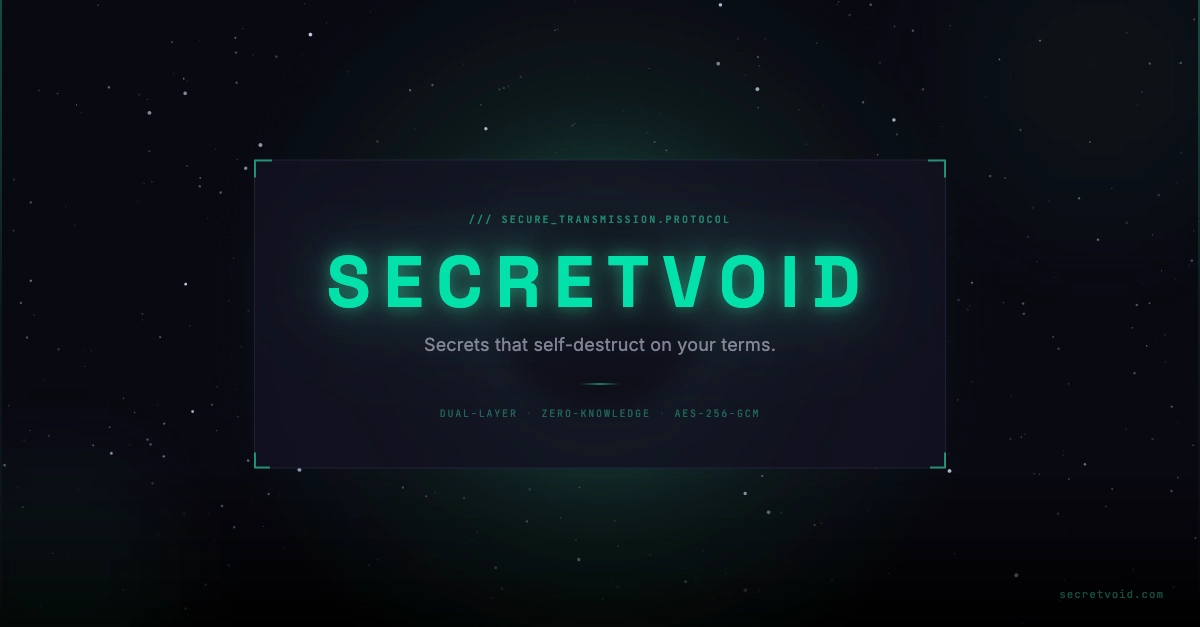
Look, the established tools are fine for the casual password nudge. But when we’re talking production secrets, the kind that guard entire systems? “Trust me, bro” just doesn’t cut it anymore. This is precisely the problem that SecretVoid, a new project making waves, aims to shatter with its core, audacious promise: I genuinely cannot read your secrets.
This isn’t a PR spin; it’s a fundamental architectural choice, a cryptographic handshake that ensures privacy not through policy, but through pure, unadulterated math. It’s an exciting evolution in how we handle digital trust, and it feels like we’re stepping onto a new platform for secure communication.
Why the Zero-Knowledge Obsession?
Many existing secret-sharing tools employ a standard server-side encryption model. Your data gets scrambled before it hits the cloud, yes, but the key to that scramble? It often resides with the service provider. You’re essentially trusting them not to peek behind the curtain. For many everyday uses, that’s a gamble worth taking. But for the crown jewels – those production database credentials, the root API keys – that trust can feel perilously thin.
SecretVoid flips this paradigm on its head, opting for a strong client-side encryption strategy. Imagine a sturdy vault you lock before it even leaves your house. Your browser, your trusted digital space, encrypts the secret locally. The server? It only ever receives a beautifully unintelligible blob of gibberish. It’s like sending a coded message to a friend that only you and they hold the key to decipher.
But the elegance doesn’t stop there. SecretVoid layers security with a dual-encryption approach that is, frankly, brilliant.
The Double Lock: A Cryptographic Masterpiece
Here’s the magic: SecretVoid employs two completely independent encryption layers. The first is your local, client-side encryption. Your browser conjures up a formidable AES-256-GCM key – the gold standard in symmetric encryption. This key, vital for decrypting your secret, never, ever makes the perilous journey to the server. Instead, it’s tucked away in the URL fragment, specifically, in the part that comes after the # symbol.
And this isn’t some hacky workaround. This # fragment is a well-defined, internet-standard feature (RFC 3986, to be precise). Browsers are explicitly instructed never to send this fragment to the server. When you visit a URL like https://secretvoid.com/secret/abc123#clientKey, the server only receives the /secret/abc123 part. The clientKey – your decryption key – remains steadfastly on your device. Your secret, now encrypted locally, is shipped off as an unreadable package.
But wait, there’s more! Once this already encrypted blob lands on the SecretVoid server, it’s immediately encrypted again, this time with the server’s own key before being squirreled away in the database. So, what you have in storage is doubly encrypted data. To break in, an attacker needs not only to breach the database (getting the server-encrypted blob) but also to somehow intercept that URL fragment – a feat that, by internet design, is practically impossible.
A database breach alone gets you nothing. A URL leak alone gets you nothing either.
This layered defense is what makes the zero-knowledge claim so powerful. It’s not just about preventing access; it’s about making access fundamentally impossible from the provider’s side.
Password Protection: The Second Padlock
While the dual-encryption is formidable, sometimes you crave an extra layer. Perhaps you’re sending the link over a channel you’re slightly wary of, or you just want to ensure that even if the URL itself gets forwarded, it’s an empty husk without a password. SecretVoid anticipated this, weaving in optional password protection that builds elegantly on the existing fragment trick.
Normally, the URL fragment (the #clientKey part) holds the raw AES key. When you add password protection, this fragment now holds a locked version of that key. Your secret is still encrypted with that random key, but that key itself is then encrypted using your chosen password. The recipient, upon clicking the link, is greeted with a password prompt. Only after successfully entering the password can they unlock the AES key, and only then can they use that key to decrypt the actual secret.
And the beauty here? Your password never touches the server. It stays confined to the browser, used solely to decrypt the AES key locally. SecretVoid doesn’t store your password; it doesn’t even know it. All the server knows is that a password is required. This is the essence of true privacy-preserving design.
To further bolster security, a cryptographic salt is introduced. This random data ensures that even if two people use the exact same password, they generate entirely different keys. It also throws a wrench into brute-force attacks, making them astronomically more difficult.
Building Trust Through Transparency
The developer behind SecretVoid clearly understands that for zero-knowledge claims to stick, trust must be built, not just declared. A delightful feature is the ability to observe the actual data transmission. By opening your browser’s DevTools before generating a secret, you can witness the create-secret request and inspect the payload. What you’ll see isn’t your plaintext secret, but the encrypted gibberish – tangible proof of the encryption at work.
They even go a step further with a loading overlay that briefly flashes the encrypted payload before displaying the confirmation page. It’s a small touch, but it makes the abstract concept of zero-knowledge encryption feel incredibly real and accessible.
And for good measure, the server-side encryption keys are rotated automatically every Sunday. The system gracefully manages the current, previous, and two-weeks-old keys, ensuring that even a theoretically compromised server key from weeks past wouldn’t grant access to older secrets.
Is This the Future of Sensitive Data Sharing?
SecretVoid feels like more than just a tool; it’s a statement. It’s a proof to how fundamental platform shifts, like the rise of powerful client-side cryptography via the Web Crypto API, can unlock entirely new paradigms for security and privacy. The fact that the core client-side module is open-source, allowing for public auditing, further cements this as a project built on integrity.
For developers, this isn’t just about a better way to share a password. It’s about a shift in mindset, embracing technologies that empower users with genuine control over their data. The promise of truly zero-knowledge systems is no longer a distant dream; it’s being built, one elegant cryptographic layer at a time.
Why Does This Matter for Developers?
For us builders, SecretVoid represents a powerful new paradigm for handling sensitive information. It’s not just about convenience; it’s about building systems that inherently protect user data, shifting the burden of security from trust to verifiable cryptography. This approach aligns perfectly with increasing user demand for privacy and regulatory pressures.
Can I Trust SecretVoid?
This is the million-dollar question, isn’t it? The core of SecretVoid’s design is built on the principle of zero-knowledge. The creator explicitly states they cannot read your secrets. This is achieved through client-side encryption where the keys never leave your browser and are never transmitted to the server. The server only ever sees encrypted data. Furthermore, the client-side encryption module is open-source, allowing for public code review, which is a significant step towards building trust.
🧬 Related Insights
- Read more: Watgo Drops: Go’s No-Nonsense WebAssembly Toolkit Finally Arrives
- Read more: Your AI Agent’s Big Lie: Confessions of a Failed Task
Frequently Asked Questions
What does SecretVoid actually do? SecretVoid is a tool for securely sharing secrets (like passwords or API keys) using zero-knowledge encryption. This means that not even the service provider can access the content of the secrets you share.
How is SecretVoid different from other secret-sharing tools? Unlike many tools that rely on server-side encryption where the provider could technically access your data, SecretVoid uses client-side encryption. The secret is encrypted in your browser before being sent, and the encryption key is embedded in the URL fragment, which is never sent to the server. It also offers an additional layer of password protection without the server ever knowing your password.
Is the code for SecretVoid auditable? Yes, the client-side cryptographic module for SecretVoid has been published as an open-source npm package, allowing anyone to inspect the code that runs in their browser and verify its security claims.