The screen flickered, displaying a wall of text – a conversation log that stretched back weeks. Alex, a developer wrestling with a particularly thorny AI project, stared at it, a familiar knot of frustration tightening in their gut. He was drowning in memory options for Hermes, the AI co-pilot he’d come to rely on, and the default setup just wasn’t cutting it anymore.
Hermes, in its relentless pursuit of helpfulness, has stuffed its architecture with more memory configurations than a hoarder’s attic. For the uninitiated, or even for seasoned users like Alex who’ve hit a wall, this deluge of choices – built-in, a baker’s dozen of external providers, each with its own cost structure and architectural fingerprint – can be downright paralyzing. But fear not, because beneath the surface of this complexity lies a fascinating architectural shift, a move towards truly persistent, context-aware AI companions.
Let’s get one thing straight from the jump: built-in memory is the always-on, no-excuses foundation. It’s the digital equivalent of a notepad scribbled with urgent reminders and your preferred coffee order. It costs nothing, demands zero setup, and works right out of the box. Two files, MEMORY.md and USER.md, tucked away in ~/.hermes/memories/, serve as its humble abode. The former captures agent’s operational notes – project conventions, learned lessons, environment facts – capped at a respectable 2,200 characters. The latter, a more personal affair, holds your user profile – name, preferences, communication quirks – topping out at 1,375 characters. Both are shoehorned into the system prompt at the dawn of every session, a frozen snapshot of what the agent thinks it knows about you and the world it inhabits. The agent, in its tireless diligence, will automatically update these files, logging preferences you correct and facts it gleans. Duplicates are politely shown the door, and everything’s scanned for security oddities. Changes hit disk instantly, but they only manifest in the system prompt at the start of the next session, a crucial detail for maintaining LLM prefix cache stability.
For the vast majority of users just dipping their toes into the Hermes pond, this built-in memory is perfectly sufficient. It handles the day-to-day – remembering your preferred coding style, the name of that obscure library you’re always forgetting, or the fact that you hate being interrupted before 10 AM. It’s like having a hyper-efficient, albeit slightly forgetful, personal assistant who jots down notes.
But here’s where things get interesting – the moments you’ll yearn for more. You’ll want an external provider when your Hermes instance needs to transcend its singular existence. Think multiple Hermes profiles that need to sync knowledge, or an agent that can truly learn and synthesize insights across entire conversations, not just within the confines of a single session’s context window. Long-form coding sessions that would otherwise drown your LLM in tokens also become a prime candidate. And for those who deal with complex datasets, needing structured retrieval of entities and their relationships, rather than just a wall of text – well, that’s where the external options shine.
Installing an external provider is refreshingly straightforward, thanks to the hermes memory setup command, which orchestrates an interactive picker. You can check the status with hermes memory status, disable them with hermes memory off, or, for the command-line purists, fiddle directly with ~/.hermes/config.yaml. Just a heads-up: only one external provider can be active at any given time, and they all act as enhancements, not replacements, for that trusty built-in memory.
Is Your AI Thinking Too Small? Why External Memory Matters
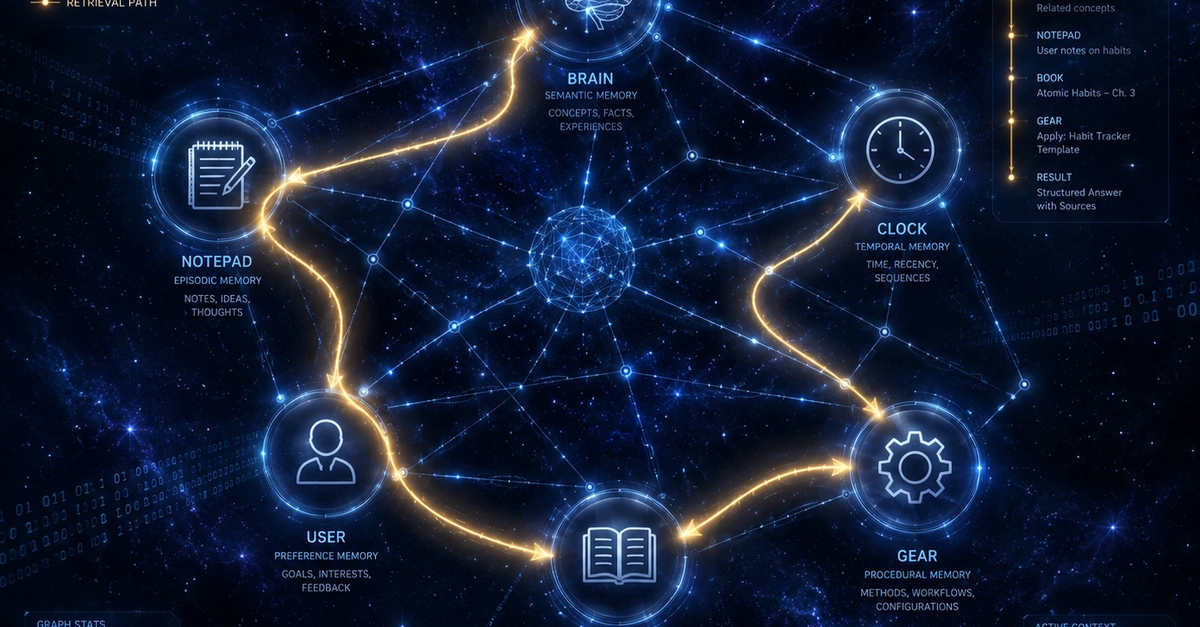
Now, let’s talk turkey – the providers themselves. We’re looking at eight distinct options, each a flavor of persistent AI consciousness. Hindsight, a local-first powerhouse, couples its free PostgreSQL daemon with a knowledge graph and reflective synthesis, offering top-tier accuracy, especially when paired with models like Gemini-3 (a cool 91.4% on LongMemEval). Holographic offers an intriguing zero-dependency SQLite solution using HRR algebra and trust scoring – perfect for air-gapped environments. OpenViking, AGPL-licensed and self-hosted, boasts tiered loading for hefty token savings, a boon for cost-conscious teams. Mem0, a cloud-based freemium option, leans on server-side LLM extraction for quick setup. Honcho, with its paid cloud or free self-hosted tiers, dive into dialectic user modeling for multi-agent scenarios. ByteRover presents a human-readable Markdown knowledge tree. RetainDB, a paid cloud service, aims for production-grade search with hybrid vector and BM25 recall. Finally, SuperMemory, cloud-focused, integrates with your browser for web research workflows.
It’s clear that Hindsight is the current retrieval accuracy champion, but the landscape is constantly shifting. The choice isn’t just about raw performance; it’s about architecture and intent.
Hindsight: The All-Around Champion for Local Accuracy
Hindsight stands out as the go-to for most users craving local control and pinpoint accuracy. It doesn’t just store text; it crafts a structured knowledge graph, cataloging discrete facts, named entities, and their complex relationships. Its secret sauce? The hindsight_reflect tool, which periodically synthesizes higher-level insights from across all memories. Imagine your AI building its own evolving mental model of your projects and your world. Setup is a breeze: hermes memory setup selects Hindsight, and you can opt for a local daemon or cloud deployment. While local is free with a PostgreSQL dependency, cloud options cater to teams. The tools hindsight_recall, hindsight_retain, and hindsight_reflect are your interface to this powerful system.
The Air-Gapped AI Dream: Holographic’s Zero-Dependency Approach
Holographic is an absolute revelation for anyone who despises external dependencies or operates in restricted environments. Seriously, nothing leaves your machine with this one. It use Holographic Reduced Representations (HRR) – think memories as superposed complex-valued vectors – where recall is an algebraic process, not a fuzzy similarity match. Crucially, it incorporates a trust-scoring mechanism: confirmed memories gain weight, while contradicted ones fade. Setup is laughably simple: select Holographic during hermes memory setup, and that’s it. No API keys, no fuss. It comes with a minimalist toolset and operates entirely locally via SQLite, making it free and utterly self-contained. Best if you’re in an air-gapped setup, allergic to dependencies, or want an AI that can genuinely learn what’s trustworthy.
OpenViking: The Token-Saving, Self-Hosted Powerhouse
For teams looking to optimize costs and maintain granular control, OpenViking presents a compelling case. This ByteDance-developed database employs a filesystem-style hierarchy with tiered loading, promising substantial token savings – a critical factor when dealing with large context windows. Its self-hosted nature, under the AGPL license, makes it a prime candidate for organizations prioritizing data sovereignty. The architecture is built for efficiency, allowing the AI to load only the most relevant memory segments, thereby reducing the computational overhead and the token count sent to the LLM.
There’s a palpable architectural shift underway in the AI tooling space. We’re moving from ephemeral, session-bound AI assistants to persistent, evolving entities. These memory providers aren’t just add-ons; they’re fundamental components that redefine the agent’s capabilities, enabling deeper understanding, more nuanced interactions, and truly personalized AI companions. The question isn’t if you’ll need external memory for your AI tools, but which architecture best suits your unique needs.
🧬 Related Insights
- Read more: Grafana’s AI Sidekick Eyes Your Private Business Metrics—Secure Enough?
- Read more: EU Tech Stack Under €10/Month: Bootstrapper’s Dream?
Frequently Asked Questions
What does Hermes built-in memory actually store?
Hermes built-in memory stores agent’s notes (MEMORY.md) and user profile information (USER.md) within its system prompt at the start of each session. This includes learned facts, conventions, preferences, and communication styles.
Can I use multiple external memory providers at once?
No, only one external memory provider can be active at a time in Hermes. These providers augment, rather than replace, the built-in memory.
Which Hermes memory provider offers the best retrieval accuracy?
Based on the LongMemEval scores provided, Hindsight currently leads in retrieval accuracy with 91.4% for Gemini-3 and 89.0% for an Open-source 120B model. However, other providers may excel in different aspects like speed, privacy, or specific architectural features.