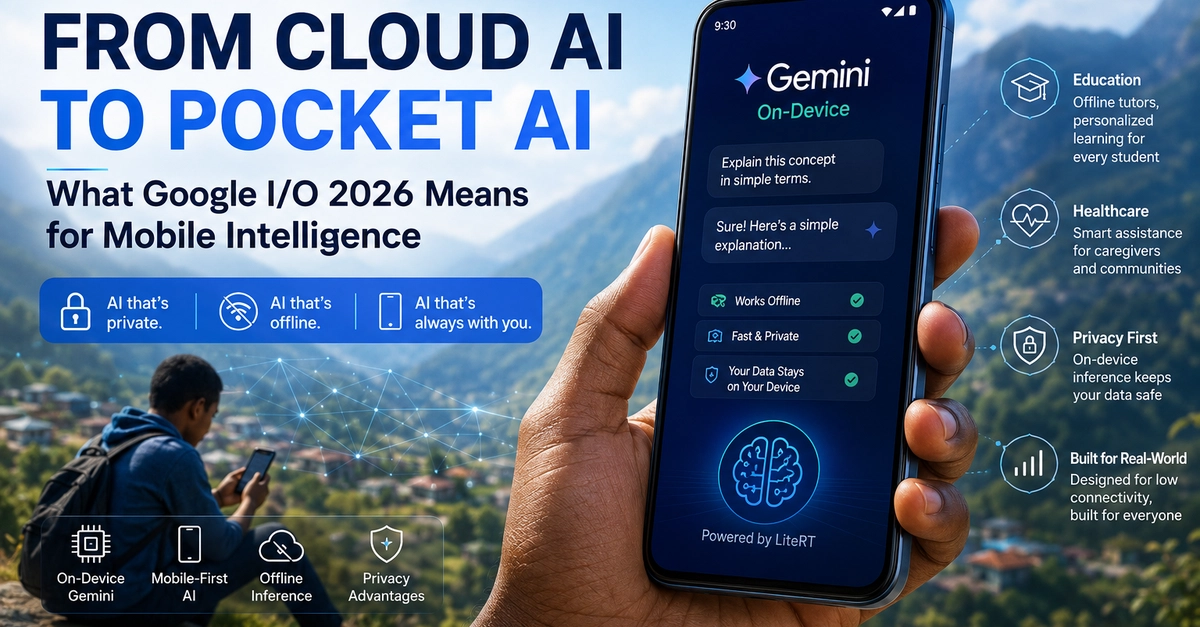
So, here we are, another Google I/O, and the air is thick with the usual pronouncements. But amidst the confetti and keynote buzzwords, something genuinely interesting — and potentially tectonic — is brewing. They’re talking about AI, of course, but not the kind that lives in some hulking data center miles away, requiring a stable Wi-Fi connection and a small fortune in API calls. No, this is about AI moving into your pocket. Locally. Privately. Instantly.
For years, the narrative has been singular: AI is a cloud thing. You type, the server thinks, a response lands. It’s how we got here, sure, but it also cemented a dangerous assumption: AI needs the internet. Badly.
But after sifting through the Google I/O 2026 announcements, and having spent two decades watching Silicon Valley chase its tail, I can’t shake this feeling: the real AI revolution isn’t going to be about bigger, fatter models hogging server space. It’s going to be about smarter, leaner models that live right on our phones.
This isn’t just about convenience, folks. It’s about access. It’s about what happens when intelligence isn’t tethered to a constant, often unreliable, internet connection. Think education in remote villages. Think healthcare diagnostics for community workers. Think accessibility for those who can’t afford constant data plans.
As someone who’s been poking around with offline-first AI systems, exploring the wilder shores of LocalMind and LiteRT-powered ideas, Google’s relentless push with Gemini’s ecosystem suddenly clicks into a bigger picture. They’re not just building a better chatbot; they’re charting a course for smartphones to become genuine intelligent companions. Forget portals to the internet; your phone might just become the brain.
What’s the big deal? Cloud AI is great, until it isn’t. We’ve all been there: buffering screens, dropped connections, the sheer frustration of needing a simple answer and getting… nothing. Cloud dependence means relying on stable internet, continuous API access, subscription costs, low-latency connections, and a cloud infrastructure that’s always on. This works fine if you’re in a tech hub café, but the world, as it turns out, isn’t always so accommodating.
For billions of people, that smartphone isn’t a secondary device; it’s the primary computing platform. It’s the classroom, the doctor’s office, the bank. Forcing these users to depend on a cloud that’s slow, expensive, or simply unavailable is, frankly, a disservice. This is why the real, albeit quiet, conversation emerging from Google I/O 2026 is about mobile-first AI.
An AI that runs locally is an entirely different beast. It’s faster, it’s more private (because your data isn’t necessarily zipping off to a server farm), and it’s dramatically more accessible. The difference between phone → internet → cloud → response and phone → response is monumental, especially when you’re on the go.
This is the core of edge AI: performing inference directly on the device. Instead of offloading everything, the intelligence stays put. I’ve found this fascinating while experimenting with LiteRT-powered local intelligence. Sure, these smaller, optimized models might not boast the sheer parameter count of their cloud-bound cousins. But they unlock something far more valuable: availability.
A slightly less powerful model that works everywhere often trumps a bleeding-edge model that only works somewhere. This is particularly potent for those on the fringes: students with limited resources, community health workers in rural areas, field workers, even small clinics trying to stretch their budgets.
Let’s talk education. Many AI educational tools assume a strong, always-on internet, a modern laptop, and a healthy subscription fee. But for countless learners, their only gateway to knowledge is a smartphone. What if AI tutors could work offline? Imagine a student being able to explain science concepts, generate quizzes, or translate learning materials without needing a connection. This is the kind of world that fuels my thinking around systems like LocalMind – designing AI for reality, not just ideal conditions. It’s a subtle shift, but for underserved communities, it’s a game-changer.
And then there’s healthcare. Beyond the big hospital systems, mobile intelligence opens up the possibility of community-level healthcare assistance. Imagine a community health worker in a remote area being able to use an AI-powered tool on their phone to help diagnose basic conditions, track patient data locally, or access medical information – all without a signal. This isn’t science fiction; it’s the logical next step when you untether intelligence from the cloud.
Google’s direction with Gemini’s broader ecosystem suggests they’re embracing this. They’re weaving AI into devices, workflows, and everyday interactions. The future feels less like “open chatbot” and more like “my device just gets it.” Your phone already knows your apps, your schedule, your preferences, your language, even your habits. Add local intelligence to that contextual awareness, and suddenly, your smartphone isn’t just a portal; it’s a partner.
Of course, I’m a skeptic. The AI race has historically been about sheer power – more parameters, more compute, bigger benchmarks. This shift to on-device AI is a different kind of race, one that prioritizes utility and accessibility. It’s a race against the limitations of our current infrastructure, and for the billions who live outside the digital ideal, it’s the most important race of all.
There’s still a long way to go, and the perennial question of who actually makes money here will always linger. But if Google can deliver on the promise of truly capable, locally running AI, then maybe, just maybe, the future of intelligence isn’t in the sky, but right here, in our hands.
The AI race often focuses on one thing: bigger models. More parameters. More compute. More benchmarks. But after experimenting with lightweight AI workflows and thinking about offline-first systems, I believe another question matters just as much: How useful is AI when the internet disappears?
Why This Matters for Developers
For us coders, this isn’t just a consumer-level shift. It means rethinking how we build. We’re talking about optimizing models for constrained environments, exploring new frameworks for on-device inference, and designing user experiences that use local context. It’s a call to arms for developers interested in edge AI and creating genuinely inclusive technologies. Forget the cloud-only mindset; the future is distributed.
Will My Phone Actually Run This?
This is the million-dollar question, isn’t it? Google’s push with Gemini and their focus on efficient models suggests that future flagship devices, and likely even some mid-range ones, will have dedicated hardware to handle on-device AI. Think of it like the evolution of graphics cards or dedicated AI chips. It won’t be instantaneous for every app, but the trajectory is clear: phones are becoming mini-supercomputers.
🧬 Related Insights
- Read more: Google AI Studio: Free Full-Stack Apps for Everyone [No CC Required]
- Read more: Terraform Azure ML Workspaces: Ditch the Portal, Provision Like a Pro
Frequently Asked Questions
What does Google’s ‘Pocket AI’ mean? It means AI models running directly on your smartphone or other mobile devices, rather than relying on cloud servers. This offers faster speeds, better privacy, and offline functionality.
Is this different from existing AI apps on my phone? Yes. While some apps use cloud AI, ‘Pocket AI’ refers to AI processes that happen entirely on your device, making them independent of internet connectivity.
Will this improve battery life or drain it faster? Optimized on-device AI should ideally improve battery life by reducing the need to constantly send data to the cloud. However, early implementations might have varied results, and intensive AI tasks will naturally consume power.