When did the planet start running a fever, and more importantly, why is it suddenly spiking?
We’ve all felt the incremental creep of warmer summers and more volatile weather patterns. But a recent, startling analysis suggests that the gradual warming we’ve been monitoring has actually been accelerating, and at a pace that’s deeply concerning. Prior to 2013-14, the Earth was steadily warming at a rate of about 0.18°C per decade. Since then? The mercury has seemingly jumped, with temperatures now climbing at a clip of roughly 0.36°C per decade. That’s a doubling, folks. And it’s a number that jolts the already anxious climate conversation into a new, more urgent register.
This isn’t just about abstract degrees on a thermometer; it’s about the real-world consequences. If this accelerated rate holds, the long-feared 1.5°C threshold set by the Paris Agreement could be breached as early as 2028. For those tracking climate models, that’s startlingly soon. Stefan Rahmstorf, a lead author on the analysis from the University of Potsdam, emphasizes the gravity of each fraction of a degree: “Every tenth of a degree matters and makes the impact of global warming worse in terms of extreme weather events, in terms of ecosystem impacts, also the risk of crossing tipping points.” The very fact that the planet is doing the opposite of what the world is striving for — that it’s accelerating — is, as Rahmstorf puts it, “of great concern.”
The Debate: Natural Cycles or Human Impact?
For much of 2023, scientists wrestled with a critical question: was the string of record-hot years a sign of genuine acceleration, or just the noisy output of natural climate phenomena like El Niño? El Niño, a naturally occurring ocean-atmosphere pattern, can indeed supercharge global temperatures temporarily. Rahmstorf and statistician Grant Foster’s work, however, claims to be the first to provide statistically significant evidence—at 98% confidence—that the acceleration is indeed due to climate change itself, not just random variability.
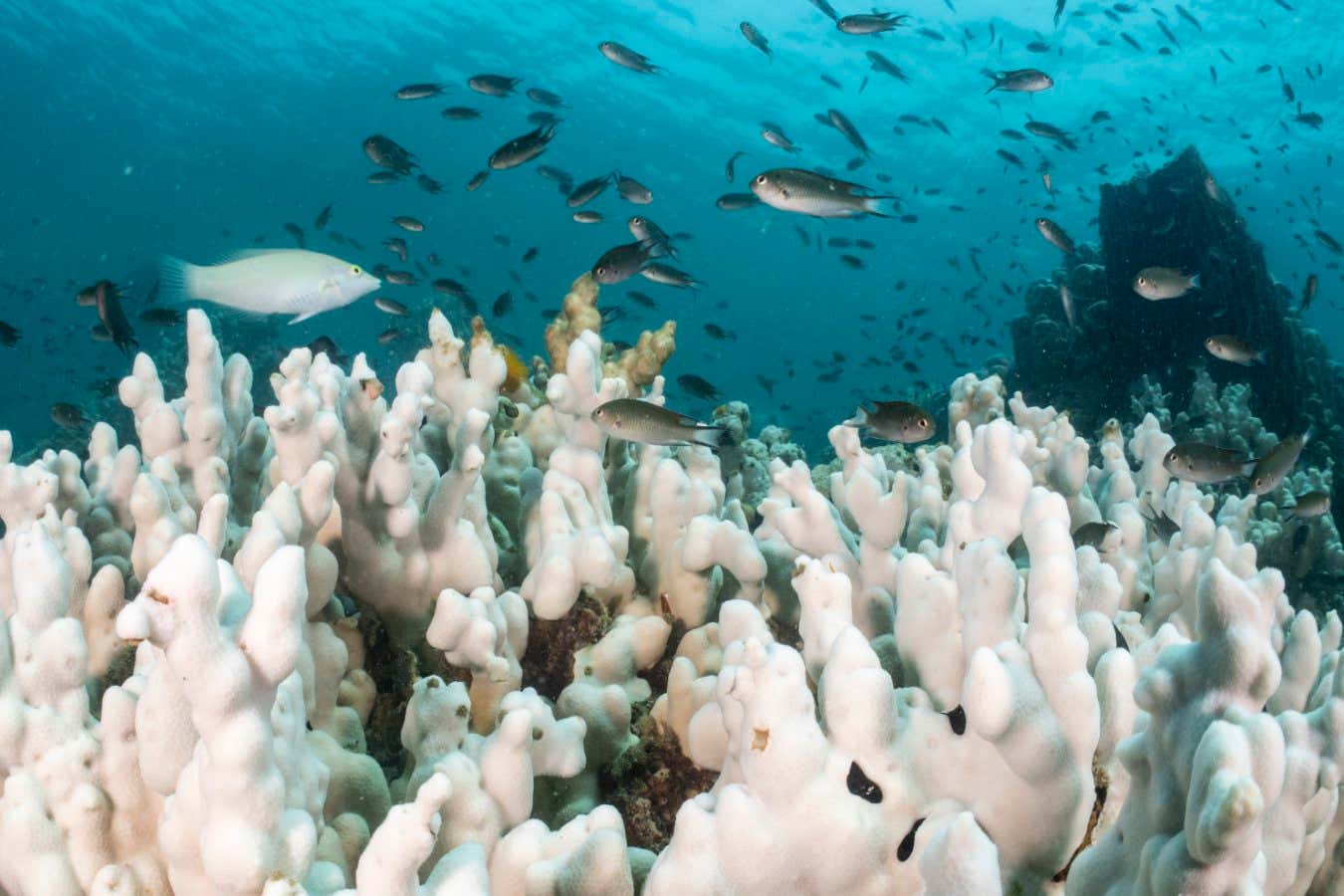
Their analysis, which crunched data from five distinct global temperature datasets, even suggests that based on one particular dataset (from the European Centre for Medium-Range Weather Forecasts), the 1.5°C mark could be hit this year, when looking at a 20-year average. That’s a stark figure when you consider what breaching 1.5°C portends: the collapse of warm-water coral reefs, the irreversible melt of Greenland and West Antarctic ice sheets, and the potential dieback of the Amazon rainforest. These aren’t distant future threats; they’re rapidly approaching cliff edges.
The Hidden Hand: Shipping Emissions and Aerosols
So, what could be driving this newfound acceleration? The leading hypothesis points to a drastic reduction in sulfur dioxide (SO2) emissions from shipping that began in 2020. While SO2 is a potent air pollutant harmful to human health, it also acts as a sort of atmospheric sunscreen, forming aerosols that reflect sunlight back into space and exert a cooling effect on the planet. When these emissions were curbed, the reflective haze thinned, allowing more solar radiation to reach the surface. It’s a classic case of an unintended, planet-scale geoengineering experiment gone into reverse.
Will this accelerated warming persist? Rahmstorf offers a nuanced outlook. He suggests that while further aerosol reductions will occur as the world continues its transition away from fossil fuels, they likely won’t be as rapid as the shipping-related cuts. This could mean that the rate of warming might actually decrease in the coming decade. It’s a fascinating, almost counter-intuitive idea: as we clean up pollution that was masking warming, we might see a brief pause in the acceleration itself, even as overall warming continues.
Why This Matters: A Shift in the Architectural Blueprint of Climate Change
The implication here goes beyond mere temperature readings. It’s about understanding the underlying architectural shifts in how our planet’s climate system is responding. For years, the narrative has been one of consistent, albeit alarming, linear warming. This new data suggests a more complex, perhaps even exponential, phase is upon us. It forces a re-evaluation of our predictive models, our mitigation strategies, and our understanding of climate sensitivity.
What’s particularly interesting is the debate around the residual effects of El Niño, volcanic eruptions, and solar cycles. Zeke Hausfather of Berkeley Earth points out that while Rahmstorf and Foster’s study offers compelling proof of acceleration, it’s challenging to completely disentangle these natural influences. This means the precise degree of acceleration might be slightly overestimated. Yet, even with that caveat, the core finding holds: warming has quickened. “The broader takeaway is that we have strong evidence for acceleration even if we don’t know precisely how much the rate of warming has increased as of yet,” Hausfather acknowledges. “We will need to wait a few more years to get more data.” That waiting period feels increasingly fraught with urgency.
This isn’t just about adding another data point to the climate crisis; it’s about recognizing a potential phase transition. The planet’s fever isn’t just rising; it might be breaking out into a run, demanding a far more aggressive and immediate response than previously planned. The time for incremental adjustments may be rapidly closing.
“The world, apart from the US, is trying to halt global warming, reduce it, and that’s why the fact that it’s now actually doing the opposite, accelerating, is of great concern.”
This rapid acceleration underscores a crucial point: our models and our understanding of Earth systems are still evolving. What was considered a stable, albeit dangerous, trajectory might have just taken a sharp, upward turn. It’s a stark reminder that Earth’s climate is not a static system, and our interventions—or lack thereof—can trigger cascading effects we’re only beginning to comprehend.
🧬 Related Insights
- Read more: ESP32 Spotify Display’s Clever Cloudflare Backbone: Secure, Shared, and Surprisingly Efficient
- Read more: ‘I Built’ Posts Get a Factory: Meet the Builder That’s Standardizing Brags
Frequently Asked Questions
What does the study say about the speed of global warming?
The study indicates global warming has accelerated and is now happening twice as fast as in previous decades, approximately 0.36°C per decade since 2013-14, compared to about 0.18°C per decade prior.
Could this acceleration mean we hit the 1.5°C limit sooner?
Yes, if warming continues at this accelerated rate, the analysis suggests humanity could breach the Paris Agreement’s goal of limiting warming to 1.5°C significantly sooner than other research has projected, potentially as early as 2028.
What caused this acceleration?
The primary suspected cause is a significant reduction in sulfur dioxide emissions from shipping starting in 2020. These emissions previously formed aerosols that masked some of the warming by reflecting sunlight.