Everyone braced for AI to automate the rote, the repetitive. We figured it would churn out boilerplate code, draft dry reports, maybe even schedule meetings. But the whispers from the trenches, the ones that truly excite the futurists among us? They’re talking about AI not just assisting but architecting. And that’s precisely what’s happening with the latest iteration of InfraSketch.
This isn’t just another AI chatbot spitting out pretty diagrams. This is a platform shift. Think of it: designing a scalable affiliate marketing system. It’s not some trivial to-do list item. We’re talking about tracking thousands of partners, validating referrals, juggling multi-tier commissions, and waging a constant war against fraud, all while wrestling with attribution headaches when a customer clicks link A, then link B, then buys. Get it wrong, and your business bleeds money or alienates its entire partner base.
Previously, this was the stuff of architects hunched over whiteboards, drawing complex, interlocking boxes that felt more like a Rube Goldberg machine than a functional system. You had your tracking layer, your attribution layer, your commission engine, your fraud detection — a delicate dance of interconnected components. Each piece had to be considered, its dependencies understood, its potential failure points mapped out. It was painstaking work.
The ‘Nervous System’ of Affiliate Marketing, On Demand
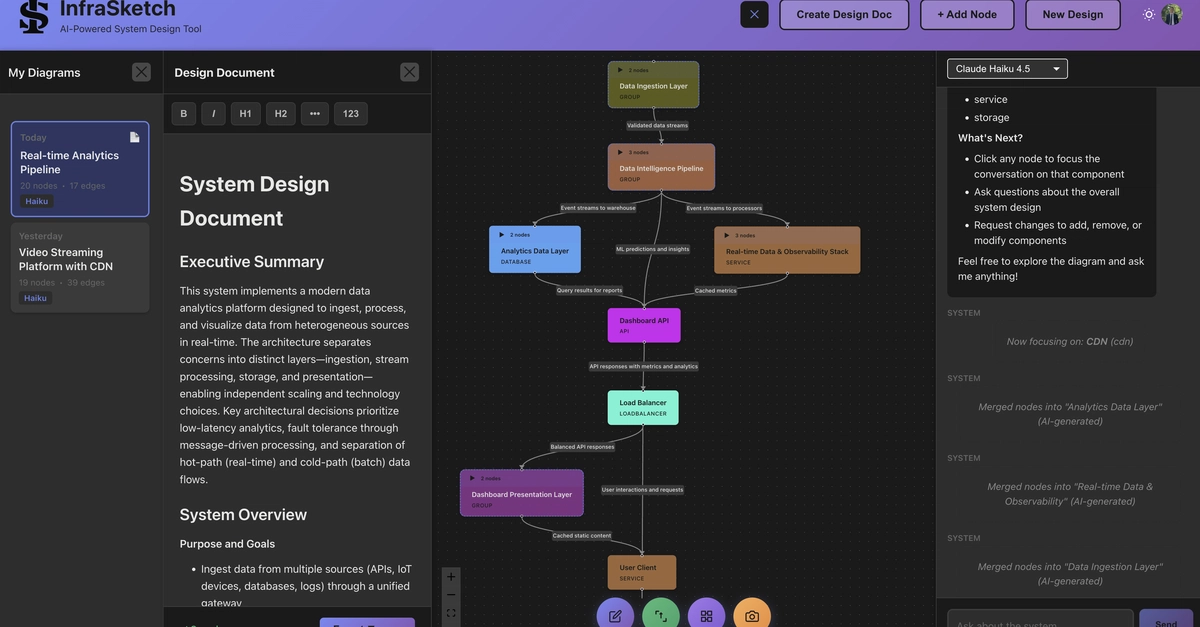
Now? InfraSketch’s AI, with its latest update, takes that entire blueprint — the tracking and attribution layer, the customer journey mapping, the complex commission and validation logic, the payout orchestration — and renders it. In seconds. It’s like handing a seasoned architect a blank sheet and saying, ‘Build me a skyscraper, but make it an affiliate marketing system, and do it by lunch.’ And the AI just… does it. It’s fascinating.
Each affiliate gets unique tracking identifiers embedded in shortened URLs or query parameters. When a customer clicks a link, a tracking service records the interaction with timestamps, device information, and session data. This layer acts as the nervous system of the platform, capturing every touchpoint a customer has with affiliate content.
This is the core of the magic. The AI isn’t just drawing boxes; it’s understanding the function. It grasps that a tracking layer needs unique IDs, that click data needs timestamps, that attribution is about more than just the last click. It understands the need for an audit trail, for a ledger, for a system that can handle multi-currency payouts and keep immutable records. It’s translating the complex requirements of affiliate marketing into a coherent, professional architecture diagram and even a design document.
Why Does This Matter for Developers?
The implications here are staggering. For years, we’ve talked about AI as a tool. Now, it’s starting to feel like a collaborator. Imagine a junior developer needing to understand how an affiliate system works. Instead of weeks poring over documentation or shadowing a senior engineer, they can describe their needs to InfraSketch and get a fully fleshed-out system design. It’s an unparalleled learning accelerator.
And for the seasoned pros? This is about productivity on an exponential scale. Architects can iterate on designs at lightning speed. Instead of spending half a day drawing out a proposal, they can generate a baseline design, then spend their valuable time refining the edge cases, optimizing the performance, and challenging the AI’s assumptions — which, let’s be honest, is where the real innovation happens.
This feels like the early days of cloud computing, or the dawn of containerization. A fundamental platform shift. It’s going to change the very nature of software design. We’re moving from crafting every single brick to curating and directing the construction crew. The emphasis shifts from manual construction to intelligent oversight and advanced customization.
The Human Element in an AI-Designed World
Now, is this going to replace human architects? Absolutely not. Think of it like this: a calculator didn’t replace mathematicians; it freed them up to tackle more complex problems. Similarly, AI-driven design tools won’t replace engineers; they’ll elevate them. The focus will shift from the drudgery of drawing boxes to the higher-order thinking required to define what those boxes should do and why. The ability to ask the right questions, to challenge the generated designs, and to inject nuanced business logic will become paramount.
InfraSketch is presenting this as part of their 365-day system design challenge. Their pitch? “The best way to deepen your understanding of affiliate platforms is to design one yourself.” And with this AI, that design process is now accessible to everyone, instantaneously. It’s a democratizing force in the world of complex system design.
This move by InfraSketch is more than just a new feature; it’s a loud declaration that AI is ready to move beyond simple assistance and into the realm of genuine architectural creation. It’s exciting, it’s a little bit terrifying, and it’s undeniably the future unfolding before our eyes.
🧬 Related Insights
- Read more: 107 MCP Calculator Downloads: The Quiet Signal of AI Workflow Evolution
- Read more: AisthOS: The OS That Compiles Raw Sensors Upward to Fuel Starving AI Models
Frequently Asked Questions
What does InfraSketch’s AI actually do? InfraSketch’s AI takes plain English descriptions of system requirements and automatically generates professional architecture diagrams and design documents. This new update specifically excels at designing complex systems like affiliate marketing platforms.
Will this AI replace software architects? No, it’s unlikely to replace human architects. Instead, it’s expected to augment their capabilities, automating the initial design phase and freeing up architects to focus on higher-level problem-solving, refinement, and strategic decision-making.
How can I try this AI system design tool? You can try the InfraSketch platform by describing your desired system in plain English on their website, as part of their 365-day system design challenge.