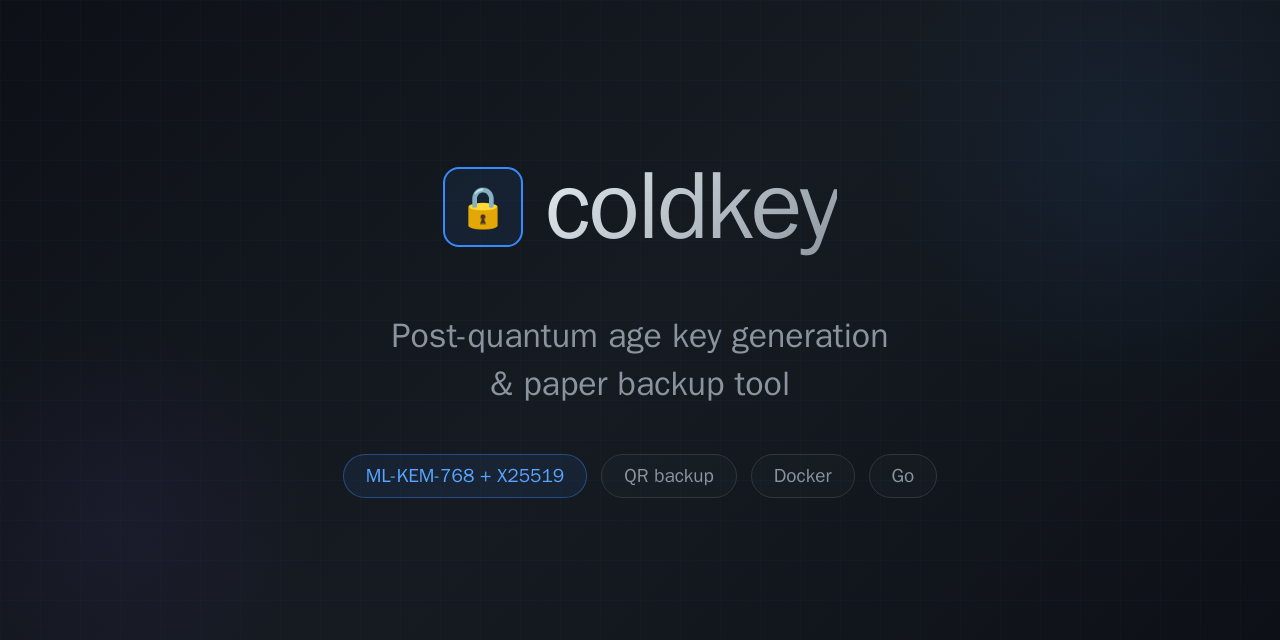
So, here’s the deal: your encryption keys are one drive failure away from total, irreversible loss. If you’re using tools like age or sops to lock down your secrets, misplacing that private key means you’re locked out. Forever. Pretty grim, right? That’s the hook, anyway, for a new tool called Coldkey.
This little utility pitches itself as a savior for the post-quantum era, churning out age keys that are supposedly resistant to future quantum computing threats, and — here’s the kicker — generating a single-page, printable HTML backup complete with QR codes. Print it, laminate it, bury it in a vault. The idea is your data survives even if every digital copy goes kaput. Sounds like sci-fi, but the underlying problem is all too real for anyone hoarding sensitive data.
Is This Just Another Shiny Toy?
Look, I’ve seen enough shiny new crypto toys come and go in my 20 years covering this circus. Every few years, a new standard rolls out, promising ultimate security. ML-KEM-768 and X25519 are the current darlings. Coldkey’s selling point is that it bundles this forward-looking cryptography with a decidedly analog fallback. In a world obsessed with the cloud, the idea of a paper backup is almost quaint, isn’t it? Almost… but also, perhaps, incredibly smart.
Coldkey is available via Homebrew, or if you’re a Go dev, a quick go install gets you going. They’ve also got Docker images. The commands are pretty straightforward. coldkey generate kicks off the process, and coldkey backup lets you create that paper trail from an existing key file. No mystery there. The real magic, if there is any, lies in the how.
The Devil’s in the (Security) Details
This is where my skepticism kicks into high gear. They tout a laundry list of security hardening flags for their Docker containers: network isolation, read-only filesystems, dropped capabilities. They even mlockall to prevent key material from hitting swap. All good things, naturally. You want your key generation process to be as air-gapped and hermetically sealed as possible, even if you’re running it locally.
All
just docker-*commands include security hardening flags (network isolation, read-only filesystem, dropped capabilities).
But then you hit the Go Garbage Collector (GC) caveat. Here’s the messy human part: Go strings are immutable. This means that even if secure.Zero() tries to wipe key material from a []byte buffer, earlier copies might still be lurking in memory, waiting for the GC to do its thing. It’s not a total crypto guarantee, they admit, more of a defense-in-depth approach. For a tool that’s supposed to be your digital doomsday device, that’s a rather… fuzzy assurance. Is it better than nothing? Sure. Is it good enough for your life’s secrets? That’s the million-dollar question, isn’t it?
Paper Backups: Genius or Guacamole?
Let’s talk about the paper backup. The HTML output includes the raw key text, QR codes (yes, multiple if needed, stitched together with a COLDKEY:part/total:data framing), a checksum, and recovery instructions. It’s designed to be printed, laminated, and stashed away. This is where Coldkey shines, or at least tries to. The sheer volume of data that can be encoded into a QR code, especially when you split it across multiple scans, is pretty impressive. A single QR code can hold a decent chunk of data, and they’ve packed it in. The idea of being able to restore your entire digital life from a few printed pages, assuming you kept them safe and legible, is compelling.
But let’s be honest. How many of us are actually going to print this, laminate it, store it in a fireproof safe, and remember where it is when disaster strikes? My bet is a lot fewer than will download the tool. It’s the digital equivalent of writing down your password on a sticky note and slapping it on your monitor. Convenient, yes. Secure? Not exactly. We’re talking about data that, if lost, means everything is gone. This isn’t your Netflix password; this is your financial records, your personal journals, your incriminating evidence.
Who is Actually Making Money Here?
This is always my final question. Coldkey is open-source, MIT licensed. The developers — Pike00 on GitHub — are not overtly selling anything. This looks like a passion project, a solution to a problem they personally faced or observed. And that’s great. The world needs more people building tools to solve real problems. But in the long run, for something this critical, relying on the benevolence of open-source maintainers for your ultimate digital safety net… well, it makes me nervous. How do you ensure longevity? How do you fund ongoing development and security audits? Will this still be supported in 5, 10, 20 years when quantum computers do become a practical threat?
Maybe the real money is in the services around this. If paper backups become the next big thing for paranoid data hoarders, you could see a market for secure printing services, specialized laminators, or even vault storage. Or perhaps, more cynically, this is just a stepping stone for the developers into building more enterprise-focused solutions down the line. For now, it’s free. And that’s both its greatest strength and its most glaring weakness.
The Bottom Line
Coldkey tackles a genuine, terrifying problem with a clever, albeit analog, solution. Post-quantum readiness and resilient backups are no longer niche concerns. The tool’s design, prioritizing security in its generation process, is commendable. But the lingering questions about Go’s GC and the human element of actually using a paper backup mean it’s not a magic bullet. It’s a tool, a very good one perhaps, but it requires diligence. Extreme diligence. The kind most of us struggle with daily. Is it better than losing your keys? Absolutely. Is it the final answer? I doubt it. But for now, it’s a damn good start for the truly paranoid among us.
Key Takeaways:
- Coldkey offers post-quantum
agekey generation and printable HTML backups with QR codes. - The tool incorporates security hardening features, especially in its Docker implementation.
- Concerns remain regarding Go’s garbage collector and potential persistence of key material in memory.
- Paper backups are a viable but potentially cumbersome method for long-term data resilience.
**
🧬 Related Insights
- Read more: Browser Tools That Let You Build Manga Without Dropping $50 on Software
- Read more: Zero Dollars to Track Cattle Prices Forever: Git as a Temporal Database via GitHub Actions
Frequently Asked Questions**
What does Coldkey actually do? Coldkey generates encryption keys resistant to future quantum computers and creates a printable HTML page with QR codes as a backup of your key.
Will this protect me from quantum computers? It generates keys using algorithms designed to be resistant to known quantum computing attacks, but the effectiveness depends on the ongoing evolution of quantum computing and cryptographic research.
Is the paper backup method secure? The paper backup is as secure as you make it. It’s printed and stored securely, protected from digital threats, but vulnerable to physical damage or loss if not handled with extreme care. The key material itself is secured during generation by the tool’s design.