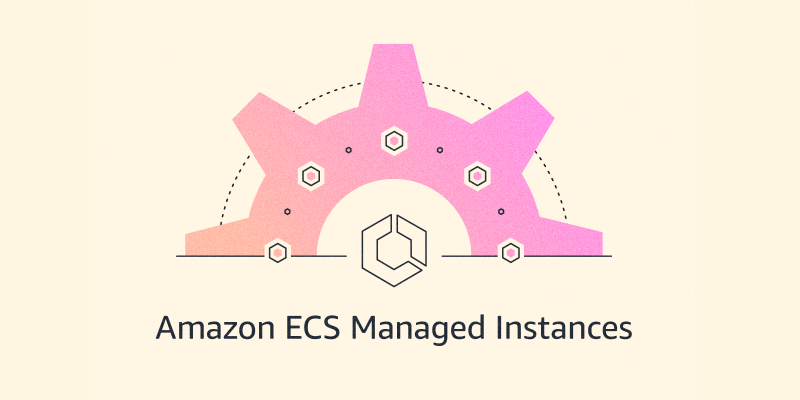
So, Amazon ECS is rolling out what they’re calling “managed daemon support” for their managed instances. For the uninitiated — and let’s be honest, most of you scrolling through tech news probably are — this means they’ve cooked up a way for platform engineers to shove monitoring, logging, and tracing agents onto servers without having to beg application developers to update their Frankenstein-like task definitions. Sounds lovely, right? Like a warm cup of coffee on a Tuesday morning. Or, you know, another way for Amazon to exert more control and potentially generate more revenue down the line.
Here’s the thing: For years, running anything at scale on AWS, particularly with ECS, has been a delicate dance. Platform folks are juggling infrastructure, patching, scaling, and making sure all those critical little bits of software — the agents that tell you if your system is on fire or just smoldering gently — are actually running. And historically, updating one of these agents was a nightmare. It wasn’t just a quick tweak; it was a full-blown project requiring coordination across teams, fiddling with task definitions (those complex blueprints for your containers), and then redeploying everything. Imagine trying to change a tire while the car is doing 80 mph on the freeway. That’s essentially what they’re claiming to fix here.
Decoupling the Daemons: A Platform Engineer’s Dream or Just More Jargon?
Amazon’s pitch is simple: a “dedicated managed daemons construct.” This means platform teams can now centrally manage these operational tools. They can deploy and update agents independently. No more begging application developers. Crucially, they’re guaranteeing these daemons start before your actual application tasks and drain last. The idea is that your logging, tracing, and monitoring are always there, humming along, ready to catch your application’s every cough and sputter.
This offers a level of flexibility that, frankly, has been missing. Platform engineers can push these agents across multiple capacity providers or target specific ones. They can define CPU and memory parameters for these daemons separately from the application’s needs. No more rebuilding Amazon Machine Images (AMIs) or messing with task definitions just to adjust agent resources. And the big win they’re touting? Each instance runs just one copy of the daemon, shared across multiple application tasks. This sounds like a genuine step towards resource optimization, which, in this economy, is always a welcome sight.
Trying It Out: My First Foray into the Daemon’s Den
Naturally, I had to kick the tires. The announcement suggests using the Amazon CloudWatch Agent as a first step. I spun up an ECS cluster with a Managed Instance capacity provider, as one does, following their (presumably well-written) documentation. The console, they claim, now sports a new “Daemon task definitions” option. I navigated there, clicked “Create new daemon task definition,” and configured the CloudWatch Agent with a modest 1 vCPU and 0.5 GB of memory. I gave it a name I wouldn’t forget, selected the ecsTaskExecutionRole (standard fare), and pasted in the container image URI: public.ecr.aws/cloudwatch-agent/cloudwatch-agent:latest. Hit create. Easy peasy.
Then, to the Clusters page, selected my cluster, and found the new “Daemons” tab. Clicked “Create daemon.” Selected my task definition, gave the daemon a name, and chose the ECS Managed Instances capacity provider I’d set up. Boom. Done. ECS is supposed to handle the rest: launching the daemon task first on every provisioned instance in that capacity provider.
To test this, I deployed a simple Nginx web service. And lo and behold, the CloudWatch Agent daemon appeared alongside it. No manual intervention, just as advertised. The real test, though, is updates. They claim ECS handles rolling deployments automatically: provisioning new instances with the updated daemon, starting it first, migrating application tasks, and then terminating the old ones. This “start before stop” dance is supposed to ensure zero gaps in data collection during updates. The drain percentage setting apparently lets you control the pace. This sounds… good. Like, actually good. If it works as described, it’s a significant improvement.
The Real Question: Who’s Actually Making Money Here?
This is where my cynical old brain kicks in. Amazon loves to simplify things for its customers, but let’s not forget the underlying motive: lock-in and driving usage of their services. By making it easier to manage agents within ECS, they’re further entrenching users into their ecosystem. These agents often feed data back to AWS services (like CloudWatch, naturally). The more smoothly these agents integrate, the more data flows into AWS, and the more AWS services you’re likely to use. It’s a classic symbiotic relationship, with Amazon holding the much larger symbiote end.
Think about it: managing these daemons, even with this new feature, still requires an understanding of ECS, AWS networking, IAM roles, and so on. It’s not magic; it’s just a more structured way of doing something that was previously chaotic. The platform engineers are still on the hook for managing the infrastructure and the agents. But now, the tooling is more streamlined. This likely translates to better utilization of existing AWS resources (which is good for the customer’s bottom line) but also potentially drives adoption of higher-tier ECS features or increased CloudWatch usage (which is good for Amazon’s.
This move feels like Amazon addressing a legitimate pain point, but in a way that also reinforces their platform’s sticky nature. It’s not necessarily a bad thing, but it’s important to see the forest for the trees. They’re not just giving away freebies; they’re optimizing their own platform and making it more indispensable.
Is This the End of Infrastructure Ops Headaches?
It’s a bold claim to say it’ll eliminate headaches. But does it significantly reduce them? Yes, potentially. The ability to manage agent lifecycles independently, without deep coordination with application teams, is a huge operational win. It means faster deployments, fewer opportunities for misconfiguration due to cross-team miscommunication, and more consistent observability across your fleet. The “start before stop” guarantee for updates is particularly compelling for ensuring continuous monitoring during critical maintenance windows. It’s the kind of feature that, when it works, makes you wonder how you ever lived without it.
Why Does This Matter for Developers?
For application developers, this should mean less disruption. The days of your carefully crafted task definition being held hostage by a routine agent update might be numbered. You can focus on your application code, while the platform team handles the underlying infrastructure tooling. It’s a division of labor that makes sense, allowing each team to play to its strengths.
🧬 Related Insights
- Read more: Niantic Spatial’s Bold Bet: Mapping the Offline 80% Economy AI Ignores
- Read more: Zero Dollars to SEO Hero: Prerendering My React SPA on AWS Without the Bill
Frequently Asked Questions
What do Amazon ECS managed daemons actually do?
They allow platform engineers to manage essential software agents like monitoring, logging, and tracing tools on Amazon ECS instances independently of application deployments.
Will this replace my job as a platform engineer?
No, it streamlines your job by simplifying agent management, but you’ll still be responsible for overall infrastructure and operational tooling strategy.
How is this different from running agents as regular ECS tasks?
Managed daemons are specifically designed to run on the host instance, ensuring they start before application tasks and are managed as a core part of the instance lifecycle, offering better guarantees for essential services.