AI interviews: The new frontier.
Look, the writing’s been on the wall (or rather, the code repository) for a while now. We’re not talking about some distant sci-fi scenario; the coding interview is actively being rewritten, right here, right now. Giants like Meta and Google, along with countless other organizations, are opening the floodgates, allowing candidates to bring their AI copilots to the technical interview table. The numbers don’t lie: a staggering 91% of engineers are already embedding AI into their daily workflows, and a massive 75% have shipped AI-generated production code in the last six months alone. On platforms like CoderPad, over 35,000 AI-assisted interviews have already transpired. This isn’t just an adjustment; it’s a fundamental platform shift, and the interview is finally, blessedly, catching up to the reality of the job.
Why Does This Matter for Developers?
Here’s the twist, the bit that usually gets glossed over in the breathless pronouncements of AI’s ubiquity: when everyone has access to the same AI magic wand, code generation itself becomes less of a differentiator and more of a baseline expectation. It’s like everyone suddenly getting a calculator; the advanced math skills aren’t about doing the calculation anymore, but about understanding what to calculate and interpreting the result. The real test, the differentiator, now lies in the realms AI can’t easily replicate. We’re talking about sharp judgment, rigorous verification, understanding complex tradeoffs, and, perhaps most importantly, crystal-clear communication. These are the human elements that elevate good code to great systems.
I’ve navigated these waters from both sides of the keyboard – as the candidate and as the interviewer – and the pattern is undeniably clear. The candidates who shine are those who cultivate a “think first, prompt second” mentality. They treat the AI as a powerful, but fallible, assistant. The strongest signal of competence? It’s in the verification – the candidate’s ability to spot and correct the AI’s inevitable missteps. Prompting AI for everything and then going silent while the code appears is a one-way ticket to failure; it screams a lack of understanding. Conversely, showing selective, strategic AI usage demonstrates a level of confidence and critical thinking that using it ubiquitously can obscure. In fact, a chilling 71% of engineering leaders are already reporting that AI is making technical skills harder to assess, not easier. The job is morphing from pure code creation into something far more nuanced.
The Engineer as Editor-in-Chief
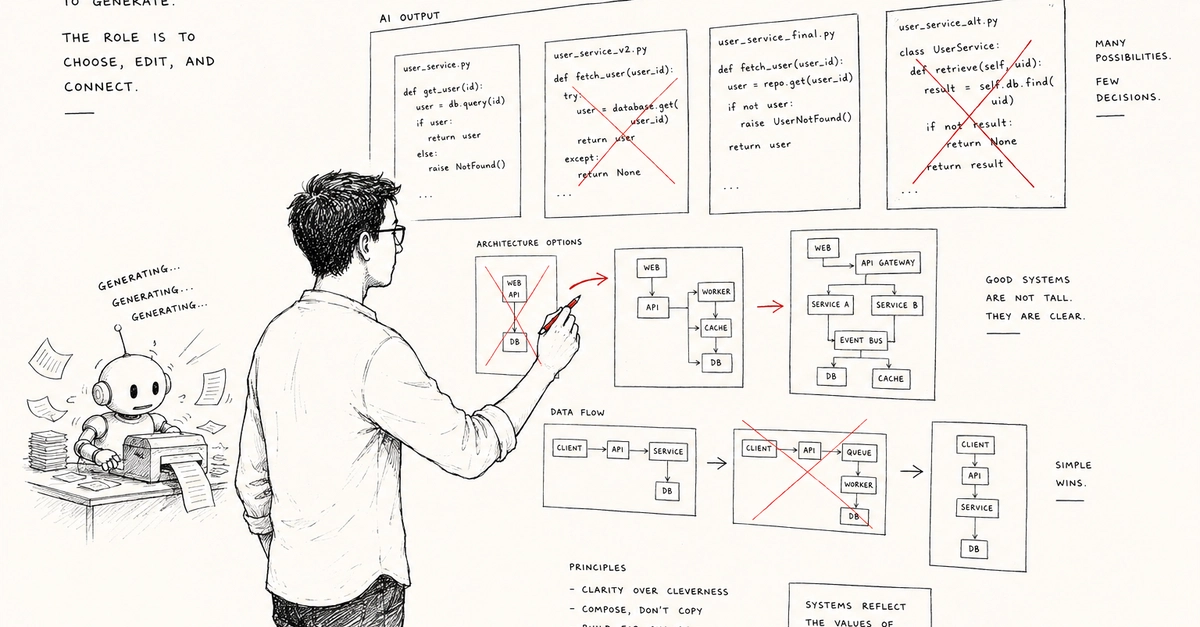
This evolution means the engineer’s role is fundamentally shifting. We’re moving from being pure code writers to becoming the editors-in-chief of our digital creations. And let’s be honest: editing – the discerning eye for what’s truly good, what’s subtly wrong, and what’s glaringly absent – is a beast of a different color. It requires a depth of understanding, a critical metacognition about the code, that transcends simply knowing how to generate syntactically correct lines. It’s the difference between knowing how to form letters and knowing how to craft a compelling narrative. AI can help with the former; it’s the latter where human expertise truly shines.
Think of it like this: you’re building a skyscraper. AI can whip up the blueprints and pour the concrete faster than ever before. But it’s the architect who understands soil stability, the structural engineer who foresees wind shear impacts, and the project manager who orchestrates it all who truly build the enduring edifice. The interview process is catching up, and it’s prioritizing that higher-level thinking. It’s testing your capacity to guide, to question, and to ultimately own the output, AI or no AI.
The interview isn’t testing whether you can code. It’s testing whether you can think.
This isn’t just a minor tweak to the hiring process; it’s a seismic event, signaling a move towards assessing a candidate’s cognitive architecture rather than just their syntactic fluency. Companies are looking for problem-solvers who can wield AI as a powerful tool, not just users who can parrot generated code. The future of technical hiring is about demonstrating mastery over the why and the how of code, with AI serving as a powerful accelerator for the what. It’s a thrilling, if somewhat daunting, prospect for everyone involved.
🧬 Related Insights
- Read more: 5 Phases to Migrate On-Prem Load Balancers to Google Cloud ALB
- Read more: AI’s Forgotten Logic: Will Step-by-Step Reasoning Finally Dethrone Pattern-Matching Hype?
Frequently Asked Questions
What does this mean for entry-level developers?
It means a greater emphasis on foundational understanding and problem-solving skills. While AI can generate code, it can’t replicate the years of experience needed to intuitively grasp complex system design or anticipate subtle bugs. Focus on strong analytical abilities and clear communication.
Will AI replace human coders entirely?
No. AI is a powerful tool that will augment human capabilities, much like compilers or IDEs did before. The demand will shift towards roles that require critical thinking, system design, AI oversight, and complex problem-solving, areas where human intelligence remains paramount.
How can I prepare for these new AI-assisted interviews?
Practice thinking through problems before you start coding. Learn to critically evaluate AI-generated code, identify potential errors, and articulate your reasoning for any changes you make. Focus on demonstrating your understanding of underlying principles and your ability to make sound technical judgments.