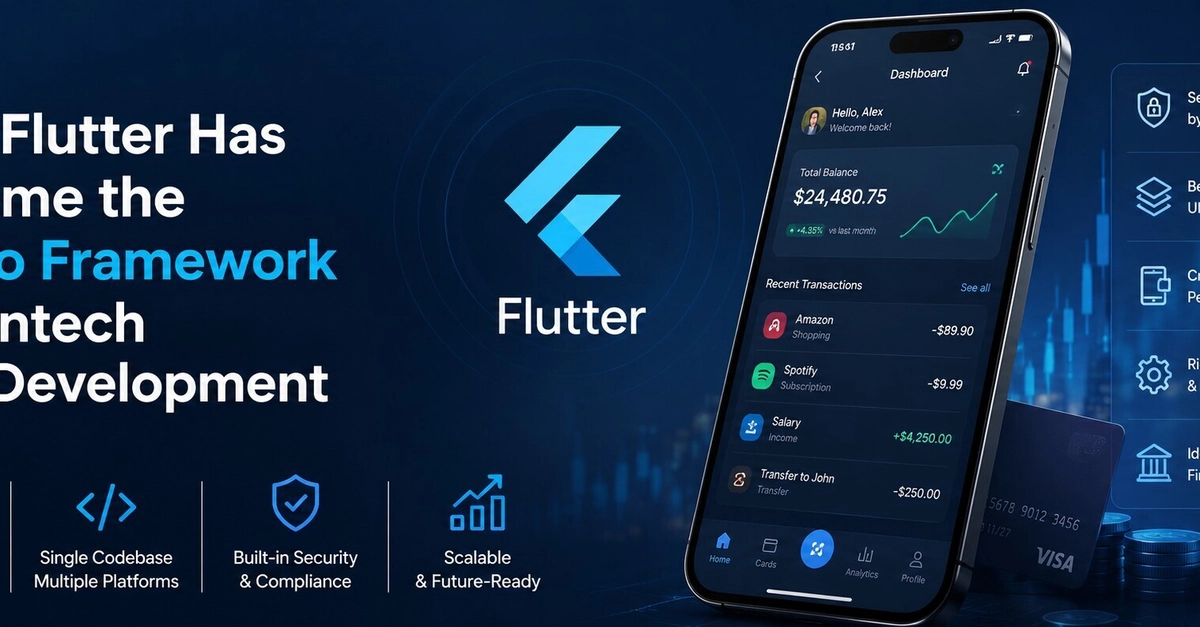
Flutter is the fintech framework.
Africa’s fintech market is on a tear, projected to balloon 13x by 2030. We’re talking about a continent that already handles the lion’s share of global mobile money transactions. This isn’t some nascent market; it’s a full-blown digital gold rush, with digital payments alone expected to top $40 billion by 2026, facilitating over $830 billion annually across 500 million accounts. And guess where every single one of those transactions happens? Mobile apps. The startups and banks building these critical pieces of financial infrastructure are increasingly betting on Flutter, and it’s not driven by vaporware.
This move to Flutter isn’t about chasing shiny new objects; it’s a calculated, pragmatic choice to tackle the core challenges in fintech development: speed, cost-efficiency, security, and the ability to scale at lightning pace. Companies aren’t just building apps; they’re building trust in high-stakes financial interactions, and Flutter offers a path to do that reliably.
Why Flutter for Fintech? The Nuts and Bolts
Flutter, Google’s open-source UI toolkit, lets developers craft cross-platform mobile applications using a single codebase written in Dart. Its secret sauce lies in its high-performance graphics engine, which means buttery-smooth animations and a consistent, polished look and feel, no matter the device. For financial services, where user trust is paramount and every pixel matters during a money transfer or a loan application, this visual fidelity and responsiveness aren’t just nice-to-haves; they’re table stakes. A clunky interface here isn’t just bad UX; it’s a potential trust killer.
Speed That Matches Africa’s Explosive Growth
Africa’s fintech landscape is a high-growth environment. We’re seeing a 38% compound annual growth rate for the sector between 2021 and 2025, fueled by mobile money adoption and a surge of startup funding—$3.2 billion in total, with Africa raising $857 million in 2024 alone, even amidst global funding slowdowns. Startups can’t afford to dawdle. Flutter’s hot reload feature and its inherent cross-platform capability slash development cycles. Instead of months, you’re talking about MVPs in weeks. This agility is invaluable when you’re trying to capture market share and iterate rapidly based on user feedback or competitor moves. Imagine not having to coordinate two separate iOS and Android teams, each wrestling with platform-specific quirks. Flutter lets teams focus on feature innovation instead of getting bogged down in native code differences.
The Economic Equation: Less Cost, More Output
Let’s talk numbers. Building native apps for both Android and iOS typically means doubling your development team, doubling your quality assurance efforts, and, you guessed it, doubling your maintenance budget. Flutter throws that math out the window. With a single codebase, you get a single app that runs everywhere. This isn’t just about consolidating costs; it’s about accelerating time-to-market. Every week saved in development translates directly into a competitive edge and faster revenue generation. For African fintech startups, where every dollar of investor capital is scrutinized, this efficiency isn’t a luxury; it’s fundamental to survival and growth. The broader MENA fintech sector is on track for a colossal $103.65 billion by 2033, growing at a 21.42% CAGR. Flutter helps players in this space get there faster and cheaper.
Security: The Bedrock, Not an Afterthought
In fintech, security isn’t a bolt-on feature; it’s the very foundation upon which everything else is built. Every line of code, every decision from user authentication to data storage, must adhere to stringent security protocols without impeding user experience or development velocity. Flutter’s ability to use native platform security features—think biometrics, secure keychains, encrypted communications, and integrations with sophisticated fraud detection systems—is a significant advantage. Coupled with its support for strong encryption libraries that safeguard data both in transit and at rest, Flutter provides a secure environment for sensitive financial transactions. This is especially critical in key African markets like Kenya, Nigeria, and South Africa, where regulatory bodies are increasingly tightening compliance requirements for digital finance.
Handling Updates Without Breaking a Sweat
Fintech products are living entities. Regulations shift, pricing models evolve, and security vulnerabilities demand immediate patching. In 2026, the expectation is continuous evolution, with compliance mandates, pricing tweaks, and security updates becoming routine. Flutter’s unified codebase streamlines this process dramatically. Updates can be integrated into a single, coherent release pipeline, sidestepping the complex coordination required for separate platform deployments. Projections show that by the end of 2026, over 70% of financial services organizations will favor cross-platform development precisely for this reason—ensuring uniform performance across all user touchpoints. Flutter is right at the heart of this industry-wide shift.
The Proof Is in the Product
Flutter isn’t some experimental framework championed by a few early adopters. Some of the biggest names in fintech are already running on it. Nubank, for example, one of the world’s largest digital banks, leaned on Flutter as it scaled at breakneck speed. Facing challenges with developer velocity and maintaining a consistent user experience across its rapidly expanding user base, Nubank found Flutter to be a key enabler of its growth. When a company of that scale adopts a technology to manage its critical customer-facing applications, it’s a strong signal to the market.
Why Does This Matter for African Fintech?
The explosive growth in African fintech isn’t just a statistic; it’s a proof to unmet needs being addressed by innovation. Mobile money, digital payments, and lending platforms are transforming lives and economies across the continent. The choice of development framework directly impacts how quickly these solutions can be built, deployed, and iterated upon. Flutter’s ability to accelerate development, reduce costs, and ensure a secure, high-quality user experience makes it an almost indispensable tool for startups aiming to capitalize on this immense opportunity. Without efficient, cost-effective development tools, the speed required to compete and innovate in such a dynamic market would be unachievable for many. It’s a pragmatic choice for a pragmatic, fast-moving market.
🧬 Related Insights
- Read more: Browser Tools That Let You Build Manga Without Dropping $50 on Software
- Read more: READMEs Reimagined: readmegen Automates Docs
Frequently Asked Questions
What does Flutter actually do for fintech apps? Flutter builds cross-platform mobile apps from a single codebase, offering fast performance, consistent UI, and enabling quicker development cycles which are crucial for fintech.
Is Flutter secure enough for financial applications? Yes, Flutter can be secure for fintech by leveraging native platform security features, encryption libraries, and adhering to best practices for secure development.
Will Flutter replace native iOS and Android development for fintech? While Flutter offers significant advantages for cross-platform development, native development may still be preferred for highly specialized or performance-critical applications where platform-specific optimizations are paramount. However, for many fintech use cases, Flutter provides a compelling alternative.