Passwords are dead.
We all know it. Your users know it. Yet here we are, still dutifully hashing and salting like it’s the aughts. The future is passwordless. And it’s not knocking; it’s kicking down the door.
But the road to WebAuthn is paved with complexity. Challenges, assertions, public-key cryptography, the browser alphabet soup—it’s enough to make a developer weep into their IDE. Until, that is, someone builds a package.
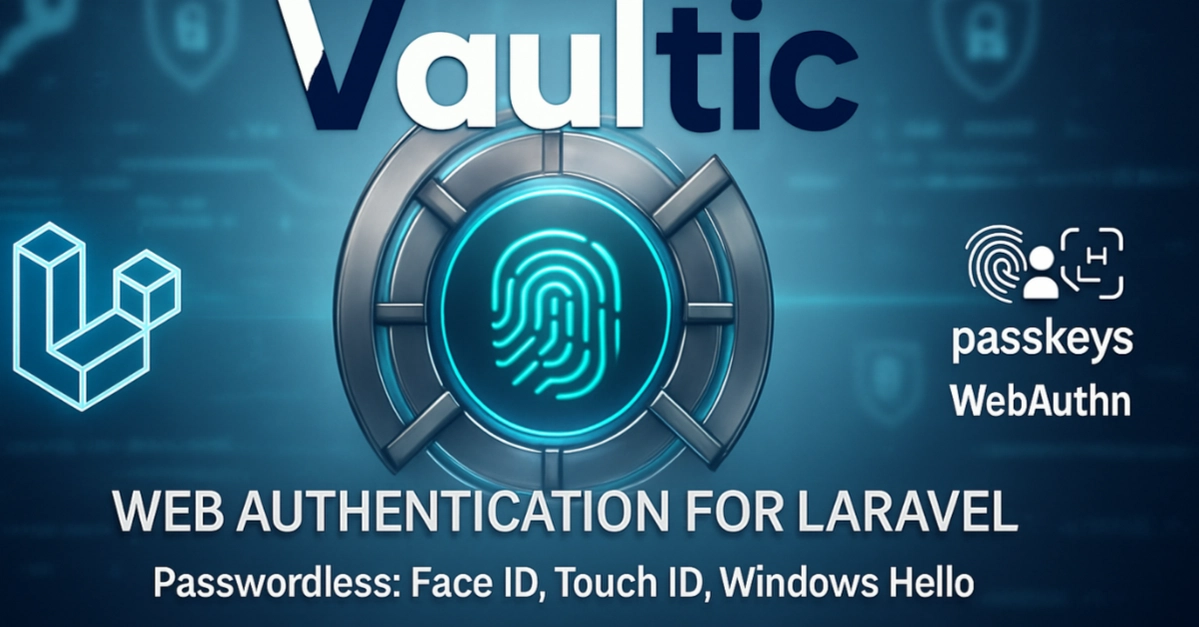
Meet Vaultic. A production-ready WebAuthn/Passkeys package for Laravel. They claim it makes passwordless auth as simple as <a href="/tag/composer/">composer</a> require. No joke.
The Password Problem, Magnified
Why are we still here? Because passwords are a dumpster fire. They’re susceptible to phishing. Users reuse them like bad habits. Data breaches are a weekly event – 33 billion passwords leaked in 2024 alone. Support costs for password resets are astronomical. And let’s not even start on the user experience.
Vaultic lists the woes:
- Phishing: Users fall for fake prompts.
- Reuse: One password, a hundred sites.
- Breaches: Billions compromised.
- Support Costs: Time wasted on resets.
- UX Pain: Nobody likes remembering more nonsense.
Their solution? A suite of benefits that sound… good.
- Phishing-proof.
- Biometric-first.
- Lightning fast.
- Cryptographically secure.
- Universal support.
This sounds less like a feature list and more like the cure for the common cold. Companies adopting passkeys, they say, see 50% fewer password reset tickets, 90% faster logins, near-zero phishing, and happier users. Sounds about right.
Vaultic: The Rails for Passkeys?
Vaultic’s core proposition is simple: it abstracts away the WebAuthn insanity. Think of it as the Rails framework for passkeys. You don’t write the low-level crypto; you just ship.
The package boasts a laundry list of features:
- Multi-guard support (web + API).
- Stateful + stateless flows.
- Pre-built Blade components.
- Activity tracking.
- Fallback authentication.
- Laravel Sanctum integration.
- Zero configuration needed.
- Custom WebAuthn verifier.
- Comprehensive tests.
- Battle-tested (19+ releases).
It’s a bold claim. Installing is standard fare:
composer require hamzi/vaultic
Then, a few vendor:publish commands and a migration:
php artisan vendor:publish --provider="Hamzi\Vaultic\VaulticServiceProvider" --tag=vaultic-config
php artisan vendor:publish --provider="Hamzi\Vaultic\VaulticServiceProvider" --tag=vaultic-migrations
php artisan vendor:publish --provider="Hamzi\Vaultic\VaulticServiceProvider" --tag=vaultic-views
php artisan migrate
Integration into Blade views is where the magic supposedly happens:
<x-vaultic::passkey-button size="md" :full-width="true" />
This single component should enable registration and login via Face ID, Touch ID, Windows Hello, or security keys. No deep WebAuthn expertise required. That’s the sales pitch, anyway.
Architecture and API Harmony
Under the hood, Vaultic touts a clean, layered architecture: HTTP Layer, Service Layer (for orchestration), Repository Layer (for persistence), and Eloquent Models. Standard stuff, really. But the devil is in the details, and Vaultic claims to handle both web UIs (Blade) and APIs (Sanctum) from a single package. The configuration for this multi-guard support seems strong:
// config/vaultic.php
'auth' => [
    'guards' => [
        // 🌐 Web Login
        'web' => [
            'guard' => 'web',
            'provider_model' => App\Models\User::class,
            'identifier_column' => 'email',
        ],
        // 📱 API Auth
        'api' => [
            'guard' => 'sanctum',
            'provider_model' => App\Models\User::class,
            'identifier_column' => 'email',
            'token_issuer' => Hamzi\Vaultic\Services\SanctumApiTokenIssuer::class,
        ],
    ],
],
The described flow — a web user tapping a passkey button for a session, or a mobile client sending a public key for a Sanctum token — using the same passkey database is where the real value lies for developers. It avoids duplication and, crucially, complexity.
User Control and Security Fortifications
User management for passkeys is handled via a <x-vaultic::passkey-panel /> component. This offers transparency: a list of linked authenticators, last used timestamp, IP address, and a simple delete option for lost devices. Transparency builds trust, a novel concept in security.
Vaultic also taps into Laravel’s event system for security events. Users can listen for PasskeyRegistered, PasskeyAuthenticated, and AuthenticationFailed events, allowing for granular logging and alerting. This is a welcome touch for proactive security monitoring.
The core idea is to make secure, modern authentication accessible without forcing developers to become cryptography experts. Vaultic aims to be the standard for passwordless adoption in the Laravel ecosystem.
Brute force protection is built-in, with configurable rate limiting (10 attempts in 60 seconds). And for those edge cases where passkeys fail—lost devices, unsupported browsers—a fallback driver (password, OTP, or custom) is available. This hybrid approach is pragmatic, acknowledging that a complete switch might not be immediate.
This isn’t just about adding a feature; it’s about future-proofing. The persistent reliance on passwords is a ticking time bomb. Solutions like Vaultic, if they deliver on their promise, are not just convenient; they are essential.