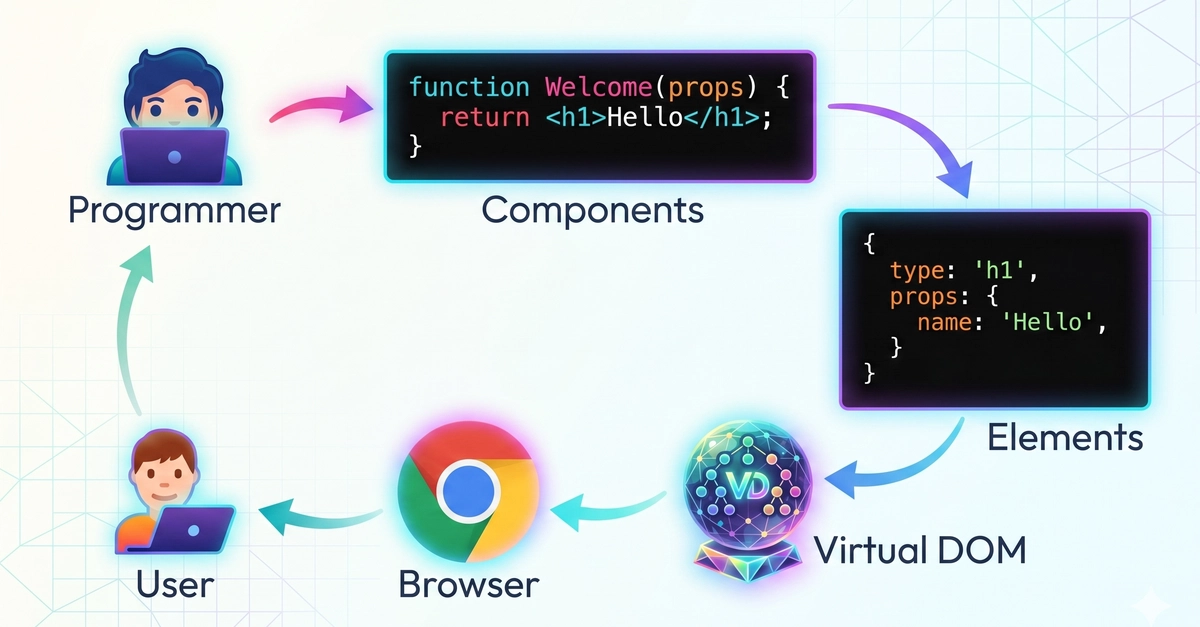
And then the developer writes code. Mountains of it. Hoping, praying, that somehow magic will occur, and a functional UI will spring forth from the ether. That’s the initial dream, isn’t it? You slap together some JSX, sprinkle in some state here and there, and poof! A dynamic web application. Except it’s not poof. It’s a meticulously orchestrated dance, a choreography of JavaScript objects and memory updates that, frankly, gets a bad rap for being a “black box.” Let’s be clear: it’s not a black box. It’s just a series of steps, and if you’re still fumbling with React rendering, maybe you skipped a few notes.
Here’s the thing. The diagram shows a flowchart. Developer writes components. Components return JSX. JSX converts to elements. Elements build a Virtual DOM. Virtual DOM diffs. Real DOM updates. Browser displays. It’s neat. It’s tidy. It’s entirely insufficient if you’re actually trying to build something beyond a simple to-do list.
Why Does This Matter For Developers?
Look, anyone can type out that diagram. The real question is, what does it mean when your app is sluggish? When that state update feels like it’s taking an eternity? When a seemingly innocuous change causes a cascade of re-renders that melt your CPU? That’s when understanding the “what happens internally when a component renders” becomes less academic and more, well, survival.
React’s core brilliance, the thing that earned it its stripes, is its Virtual DOM. It’s a clever abstraction. Instead of poking directly at the browser’s sluggish, often inconsistent DOM, React builds a lightweight, in-memory representation. Think of it as a blueprint. When something changes – a prop, a piece of state – React doesn’t redraw the whole damn house. It updates the blueprint, then meticulously compares the old blueprint to the new one.
After finding the differences: React updates only the changed parts in the Real DOM.
This “diffing” or “reconciliation” process is where the perceived magic happens. It’s efficient. It’s precise. But it also has overhead. Every single component re-render, whether triggered by state, props, or even a parent re-render, initiates this cycle. And if you’re not careful, you’ll find yourself creating those old virtual DOMs and new virtual DOMs unnecessarily, like a busy architect redrawing entire rooms for a single misplaced nail.
Think of the early days of web development, when JavaScript was a brute force instrument. Direct DOM manipulation. It was painful. It was slow. React smoothed that out. But now, with hooks and complex state management, the potential for performance pitfalls has, ironically, grown. It’s no longer enough to just write components and trust the system. You need to know when and why things are re-rendering.
Is React’s Rendering Actually Better Than Alternatives?
It’s better than the mess that preceded it. It’s a massive improvement over manual DOM manipulation. But is it some divine intervention? No. Angular has its own change detection. Vue has its own reactivity system. They all grapple with the same fundamental problem: how to efficiently update a UI based on changing data. React’s approach – the declarative JSX, the Virtual DOM, the reconciliation algorithm – has proven incredibly popular and effective. But popularity doesn’t absolve you from understanding its mechanics.
When you see something like this:
function MyComponent({ data }) {
  // ... some logic ...
  return (
    <div>
      {data.map(item => (
        <p key={item.id}>{item.name}</p>
      ))}
    </div>
  );
}
You might think, “Easy peasy.” But if data changes even slightly, all the paragraphs are conceptually re-rendered by React. The key prop is absolutely vital here. Without it, React would struggle to identify which specific <p> tag needs updating, potentially tearing down and rebuilding the whole list. That’s the kind of detail the simple diagram glosses over.
Ultimately, understanding React’s rendering flow isn’t just about passing an interview question. It’s about writing code that doesn’t make your users’ browsers weep. It’s about optimizing, about debugging, about not falling into the trap of thinking React is some all-knowing oracle. It’s a tool, and like any tool, its effectiveness depends entirely on the craftsman wielding it.
🧬 Related Insights
- Read more: One Docker Command Dumps Your Postgres DB — Here’s Why It’s Non-Negotiable Now
- Read more: pgEdge’s MCP Server: Why AI Agents Need More Than Just Postgres APIs
Frequently Asked Questions
What does the Virtual DOM actually do?
It’s a lightweight, in-memory representation of the browser’s DOM. React uses it to quickly compare changes and determine what needs to be updated in the actual DOM, improving performance.
Will I ever need to touch the Real DOM directly in React?
Almost never. React is designed to manage DOM updates. Direct manipulation usually indicates a misunderstanding of React’s lifecycle or a need for a more advanced pattern.
How does state change affect rendering?
When a component’s state changes, React triggers a re-render of that component and its children. This process then kicks off the diffing and reconciliation cycle to update the UI efficiently.