Your next enterprise demo just got a lot steamier. Or not. Because when a developer drops the Teapot™ Enterprise Brewing Platform into the wild, it’s not about brewing tea—it’s about brewing laughter at the soul-crushing rituals of Big Tech software.
Devs everywhere—those late-night coders wrestling APIs that promise the moon but deliver migraines—now have a new patron saint of satire. This April Fools’ project enforces RFC 2324, the 1998 joke protocol demanding HTTP 418 “I’m a teapot” for any brew request. Real people? They’re the ones giggling over coffee (actual coffee) while realizing their production codebase might be just as pointless.
Look.
It scales. Perfectly. To reject you.
Why Mock a 25-Year-Old Teapot Joke Now?
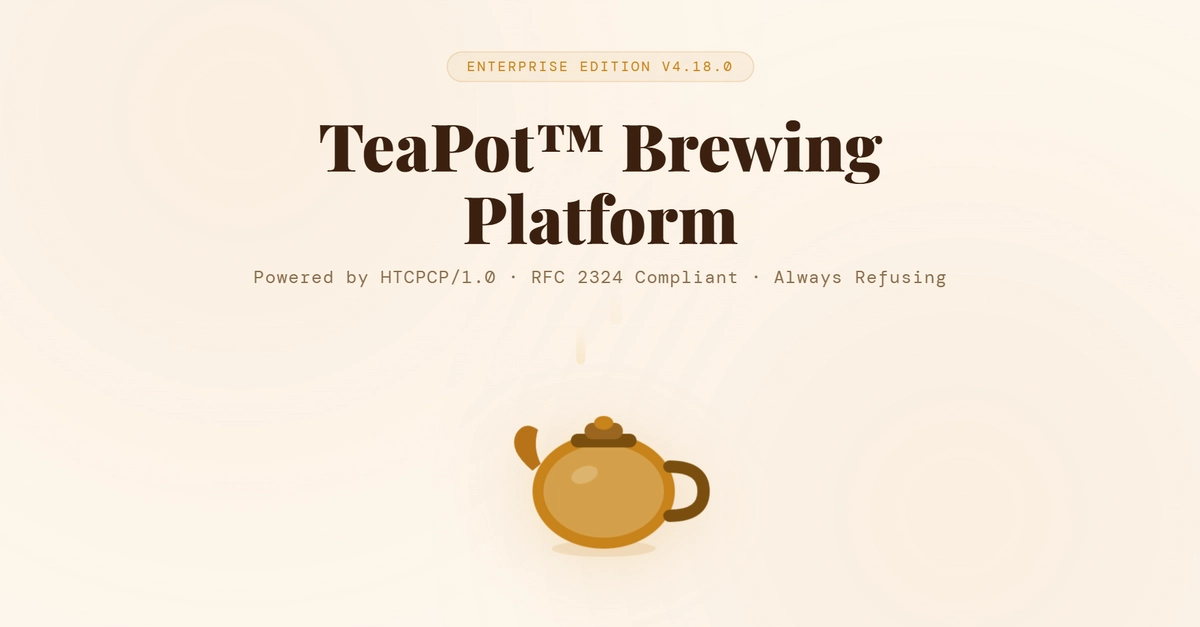
RFC 2324 hit the wires as Larry Masinter’s April Fools’ prank—Hyper Text Coffee Pot Control Protocol, a mock standard for remote teapot domination. Fast-forward to 2024, and some genius rebuilds it as NestJS perfection. Why? Because enterprise stacks have bloated into parody. Remember when software solved problems? Now it’s observability on top of rate-limiting for failures that never succeed.
The creator—anonymous hero of the DEV April Fools’ Challenge—didn’t half-ass it. Backend? Strict TypeScript, Winston logging (for what, teapot tears?), OpenTelemetry tracing every doomed request. Throttler caps you at three pleas per minute: “The kettle needs time to cool down.” Frontend? Vanilla HTML/CSS/JS with custom SVGs of a smug animated teapot. Sliders for temp and sugar? They wink: “Does nothing. Sorry.”
Welcome to the Teapot Service. This highly scalable, flawlessly engineered NestJS application is responsible for managing the teapot infrastructure of our enterprise architecture.
That’s the README. Pure gold.
Swagger docs at /docs polish the turd into a premium SaaS mirage. Multi-step “validation”—“Consulting the Geneva Convention…”—before the inevitable 418. It’s a mirror held to Kubernetes clusters humming for empty CRUD ops.
But here’s my dig—the one nobody’s saying. This isn’t just fun; it’s a stealth critique of vendor lock-in theater. Real vendors peddle “scalable refusal engines” daily: auth proxies that block 99% traffic, dashboards tracking ghost metrics. Teapot™? It admits the scam upfront. Bold prediction: this spawns a meme repo template. Next April, every dev team’s shipping their own “Enterprise Widget Fail-O-Matic.”
How’d They Pull Off Premium Uselessness?
NestJS standardizes the rejection symphony. Config-driven rate limits—TTL 60 seconds, limit 3—mock SRE playbooks. Observability? Because why not trace a teapot’s existential crisis?
Frontend steals the show. Playfair Display headlines scream luxury; DM Mono codes the lie. CSS transitions animate the pot as it—poof—refuses. No React bloat. Just raw web mocking a $10k/month dashboard.
Wander into the GitHub repo. npm install, npm run start:dev, hit localhost:4180/docs. Boom. Enterprise disciplinary action awaits tea-thieves.
Short para for rhythm.
And the UX flow? Masterful cruelty. Pick tea type (irrelevant). Tweak sliders (ignored). Fake loading spinners. Then—418, with flair. It’s the dev equivalent of a mic drop on Jira tickets.
Does Enterprise Dev Really Need This Wake-Up?
Yes. Desperately.
We’ve all shipped it: microservices for hello-world, Helm charts for static files. Teapot™ exposes the architecture fetish—“flawlessly engineered” for null. Historical parallel? Remember Pets vs. Cattle? This is Teapots vs. Reality. Larry Masinter’s gag warned us; we ignored it for VC-fueled vaporware.
The PR spin? None here—it’s self-aware. “Ode to Larry Masinter,” submits the maker. Antigravity AI helped commits, but VSCode still wins. Experience? “Good,” they say. Understatement.
Punchy truth: in a world of Copilot hallucinations, hand-built absurdity feels human. Refreshing.
Scale it? Dockerize, K8s it. It’ll 418 a million users flawlessly. That’s the joke’s genius—impeccable execution of impotence.
What Skews the Corporate Hype Machine
Vendors, take note. Your “AI-powered” log aggregators? Teapots with charts. This project calls bluff without naming names. Skepticism reigns: is your observability stack tracing value, or just bills?
Unique angle: parallels the Theranos of tech—hype vessels empty inside. But Teapot owns it. Prediction: forks explode into “Enterprise Fridge Raider” or “Coffee Pot Denial Service.” Dev humor evolves.
Live demo? Linked in original. Poke it. Feel the burn.
🧬 Related Insights
- Read more: Zero-Signup AI Gambit: ZSky Proves the Experts Wrong
- Read more: BlackSwanX Unleashes 374 Fighting AI Agents to Hunt Market Crashes
Frequently Asked Questions
What is the Teapot Enterprise Brewing Platform?
A NestJS app enforcing RFC 2324—returns HTTP 418 for all brew requests, with fake enterprise UI.
Why HTTP 418 I’m a teapot?
April Fools’ RFC 2324 joke from 1998; this project celebrates it with overkill engineering.
How to run the Teapot app locally?
npm install, npm run start:dev, visit localhost:4180/docs for Swagger.