Okay, buckle up, DevTools Feed readers. We all expected the next big security headaches to involve fancy zero-day exploits, maybe some AI-powered credential stuffing that’s scarily good. We envisioned elaborate phishing campaigns, sophisticated nation-state attacks. That’s the Hollywood version, right? The one where the digital bad guys are always trying to blast through the firewall. But what actually happened? What’s really making security teams sweat in 2026? It’s a lot less James Bond, and a lot more… messy housekeeping.
Look, the recent kerfuffle at GitHub and Grafana Labs isn’t just two isolated incidents. It’s a flashing neon sign, screaming a fundamental truth: you can have the most Fort Knox-level perimeter security on the planet, but if you’re sloppy with your digital keys? You’re basically leaving the back door wide open with a welcome mat.
The Unholy Alliance: Supply Chains and Stale Secrets
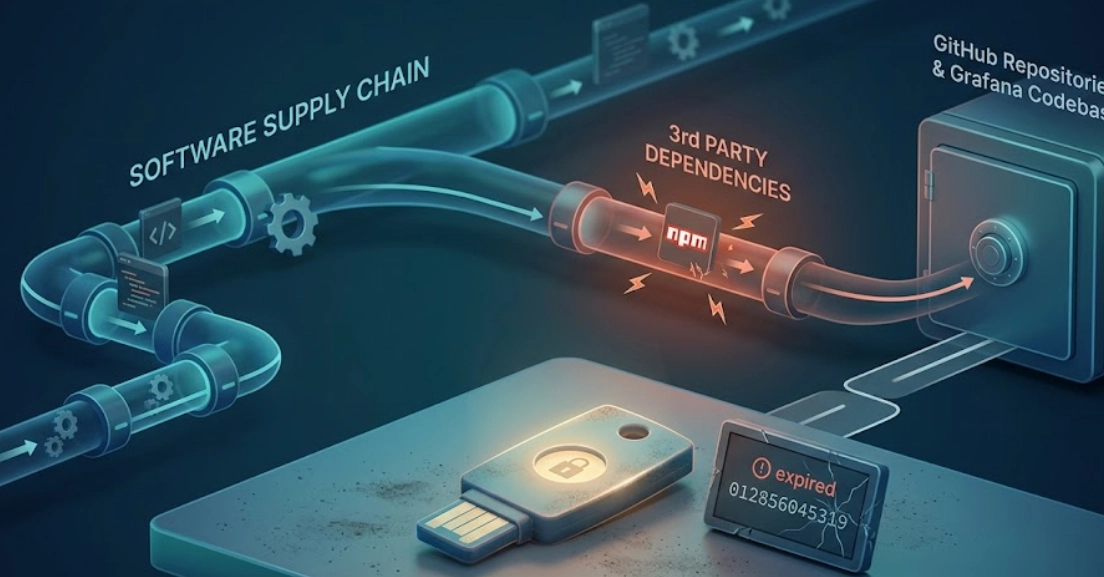
Here’s the nasty cocktail that’s brewing. First, you’ve got the supply chain attack. Think of it like this: instead of breaking into your house, a bad actor infects the very tools and materials you use to build your house. They taint the bricks, the mortar, even the blueprints. That’s what happened with those compromised TanStack npm packages – a seemingly innocent ingredient that, when baked into GitHub’s development process, led to a colossal breach of over 3,800 internal repositories. All thanks to a malicious VS Code extension, no less. It’s like a Trojan horse, but the horse is a friendly-looking open-source library.
Then, you layer on the second, arguably more insidious, problem: stale credentials. This is the digital equivalent of losing your spare key under the doormat and forgetting it’s there for years. Grafana Labs had their source code pilfered because a single GitHub token, a crucial digital key, was missed during an emergency rotation. Missed. It sounds so… humanly fallible. And that’s precisely the point.
Human memory is not a valid security strategy.
This isn’t a revelation for seasoned infrastructure folks, but it’s one that’s often lost in the glamorous chase for the latest threat intel. We pour money into WAFs, intrusion detection systems, sophisticated anomaly detection – all vital. But the digital equivalent of locking your doors and checking them? The basics of credential hygiene, like regularly changing passwords and, critically, rotating access tokens and secrets, are too often treated like a chore, easily postponed or, as we’re seeing, outright forgotten.
Why This Dynamic Duo Is a Doomsday Scenario
When these two threats collide, it’s not just additive; it’s exponential. Attackers don’t need to spend sleepless nights trying to brute-force your defenses or craft zero-day exploits. Why bother when they can simply walk in with a key you already gave them and then forgot about?
A single overlooked token becomes a VIP pass to your most sensitive systems. It’s the ultimate insider threat, but the ‘insider’ is an external attacker wielding a long-forgotten credential. And that compromised dependency? It’s the silent alarm, bypassed because you’re too busy listening for sirens outside. This isn’t a future hypothetical; it’s the ground truth in cloud-native, CI/CD-driven development environments today.
Engineering for Resilience, Not Just Defense
So, what’s the answer in 2026? We need to stop playing whack-a-mole with external threats and start building systems that are inherently more forgiving of our own inevitable screw-ups. It’s a fundamental shift from defense to resilience.
Automated secret rotation isn’t a nice-to-have; it’s table stakes. If a secret isn’t expiring by default, you’re already losing. Automation is the only way to truly divorce security from the fickle nature of human attention spans. Think of it as an industrial-grade key-locking mechanism that automatically rekeys itself on a timer, no matter how many times you forget to do it manually.
And least privilege? Absolutely non-negotiable. Every service account, every CI/CD pipeline token, should operate with the absolute bare minimum permissions required. If a tool only needs to read from a database, it shouldn’t have write access. Full stop. It’s about creating tiny, isolated blast zones, so if one component gets compromised, the damage is contained.
We also need to adopt a default-hostile stance towards every third-party dependency. Treat every npm package, every VS Code extension, like a new neighbor you’re not quite sure about. Continuous scanning, vulnerability monitoring, and a quick, decisive response to any suspicious activity must be woven into the fabric of your development pipeline.
My own take? This is where platforms start to truly shine. Imagine CI/CD systems that proactively flag unusual dependency behavior or secrets management tools that force rotation and alert you with the fervor of a smoke detector on steroids when a token is misused. We’re moving beyond just building software; we’re building self-healing digital ecosystems.
The New Frontier of Security
In 2026, the conversation around security isn’t just about keeping attackers out. It’s about building digital fortresses that can withstand the inevitable breaches, the accidental misconfigurations, the simple, dumb human errors that will happen. The potent brew of supply chain attacks and stale credentials is the ultimate test, exposing the trust we place in our ecosystem and the cracks in our own operational discipline.
How is your team grappling with this dual threat today? Are you automating your way out of human error, or are you still relying on sticky notes for your API keys?