The salary chasm widens.
The numbers for GRC pros in India in 2025? They’re starting to look less like a gap and more like a canyon. Especially when you pit those working within Global Capability Centers (GCCs) against their counterparts in actual product companies. This isn’t just a salary bump; it’s a seismic shift in how these roles are valued, and more importantly, what skills command the premium.
The Great Skill Divide: What’s Driving the Numbers?
Forget the old guard of dusty policy documents and tick-box compliance. The modern GRC professional, particularly in the high-octane world of Security Operations (SecOps), is becoming a deeply technical beast. For those with the crucial 3-7 years of experience—the real backbone of any team—compensation now hinges on a very specific set of capabilities. We’re talking about the gritty, hands-on stuff: mastering compliance automation tools that actually work, navigating the labyrinthine complexities of cloud governance frameworks, and, critically, proving your mettle in DevSecOps environments. It’s not enough to talk about risk; you need to demonstrate the ability to manage it actively, and that means a constant, almost symbiotic, communication with engineering teams.
And here’s the kicker: the traditional distinctions are blurring.
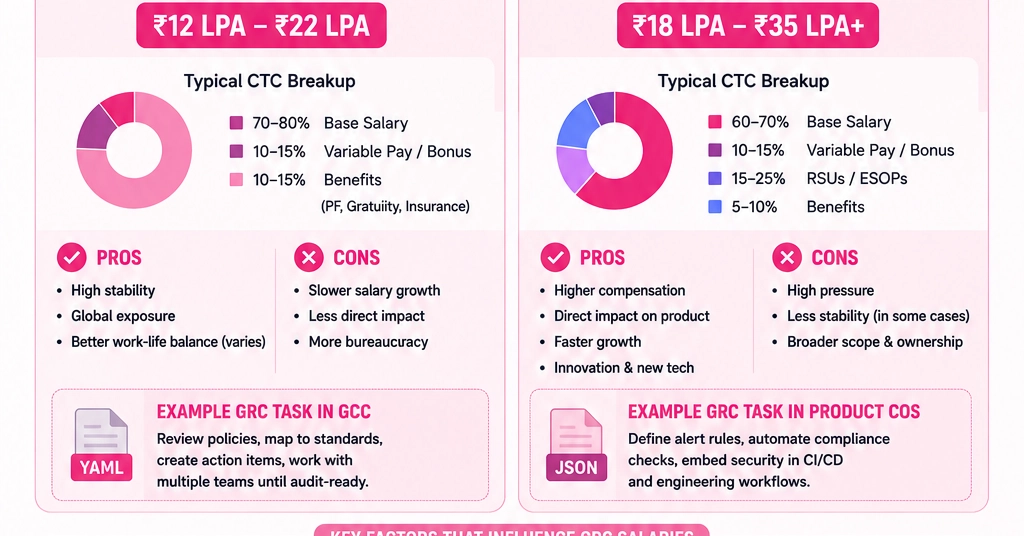
A GCC role, which might have once offered a stable, predictable paycheck, now sees salaries ranging from ₹12–22 LPA. Perfectly respectable, sure. But then you look at product companies, where that same experience, that same blend of technical acumen and strategic foresight, is pulling in a staggering ₹18–35+ LPA. That’s not just a marginal difference; it’s a near doubling in some cases.
From Policy Paper Pushers to Engineering Lifelines
The biggest upheaval isn’t just the money. It’s the fundamental redefinition of what a GRC role is. The days of GRC being an isolated department, a necessary evil generating endless reports for auditors, are rapidly fading. They’re increasingly embedded directly into the engine room of product development. Think about it: CI/CD pipelines, the very arteries of modern software delivery, now demand security baked in, not bolted on. Identity and Access Management (IAM) governance is no longer a theoretical exercise but a constant, evolving battle for control. And cloud security operations? That’s not just about firewalls anymore; it’s about understanding the dynamic, ephemeral nature of cloud infrastructure and securing it at every level.
“Modern GRC roles are no longer only policy-driven. They’re increasingly tied to engineering workflows, CI/CD security, IAM governance, and cloud security operations.”
This quote, stripped from the basic figures, encapsulates the core shift. It’s a move from the periphery to the core, from governance as a control to governance as an enabler.
Why Does This Matter for Developers?
This isn’t just about GRC folks chasing bigger paychecks. This evolving landscape has profound implications for the entire engineering ecosystem. For developers, it means that security and compliance aren’t abstract concepts handed down from on high. They are increasingly part of the daily development cycle. Understanding cloud security, practicing secure coding, and even comprehending IAM policies directly impacts a developer’s ability to ship code efficiently and securely.
Product companies, in their drive for innovation and speed, are willing to pay a premium for GRC professionals who can smoothly integrate with their engineering teams. They need people who speak the same language, understand the pressures of agile development, and can implement security and compliance measures without becoming a bottleneck. GCCs, often tasked with supporting complex, global operations, are also feeling the pressure, but their hiring models and organizational structures can sometimes lag behind the agility demanded by these new, technically-oriented GRC roles. This creates the salary disparity we’re observing. It’s a clear signal that the market is rewarding proactive, technically adept security and governance expertise, especially when it’s woven directly into the fabric of product development.
The Future: A Hybrid Skillset is Key
So, what’s the takeaway for aspiring SecOps or GRC professionals in India? The writing’s on the wall: a purely policy-focused career path is becoming a relic. The future belongs to those who can straddle the line between governance frameworks and the complex realities of software engineering. This means continuous learning, acquiring certifications in cloud security and DevSecOps, and honing those all-important communication skills. The ability to bridge the gap between security mandates and development realities will be the most valuable asset in the coming years.
And for the companies? Those that can adapt their hiring and compensation strategies to recognize and reward these hybrid skillsets will be the ones best positioned to attract and retain the talent needed to navigate the ever-increasing complexity of the modern digital landscape. The salary guides are just the symptom; the underlying architectural shift in how security and compliance are perceived and implemented is the real story.
🧬 Related Insights
- Read more: Webhook Security: Verifying Requests with HMAC Signatures
- Read more: Rust’s Puppeteer Killer: Chromiumoxide Edges Out Python – But Only If You’re Scaling Big
Frequently Asked Questions
What are the main factors influencing GRC salaries in India in 2025? Compensation for GRC professionals is increasingly determined by their skills in compliance automation, cloud governance, DevSecOps exposure, risk management, and their ability to communicate effectively with engineering teams.
Is the salary gap between GCCs and product companies significant for GRC roles? Yes, the gap is becoming very noticeable. Product companies are offering significantly higher compensation ranges (₹18–35+ LPA) compared to GCCs (₹12–22 LPA) for GRC professionals with 3-7 years of experience in 2025, reflecting the demand for specialized technical skills.
What kind of skills are becoming more important for GRC professionals? Modern GRC roles increasingly require expertise in engineering workflows, CI/CD security, IAM governance, and cloud security operations, moving beyond traditional policy-driven responsibilities.