A lone developer hunched over a glowing screen, debugging lines of smart contract code at 3 AM.
That’s the gritty reality behind countless open-source projects, and the recent overhaul of Proof, a decentralized learning management system (LMS) built on EduChain, is no exception. What started as a GitHub Finish-Up-A-Thon challenge has blossomed into a significantly more polished — and dare I say, functional — platform. The core idea, to make academic records immutable and trustworthy by locking key learning actions like course enrollment, exam submissions, and scores onto the blockchain, remains compelling. It’s a noble pursuit, aiming to cut through the noise of easily faked certificates and opaque educational pathways.
But let’s be honest, early-stage blockchain projects often struggle with the ‘how’ of user experience. Proof, in its previous iteration, was a prime example. The underlying architecture might have been sound, but the tutor and student flows were, by the project’s own admission, “kind of confusing.” Navigation felt more like a maze than a clear path, and the separation between roles — tutors managing courses and exams versus students taking them — was blurry. Add to that inaccurate grading and scoring, and you’ve got a system that, while technically innovative, risked alienating the very users it aimed to serve.
Why Does This Matter for Developers?
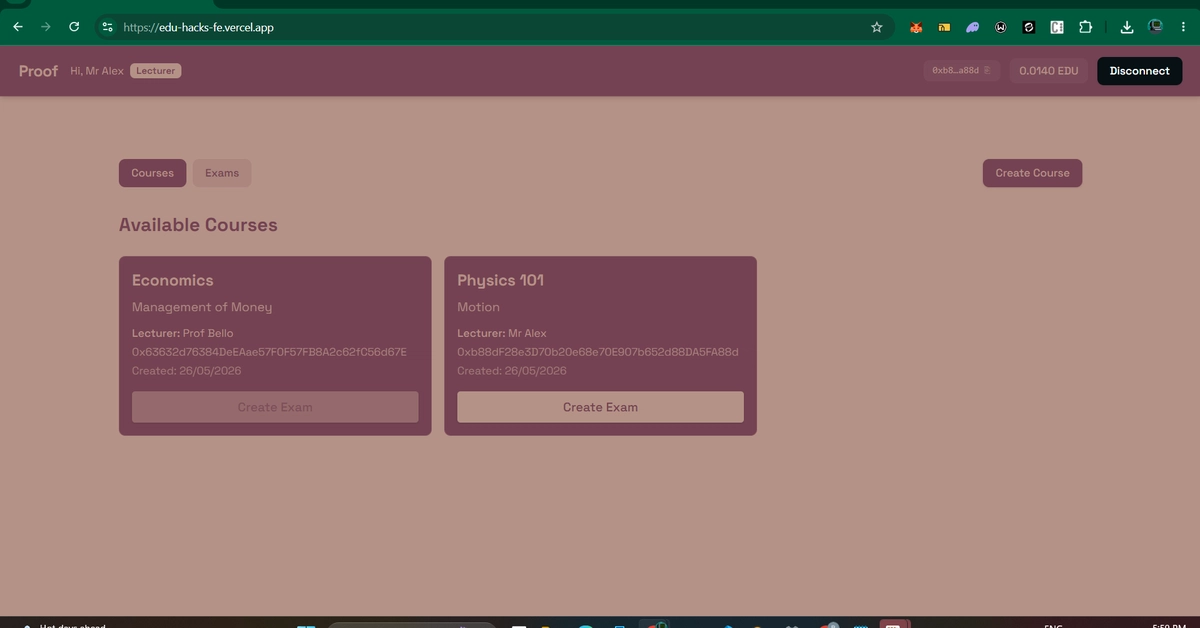
This isn’t just a story about one person’s dedication. It’s a microcosm of the broader challenge facing decentralized applications: bridging the gap between powerful, secure backends and intuitive, accessible frontends. The revamp tackles this head-on. Tutors now have clearer pipelines for creating courses, generating or uploading questions (even in batches!), and managing exams. Students can navigate enrollment, take exams, and critically, access AI-generated explanations for answers after submission. This AI layer is particularly fascinating. It transforms the system from a mere record-keeper into an active learning tool, offering immediate feedback and fostering deeper understanding, a critical differentiator in the crowded educational technology space.
The smart contract side also saw a deep clean. Unused storage, unnecessary timing logic, and confusing mappings were excised. Private mappings, safer getters, and the specific storage of student answers were implemented, alongside a getMyExamCorrection() function. Crucially, submission views are now restricted to lecturers, adding another layer of security and role-based access control. This kind of meticulous refactoring is where the true long-term value of blockchain architecture is unlocked – it’s not just about immutability, but about building strong, auditable systems.
And then there’s GitHub Copilot. The project’s lead developer credits it with accelerating the update significantly. It wasn’t just a rubber stamp; Copilot reportedly assisted with the removal of outdated exam logic, the implementation of the new student answer correction features, updating tests, and even contract verification. On the frontend, it helped integrate new contract functions, refine those all-important role-based flows, and connect disparate features like course management and question uploading. This symbiotic relationship between human ingenuity and AI assistance is, I suspect, the new bedrock of rapid development for tools like Proof.
Previously, Proofs’ user experience was not the best. The app had the core idea working, but tutor and student flows were kind of confusing to new users, navigation was not really clear, and exam/course actions were not well separated by role and grading/scoring was not accurate.
It’s a stark reminder that even the most revolutionary underlying technology is worthless if the user can’t interact with it effectively. The Proof revamp isn’t just a technical patch; it’s a strategic pivot towards usability, with AI acting as a powerful accelerator and enabler. This is how decentralized platforms evolve from interesting experiments into practical, everyday tools.
Before and After
The visual distinctions, even without the original images, speak volumes. The shift from what was likely a cluttered, less organized interface to a streamlined experience with clear distinctions between tutor and student actions is the hallmark of good product development. It’s proof positive that a well-designed user interface isn’t a luxury, but a necessity, especially when dealing with complex systems like blockchain-based educational platforms.
The question isn’t if blockchain will play a larger role in education; it’s how it will integrate without becoming an insurmountable barrier. Proof’s evolution offers a compelling blueprint.
🧬 Related Insights
- Read more: Caching Turned My API Integration into a Silent Failure Machine – And the Gruesome Fix
- Read more: GitHub Pages in 2026: Free Jekyll Hosting That Actually Works – No Hype, Just Steps
Frequently Asked Questions
What exactly is Proof?
Proof is a decentralized learning management system (LMS) built on EduChain. Its primary goal is to make academic records and learning activities more transparent and trustworthy by recording them on a blockchain.
How did AI help improve Proof?
AI, specifically through tools like GitHub Copilot, assisted in accelerating development tasks such as implementing new features like AI-powered explanations for student answers, refining user flows, updating tests, and integrating contract functions.
Is this system ready for mass adoption?
While the revamp significantly improves usability and functionality, mass adoption depends on factors like broader blockchain adoption, scalability of EduChain, and continued development to meet diverse institutional needs.