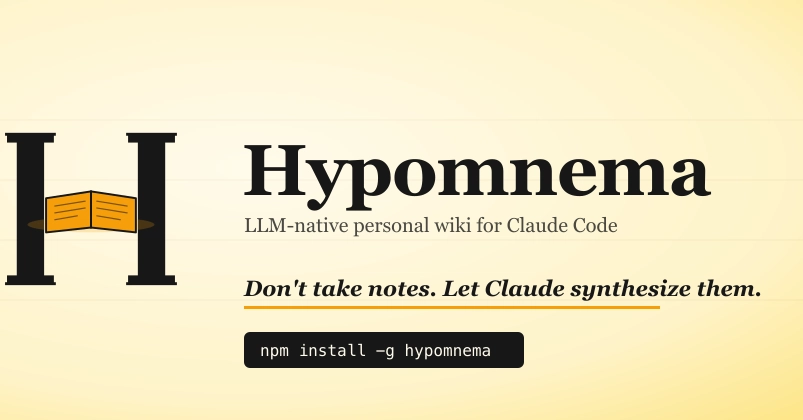
It’s late, the coffee’s gone cold, and the CI pipeline for Hypomnema is finally churning through its suite of tests. This isn’t just another open-source drop; it’s a battlefield report from the trenches of personal AI knowledge management. For a solid month, the author wrestled with a thorny problem that plagues anyone trying to maintain a consistent, evolving understanding with AI assistants: AI behavior corrections rotting across three hand-synced storage layers. The solution? A tool called Hypomnema, born out of frustration and now unleashed under an MIT license. Forget your vector databases and API keys; this is plain markdown, git, and a clever orchestration of Claude Code’s lifecycle hooks.
We’ve all been there. You pour hours into refining your AI’s responses, meticulously correcting its output, crafting the perfect prompt. Then, days later, it’s like that effort never happened. Claude has no memory of your nuanced guidance. This isn’t a minor annoyance; it’s a fundamental flaw in how we currently store and retrieve AI-augmented knowledge. The author’s dissection of existing tools – from Obsidian and Notion’s isolated notes to RAG’s accumulating chunks and Mem’s proprietary lock-in – paints a grim, familiar picture.
The Synthesis Gap: Where AI Tools Fail
The core issue, as articulated by the author and echoed by AI luminaries like Andrej Karpathy, is synthesis. Most tools excel at storage or retrieval, but they fundamentally fail to update what you already know with what you just learned. RAG re-reads source material on every query, a Sisyphean task. A true wiki, however, should persist that synthesized understanding, building upon itself. The bottleneck, historically, was bookkeeping; LLMs, the author argues, have effectively reduced that cost to zero.
So, Hypomnema was born. The setup is disarmingly simple: npm install -g hypomnema, then /hypo:init within Claude Code. The magic lies beneath the surface, in 14 meticulously crafted lifecycle hooks that ensure the wiki maintains itself. Auto-commit, auto-push, session-state injection – it’s designed to be a living, breathing part of your AI workflow, not a static archive.
Triangulating Truth: The Fix for State Rot
The most acute problem surfaced during the month of dogfooding: AI behavior corrections were decaying. The author’s journey to a stable fix was anything but linear, involving three distinct attempts. Printing to stderr? Captured and lost by Claude Code’s TUI. Injecting via additionalContext in SessionStart hooks? It turned out Claude Code only reliably keeps the last injection, silently overwriting earlier attempts when multiple hooks fired. The breakthrough? A delicate dance involving a marker file in /tmp and the first UserPromptSubmit hook, which reliably injects session state and corrections. This complex dance—writing a marker, reading it, injecting, then deleting—is a masterful workaround for platform constraints, demonstrating an understanding of how these systems actually behave, not just how the documentation says they should.
You can’t rely on prompts; you also can’t rely on a single hook channel — you have to triangulate around platform constraints.
This insight is gold. It’s the kind of hard-won wisdom that separates genuine engineering from theoretical design. The author lost a full day to debugging what seemed like simple stderr output, only to discover this fundamental limitation. That’s the grit that builds strong OSS.
Guarding Against the Compact Button
Another daily annoyance for Claude Code users is the /compact command, which intelligently prunes conversation history. Brilliant for reclaiming space, disastrous for un-saved insights. The author suffered two afternoons of lost productivity before realizing that /compact also obliterates anything not explicitly written down. Hypomnema’s defense? A PreCompact hook that refuses to compact if the session-close checklist is unfinished or the wiki lints fail. It’s a proactive guardian against accidental data loss, ensuring your AI’s memory isn’t summarily wiped.
This same defensive posture extends to /clear. A “stop-chain auto-minimal-crystallize” step, combined with session end markers and a source=clear recovery mechanism in SessionStart, ensures that even a /clear-then-restart round trip is clean. This level of detail in architectural decision records (ADRs) is precisely what DevTools Feed readers crave. It’s not just what works, but why and how it was made resilient.
Simplicity Wins: Goodbye Modes, Hello .hypoignore
An earlier prototype flirted with personal / shared / public modes per page. While seemingly a good idea on paper, it quickly devolved into managing exclusions. The fix was elegant: scrap the modes entirely. Now, a single .hypoignore file dictates what’s public, using familiar glob patterns. This not only halved the codebase but, more importantly, doubled the clarity of the mental model. For a tool designed to manage knowledge, simplicity is paramount. This is a textbook example of reducing cognitive load through intelligent design.
Market Dynamics & The Future of Personal Knowledge
The personal knowledge management (PKM) space is fractured. On one hand, you have the established giants like Notion and Obsidian, powerful but siloed. On the other, the AI-native entrants like Mem and Reflect, often built on proprietary formats, raising long-term trust issues. Then there are RAG systems, which Karpathy rightly points out are a step back from true synthesis. Hypomnema carves a crucial niche here. By grounding itself in plain markdown and Git, it offers an unparalleled level of data sovereignty and long-term viability. No vendor lock-in, no disappearing API keys.
The 14 lifecycle hooks, while seemingly a technical detail, are the secret sauce. They represent a deep understanding of how to integrate LLM interaction into a tool’s workflow, rather than just slapping an AI feature onto an existing product. This is where the future of AI Dev Tools lies: not in abstracting AI away, but in deeply embedding it into productive workflows in a way that feels organic and controllable.
My Take: This is the kind of pragmatic, developer-first innovation that makes open source so vital. Hypomnema isn’t just solving a personal problem; it’s providing a blueprint for how to build persistent, synthesized knowledge systems that can actually keep pace with AI’s rapid evolution. The market is ripe for tools that prioritize transparency, control, and actual knowledge compounding over ephemeral AI “magic.” Hypomnema, with its MIT license and Git-backed simplicity, is precisely that kind of tool. It’s a quiet revolution in how we manage our digital minds.
🧬 Related Insights
- Read more: Go Devs Get Better Auth: Limen Library Arrives
- Read more: The Runtime Illusion: Observability Fails Under Attack
Frequently Asked Questions
What does Hypomnema actually do? Hypomnema is an MIT-licensed personal wiki tool that uses plain markdown and Git to store and synthesize knowledge from AI conversations. It integrates deeply with Claude Code via lifecycle hooks to automatically maintain your wiki, manage session state, and correct AI behavior over time, avoiding common pitfalls of other PKM and RAG tools.
Will this replace my Obsidian vault? Hypomnema is designed for a different use case: managing evolving knowledge synthesized from AI interactions, not necessarily a static collection of personal notes. While it uses markdown, its strength lies in its active integration with an AI assistant to ensure knowledge compounds and corrections persist, something Obsidian, by itself, doesn’t facilitate.
Is it difficult to set up?
Setup is straightforward. You install it globally via npm (npm install -g hypomnema) and then initialize it within Claude Code using a simple slash command (/hypo:init). The complexity is handled by the tool itself through its lifecycle hooks.