Look, the US remote patient monitoring market is poised for a dramatic surge, projected to climb from $17.2 billion in 2026 to a staggering $49.5 billion by 2033. This isn’t just a trend; it’s a gold rush, pulling in everyone from plucky digital health startups to established hospital systems and seasoned medtech executives, all wrestling with the same fundamental question: ‘Should we build one, and what will it cost?’
Here’s the kicker, the part most teams gloss over: the reimbursement math. Too many venture-funded ventures, and even some internal hospital projects, scope their remote patient monitoring apps based purely on clinical features. They ship, celebrate a successful launch, and then hit a brick wall when they realize their architecture simply can’t accommodate the CPT codes that actually fund these programs. The end result? A beautifully designed clinical tool that hemorrhages cash. This piece cuts through the hype, detailing precisely what you must scope when building a remote patient monitoring app in 2026: the features that directly map to billable services, the architecture that can withstand regulatory scrutiny, and the cost ranges aligned with each clinical objective.
Two seismic shifts in 2026 have fundamentally reset the business calculus for RPM. First, the Centers for Medicare & Medicaid Services (CMS) introduced two vital RPM CPT codes effective January 1st: 99445 and 99470. CPT 99445 offers $52.11 for patients transmitting readings on 2 to 15 days within a 30-day period. Meanwhile, CPT 99470 reimburses clinicians $26.05 for their initial 10 to 19 minutes of remote treatment management per month. These new codes complement existing ones like 99454 (for 16+ days of data) and 99457 (for the first 20 minutes of management). Stack them shrewdly, and a single RPM patient can generate between $150 and $200 in Medicare revenue monthly.
Second, the updated HIPAA regulations for 2026 mandate multi-factor authentication (MFA) for every system interacting with protected health information (PHI), alongside a complete asset inventory detailing PHI movement. Trying to tack this on post-launch isn’t just difficult; it’s often impossible. The requirements for MFA and comprehensive auditing deeply influence your design decisions for authentication, session management, and the entire data plane from conception.
The logic is stark: either you build a remote patient monitoring app that satisfies both the billing requirements and the stringent security mandates, or you’re building a system destined for financial underperformance and regulatory headaches.
When teams embark on building an RPM app, the feature set invariably splits into three distinct applications, all sharing a common backend. The patient-facing app requires strong wearable integration (Bluetooth pairing), manual data entry as a fallback, medication reminders, and secure messaging with the care team. A consent dashboard is also a must. Crucially, push notifications for missed readings are vital for hitting the 16-day threshold required for CPT 99454.
The clinician dashboard needs to provide a real-time vitals feed with trend analysis, configurable alert thresholds tailored to specific conditions, an alert triage queue with assignment capabilities, and time-tracked encounters that directly correlate to CPT 99457 and 99470. Audit logs aren’t optional; they’re mandatory. Every interaction with PHI demands a tamper-evident audit trail, a non-negotiable in today’s regulatory climate.
Finally, the admin console handles patient enrollment, including BAA (Business Associate Agreement) tracking, billing automation that links device usage days to CPT codes (99445 or 99454), and a reporting layer to identify patients on track to meet billable thresholds for the current cycle.
Three features are far too often jettisoned when teams rush RPM app development under tight deadlines, and that’s a critical error. Anomaly detection at the device level is paramount, especially since 83% of existing RPM platforms support real-time data transmission and 59% incorporate AI-driven analytics. Without it, your clinicians face an avalanche of alert fatigue. HIPAA also necessitates strict role separation across at least three distinct personas: patient, clinician, and admin. Treating this as a ‘version 2’ feature usually leads to a costly rewrite of your authentication layer. Furthermore, full FHIR R4 resource modeling for Patient, Observation, and Device data positions you to integrate with Electronic Health Records (EHRs) from day one, rather than facing a painful, late-stage retrofit.
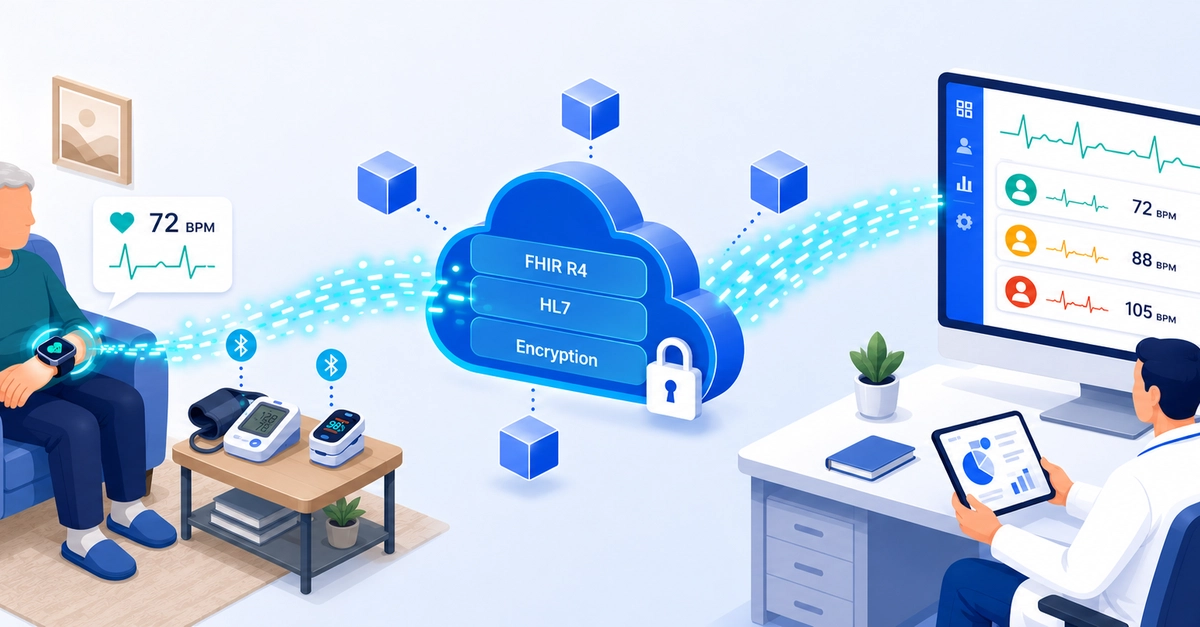
The underlying architecture typically comprises four distinct layers, and cutting corners in any one of them spells disaster.
The device and connectivity layer must facilitate secure Bluetooth Low Energy pairing with FDA-cleared devices like blood pressure cuffs, pulse oximeters, glucose monitors, and continuous wearables. For chronic conditions requiring nightly data synchronization, MQTT over TLS to a managed broker is the most practical and reliable default.
The ingestion layer relies on a message queue—think Kafka or AWS SQS—to smoothly handle data spikes when thousands of devices report simultaneously. A sophisticated rules engine is essential here to normalize incoming events, manage late or out-of-order data, and apply threshold logic before fanning out notifications to clinicians.
The FHIR normalization layer is where many otherwise competent teams stumble when building an RPM app. Raw data from various device vendors must be translated into standardized FHIR R4 Observation and Device resources, correctly linked to Patient identifiers (MRNs). HL7 v2 ADT feeds are necessary to manage EHR-side events, and SMART on FHIR launch flows allow clinicians to access the dashboard directly from within EHR systems like Epic or Cerner, eliminating the need for a secondary login.
The security and compliance layer is non-negotiable: AES-256 encryption for data at rest and in transit, role-based access controls enforced at the API gateway, end-to-end tamper-evident audit logs, and signed BAAs with every third-party vendor involved. Neglecting any of these elements incurs substantial financial risk. In 2025, US healthcare breaches averaged a staggering $10.22 million per incident, a grim statistic that has kept the sector at the top of IBM’s breach-cost ranking for 14 consecutive years.
Is Your RPM App Actually Billable?
The answer hinges on whether your architecture is designed to capture revenue from day one. The new CMS CPT codes (99445, 99470) fundamentally alter the economics. If your app doesn’t automatically track patient engagement (days of data transmission) or clinician time spent on remote management, you’re leaving money on the table. Beyond the codes, the 2026 HIPAA update adds another layer of complexity. Multi-factor authentication and detailed audit trails aren’t just best practices; they are legal requirements. An app that can’t demonstrate compliance won’t pass muster, regardless of its clinical utility.
What’s the True Cost of Building an RPM App?
It’s a spectrum, but cutting corners is the most expensive mistake. A bare-bones implementation might range from $70,000 to $150,000 for a minimal viable product (MVP) focusing on one chronic condition. However, a truly compliant, feature-rich platform, designed for scalability and interoperability (think FHIR R4, strong security, and comprehensive audit trails), will likely fall between $200,000 and $500,000+ for the initial build. This doesn’t include ongoing cloud hosting, device management, and support costs, which can add another 15-25% annually. The key is understanding that the cost isn’t just in the code; it’s in the compliance and the revenue-generating capabilities built into the architecture.
The math is simple. Either you build a remote patient monitoring app that satisfies both, or you build something that cannot bill and cannot pass an audit.
Critical Features That Get Cut (And Why You Need Them)
Anomaly Detection at Device Level: Vital for filtering noise and preventing clinician burnout. Hard Role Separation: Essential for HIPAA compliance across patient, clinician, and admin personas. Full FHIR R4 Resource Modeling: Crucial for EHR interoperability from the outset.
Architectural Pillars for Success
Device & Connectivity: Secure BLE pairing, reliable MQTT for continuous data. Ingestion: Scalable message queues and intelligent rules engines. FHIR Normalization: Standardizing data for interoperability and billing. Security & Compliance: Encryption, RBAC, tamper-evident logs, BAAs.
🧬 Related Insights
- Read more: The AI Research Engine That Ditches Google for 100+ Raw Data APIs
- Read more: Grafana’s AI Sidekick Eyes Your Private Business Metrics—Secure Enough?
Frequently Asked Questions
What does the new RPM CPT code 99445 cover? CPT 99445 covers remote monitoring of physiologic parameter(s) (e.g., weight, blood pressure, pulse oximetry, respiratory flow rate) when the service is not a remote monitoring of cardiovascular, sleep or respiratory system(s), initial 16 days or more of data transmission, within a 30-day period. It pays $52.11.
Will building an RPM app require HIPAA compliance? Yes, absolutely. The 2026 HIPAA updates specifically mandate multi-factor authentication for all systems handling PHI and require comprehensive asset inventories. Non-compliance can lead to severe penalties.
Can I build an RPM app on a tight budget? You can build an MVP on a tighter budget, but it will likely lack critical features for billing and compliance. A truly functional and compliant RPM app, capable of generating revenue and passing audits, requires a significant investment in strong architecture and security.