Look, the real impact of CloudClaw isn’t that someone built a cool chatbot. It’s that it signals a shift. A shift away from clunky UIs and cryptic CLIs for basic tasks. For the average developer, this means one less barrier to managing your infrastructure, especially when the caffeine has worn off and your brain is fried.
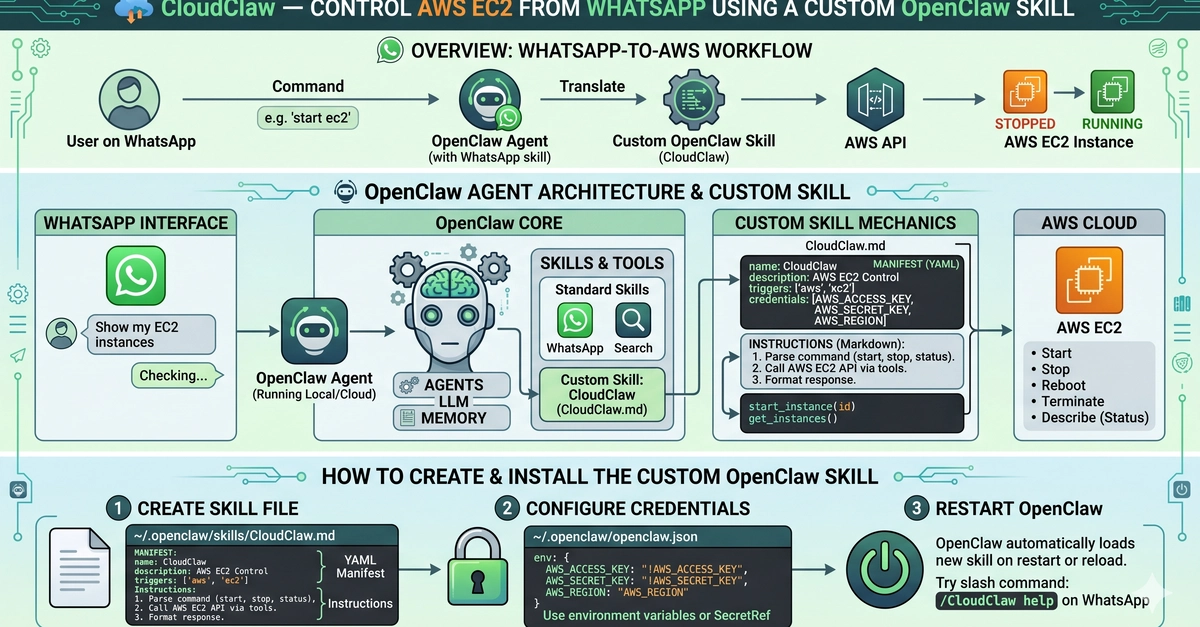
We’re talking about simple commands like “stop vm” or “check cpu” delivered via WhatsApp. No VPN, no opening a browser, just a quick text. It’s the digital equivalent of yelling at your smart speaker, but with actual consequences for your cloud bill. This isn’t about replacing sysadmins; it’s about making the basic fiddling of servers accessible to everyone who needs it, right when they need it.
Is This Just Another Shiny Toy?
On the surface, CloudClaw, built on OpenClaw, sounds like a novelty. Controlling AWS EC2 instances from WhatsApp? Really? But the genius here isn’t the platform, it’s the premise: natural language interfaces for technical tasks. The developer, Parul Malhotra, didn’t need to build a complex NLP parser from scratch. OpenClaw’s SKILL.md file acts as the brain, interpreting human-like requests and translating them into boto3 calls to AWS. It’s like having a personal IT assistant who speaks emoji and understands your half-baked commands.
This is where the skepticism kicks in. Is this truly practical, or just a clever demo? The demo itself is impressive. The flow from WhatsApp message to cloud API call and back is remarkably smooth. The use of OpenClaw’s Linked Devices protocol means no fiddly Meta developer accounts or exposed webhooks. It’s a direct line from your chat app to your cloud.
The LLM’s natural language understanding is baked in — I didn’t need to write any intent parsing code at all. I just described in plain English what “start vm” means and OpenClaw figured out the rest.
That quote. That’s the money shot. It highlights the core value proposition: abstracting away the boilerplate. Instead of writing lines of code to parse intent, you write a .md file describing what you want. It’s a powerful idea, but the real test comes with complexity. Can it handle more than just start/stop/status?
Why Does This Matter for Developers?
Here’s the thing: DevOps has always been about reducing friction. CloudClaw, in its own quirky way, is doing just that. Imagine being on call, half asleep, and getting an alert about a critical server. Instead of fumbling for your laptop and navigating a complex AWS console interface, you can send a quick “restart vm” from your phone. It’s immediate, it’s accessible, and it reduces the cognitive load during stressful situations. This isn’t about replacing the complex work of infrastructure management; it’s about making the everyday chores less of a pain.
And the persistent memory? That’s not a trivial feature. Remembering your “default web server” means you don’t have to specify the instance name every single time. It adds a layer of intelligence that makes the interaction feel more human, less robotic. This is the kind of subtle polish that can turn a cool hack into a genuinely useful tool.
But let’s not get carried away. This is still a personal project, a submission to a challenge. The security implications of controlling critical infrastructure via SMS-like messages are, shall we say, robustly unaddressed. Sending “delete all data” via WhatsApp would be… catastrophic. The current implementation focuses on essential commands, and the assumption is you’re not handing over the keys to your kingdom to just anyone with your phone number. Still, the potential for misuse or accidental commands is a significant, albeit unexamined, risk.
The Future of Cloud Interaction?
Is this the future? Probably not directly. We likely won’t see official AWS commands coming through your aunt’s forwarded chain messages. However, the principle behind CloudClaw is undeniably potent. The idea that complex technical operations can be managed through intuitive, conversational interfaces is not new, but its application here is particularly compelling. Think of AI-powered code completion, but for infrastructure.
We’ve seen similar attempts before, often requiring custom integrations or clunky bots. What makes CloudClaw interesting is its reliance on an existing, widely used communication platform (WhatsApp) and a flexible, LLM-driven orchestration tool (OpenClaw). The fact that it bypasses the need for Meta’s developer ecosystem is a significant win for accessibility.
Ultimately, CloudClaw is a fascinating glimpse into a world where managing cloud resources is as simple as sending a text. It’s a proof to how far natural language processing has come, and a playful challenge to the traditional command-line-and-console paradigm. It’s not perfect, it’s not production-ready for mass deployment, but it’s a darn good demonstration of what’s possible.
🧬 Related Insights
- Read more: Power BI’s Data Frankenstein: Stitching Sources Together Without Screaming
- Read more: Base L2: Micro-Bets’ Fee Slayer or Gaming Gimmick?
Frequently Asked Questions
What does CloudClaw actually do? CloudClaw is a system that allows users to control AWS EC2 instances using natural language commands sent via WhatsApp. It uses OpenClaw to interpret these commands and interact with AWS APIs.
Will this replace my job as a cloud engineer? No, CloudClaw is designed for simpler tasks and quick checks. It won’t replace the complex tasks and strategic planning performed by cloud engineers. It’s more of a convenience tool for basic operations.
Is it secure to control AWS from WhatsApp? Controlling cloud infrastructure via WhatsApp has inherent security risks. While this project uses specific protocols, any system using text-based commands for critical actions requires careful consideration of access control and command validation to prevent unauthorized or accidental operations.