The whirring of a decades-old CD-ROM drive, usually a sound of nostalgic reverence, this time heralded the arrival of a genuine digital ghost.
It’s early 2026, and Sega Retro’s archives are a sprawling proof to the company’s ambitious, and sometimes bizarre, past, boasting over 300 pages dedicated to unreleased Saturn titles. Yet, one project, simply designated Pyramid, remained a void—until now.
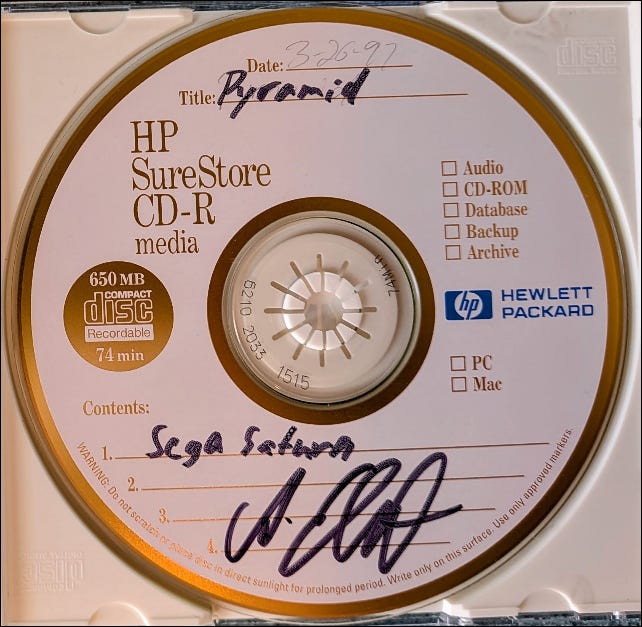
And what exactly is this ‘Pyramid’? That question hung in the air when a mysterious disc, surprisingly intact after 29 years, surfaced. The owner offered precious few details, leading to an initial, albeit incorrect, hypothesis that it might be a variant of Pyramid no Nazo: Ankh 2, another unreleased Saturn FMV game. The disc, however, had other ideas, booting up to a title screen that defied immediate categorization.
Challenging the Pharaoh’s Narrative
The initial boot screen, cryptic as it was, proved to be the key. Cross-referencing it with PC game titles containing ‘Pyramid’ quickly pointed to Pyramid: Challenge of the Pharaoh’s Dream. This wasn’t some cutting-edge action title destined for arcades, but rather an edutainment game, the kind that populated elementary school computer labs in the mid-1990s. Anecdotes on YouTube and Reddit corroborate this memory; it was a title designed to occupy young minds with ancient Egyptian history while teachers could focus on their administrative duties.
The game’s premise places the player in the role of an archaeologist whisked away to ancient Egypt, tasked with observing the construction of a great pyramid. The hope was to impart historical knowledge—or at least keep students engaged. The Saturn version, however, appears to be more of a technical demonstration. Controls were basic: a D-pad for cursor movement, the Z button for object interaction, L and R for scrolling, and A to trigger voice clips.
Scrolling to the right revealed three figures, ostensibly workers, who moved independently. Their interaction with the player, or rather the lack thereof in this demo, is telling. A HINT_1.TXT file from the PC version, labeled ‘Leveling the Foundation,’ suggests a more interactive experience. The objective was to present various tools to the workers, who would then explain their function and relevance to the pyramid’s construction. The walkthrough details steps involving water collection, tool placement on a mat, and logical sequencing—actions that are largely unavailable in the Saturn build.
Digital Archaeology Unearthed
The Saturn disc contained two crucial files: 0, the main executable dated March 24, 1997, and TEST.MME, an archive file from the day before, likely containing game assets. Reverse-engineering the executable revealed surprisingly clear control logic:
if ((held_1 & 0x1000) != 0) {
/* Pressed Up: move cursor */
cursor_delta_y_1 = -2;
}
if ((held_1 & 0x2000) != 0) {
/* Pressed Down: move cursor */
cursor_delta_y_1 = 2;
}
if ((held_1 & 0x4000) != 0) {
/* Pressed Left: move cursor */
cursor_delta_x_1 = -2;
}
if ((held_1 & 0x8000) != 0) {
/* Pressed Right: move cursor */
cursor_delta_x_1 = 2;
}
if (((held_1 & 8) != 0) && (*(short *)(game_state_1_[2] + 8) < 0x2c)) {
/* Pressed L: scroll left */
*(short *)(game_state_1_[2] + 8) = *(short *)(game_state_1_[2] + 8) + 2;
}
if (((held_1 & 0x80) != 0) && (-0x1aa < *(short *)(game_state_1_[2] + 8))) {
/* Pressed R: scroll right */
*(short *)(game_state_1_[2] + 8) = *(short *)(game_state_1_[2] + 8) + -2;
}
if ((pressed_1 & 0x400) != 0) {
/* Pressed A: play the voice clip */
pressed_a_060133a8();
}
The TEST.MME file proved to be a repository for background images, sprites, and, as anticipated, sound clips. Despite this deep dive into the data, the developers remained anonymous. No credits, no build strings—just the digital detritus of a project lost to time.
The Signature as a Clue
But the disc itself offered a faint, almost overlooked, clue: a signature scrawled across its surface. Scouring MobyGames for names vaguely matching the illegible script led to Alexander Ehrath. A quick search of his YouTube channel revealed a series chronicling his game development career. In one video, he casually mentioned porting ‘some educational Egyptian thing’ to the Sega Saturn. The pieces clicked.
Contact was made, and Ehrath graciously agreed to a podcast interview, confirming the disc’s identity. His involvement confirms this wasn’t some casual hobbyist project, but a deliberate, albeit ultimately unreleased, port by a professional developer.
“I did port some educational Egyptian thing to the Sega Saturn,” Ehrath stated in a YouTube video, a throwaway line that has now become a vital historical record.
This discovery underscores the ephemeral nature of game development. Even projects with established publishers and developers can vanish without a trace, only to be rediscovered years later through the persistent efforts of enthusiasts and dedicated researchers.
This ‘Pyramid’ prototype represents more than just an unreleased game; it’s a fragment of a larger narrative about the Sega Saturn’s life cycle and the often-unseen work that went into its software library. While it never saw a commercial release, its reappearance provides valuable insight into the Saturn’s capabilities and the diverse range of software considered for the platform.
It’s a proof to the power of preservation that such a relic can still boot up and offer its secrets. The data-driven analysis of its code and assets, coupled with the human element of reconnecting with its creator, paints a fuller picture of this forgotten piece of Sega history.
Why Does This Matter for Game History?
The emergence of an unreleased Sega Saturn project like ‘Pyramid’ isn’t just a curio for hardcore retro gamers. From a data perspective, it offers a concrete artifact for understanding the software development pipeline of the era. The executable code, the asset archives, and the developer’s own recollections provide empirical evidence of the challenges and decisions made during porting and development.
For scholars of game history and emulation, this find allows for deeper analysis. It showcases the technical constraints of the Saturn, the methods of edutainment software design in the mid-90s, and the often-protracted process of bringing a game from one platform to another. It’s a direct data point, unvarnished by marketing spin, into the realities of game creation before the widespread adoption of modern game engines and development tools.
Furthermore, the very fact that this disc survived 29 years and was eventually analyzed speaks volumes about the community’s dedication to preserving gaming’s past. Each unearthed prototype, each recovered piece of code, adds a valuable layer to our understanding of how interactive entertainment evolved.
🧬 Related Insights
- Read more: Local AI’s Silent Takeover: Ollama Benchmarks Prove $0 Inference Wins in 2026
- Read more: Claude Code’s Dirty Secret: .claudeignore Stops the Node_Modules Madness
Frequently Asked Questions
What was Pyramid: Challenge of the Pharaoh’s Dream? It was an edutainment title developed for PC, designed to teach children about ancient Egypt and pyramid construction.
Why was the Sega Saturn version unreleased? The exact reasons are unclear, but it appears to have been a technical demo or prototype that did not proceed to a full commercial release on the platform.
Is this a complete game? No, the discovered disc is believed to be a prototype or tech demo, featuring limited interactivity and functionality compared to the original PC version.